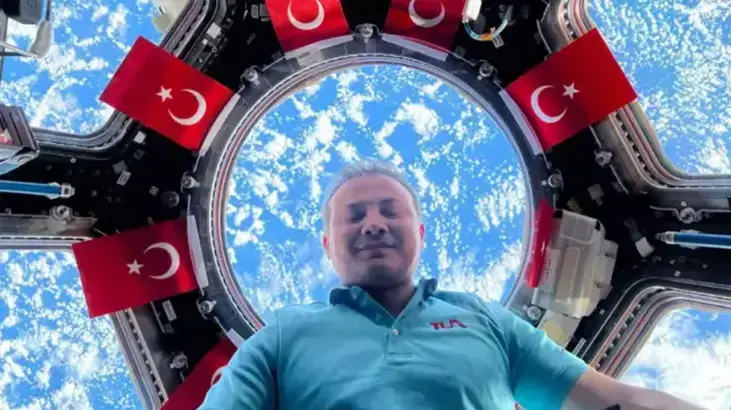
The frontier of space exploration is often framed as a triumph of physics, engineering, and cold mathematics. However, for the humans venturing beyond our atmosphere, the journey is as much a spiritual and psychological challenge as it is a technical one. This intersection of science and faith was highlighted during the historic mission of Alper Gezeravcı, the first Turkish astronaut, who found himself addressing one of the most human questions possible while orbiting the Earth: how does one maintain religious practice in zero gravity?
During a series of interactions and educational outreach sessions, Gezeravcı was asked a question by a student that touched upon the practicalities of Islamic prayer (Salah) outside the confines of Earth’s gravity. The inquiry—which some characterized as “strange” or unexpected in a high-tech environment—focused on the direction of prayer and the physical requirements of worship while traveling at 17,500 miles per hour aboard the International Space Station (ISS).
Gezeravcı’s mission, part of the Axiom Mission 3 (Ax-3), was not only a milestone for Turkey’s national space ambitions but also a moment of visibility for millions of Muslims worldwide. His response to the student’s question provided a glimpse into how astronauts reconcile ancient traditions with the realities of modern aerospace medicine and orbital mechanics.
The Challenge of the Qibla in Zero Gravity
For practicing Muslims, the direction of the Kaaba in Mecca, known as the Qibla, is a fundamental requirement for the validity of the five daily prayers. On Earth, this is a straightforward matter of geography. In low Earth orbit, however, the geography changes every few seconds. The ISS completes one full orbit of the Earth approximately every 90 minutes, meaning an astronaut’s position relative to Mecca shifts constantly.

When addressing the student’s question, the conversation centered on the concept of flexibility within Islamic jurisprudence. In traditional Islamic law, there is a principle of “facilitation” or “ease,” which allows for adaptations when a person is faced with extreme hardship or impossible circumstances. For an astronaut, the inability to maintain a fixed orientation toward a single point on a rotating sphere falls under these exceptional conditions.
While some astronauts attempt to use software or specialized apps to track the Qibla in real-time, the general consensus for those in orbit is that the intention (niyyah) and the effort to face the general direction of the Holy City are what matter most. Gezeravcı’s interaction emphasized that faith is not bound by gravity or geography, but by the commitment of the believer to their practice regardless of their environment.
Adapting Rituals to the ISS Environment
Beyond the direction of prayer, the physical acts of worship present unique challenges in a microgravity environment. The ritual washing (Wudu) required before prayer, which involves water, is particularly complex on the ISS. Water does not flow in space; it clings to surfaces in spheres, posing a significant risk to the station’s sensitive electronics if not managed carefully.
Astronauts typically use damp cloths or specialized hygiene wipes to perform a modified version of ablution. This adaptation is a practical necessity, as the NASA-led environmental control and life support systems on the ISS are designed to recycle every drop of moisture to sustain the crew. The transition from flowing water to moisture-controlled hygiene is a prime example of how religious rituals are streamlined to fit the constraints of space travel.
the concept of time itself is skewed in orbit. Because the ISS experiences 16 sunrises and sunsets every 24 hours, the traditional markers for prayer times—dawn, noon, afternoon, sunset, and night—do not exist in a conventional sense. To maintain a schedule, astronauts typically follow the Coordinated Universal Time (UTC) or the time zone of their launch site, ensuring a structured routine that supports both their mental health and their spiritual obligations.
Why This Matters for Future Space Exploration
The dialogue between Alper Gezeravcı and the student is more than a curious anecdote; it is a precursor to the challenges of long-duration spaceflight. As agencies plan for missions to the Moon and eventually Mars, the psychological well-being of crews will be paramount. For many, spiritual practice is a vital tool for resilience, providing a sense of continuity and connection to home while millions of miles away from Earth.
The inclusivity of these discussions signals a shift in how space agencies view the “ideal” astronaut. While the early era of spaceflight was dominated by a specific mold of military test pilots, the modern era embraces a more diverse array of backgrounds, cultures, and beliefs. Acknowledging the need for prayer spaces or dietary considerations (such as Halal requirements) is essential for the sustainability of multi-national crews.
Gezeravcı’s presence on the ISS, and his willingness to engage with these “strange” but essential questions, helps demystify the experience of the astronaut. It reminds the public that while the technology is futuristic, the people operating it remain anchored by their human identities, histories, and faiths.
Key Takeaways on Faith in Space
- Directional Flexibility: Due to the 90-minute orbital period of the ISS, astronauts utilize the Islamic principle of facilitation regarding the Qibla.
- Modified Ablution: Water is managed strictly on the ISS, leading astronauts to use damp cloths or wipes for ritual washing.
- Temporal Adaptation: Prayer times are generally synchronized with UTC or the launch site’s time zone rather than local orbital sunrises.
- Psychological Resilience: Spiritual practices are recognized as key components of mental health for astronauts during long-term isolation.
As Turkey continues to expand its footprint in the space sector, the legacy of the Ax-3 mission will likely be measured not just in the scientific data collected, but in the inspiration it provides to students who now know that their questions—no matter how unusual they seem—have a place among the stars.
The next major milestone for international crew rotations will be monitored through official updates from the International Space Station program and the Turkish Space Agency as they coordinate future missions.
Do you think space agencies should provide dedicated spiritual facilities for astronauts on future Mars missions? Let us know your thoughts in the comments below.
Keep reading