
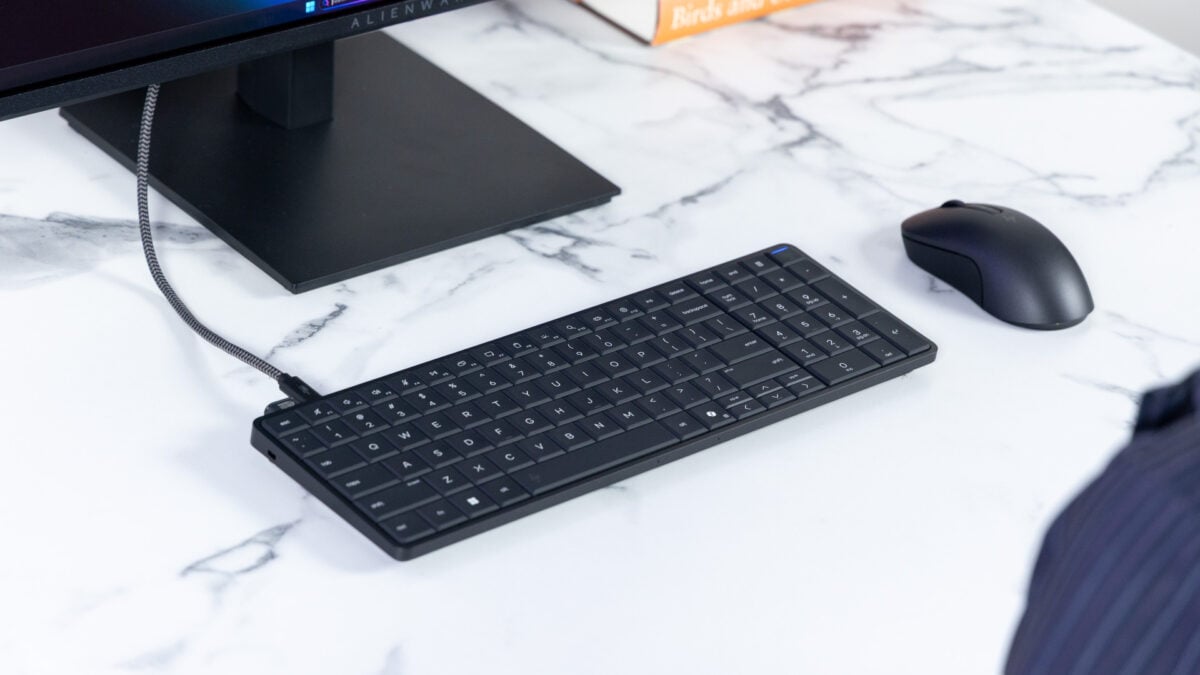
HP has unveiled a device that challenges conventional notions of what a personal computer should look like. The HP EliteBoard G1a Next Gen AI PC integrates a full computing system directly into a keyboard form factor, presenting a radical reimagining of the desktop experience. Announced in early 2026, the device represents HP’s latest effort to merge portability with performance in professional computing environments.
The EliteBoard G1a was officially introduced at CES 2026 in Las Vegas on January 5, 2026, where it was named a CES Innovation Award Honoree. HP positioned the product as the world’s first full AI PC built into a keyboard, designed to eliminate clutter while delivering desktop-grade performance in shared and dedicated workspaces. The announcement highlighted the device’s integration of local AI processing capabilities through an AMD Ryzen processor with an up to 50 TOPS NPU, enabling on-device AI workloads without relying on cloud connectivity.
Beyond its innovative form factor, the EliteBoard G1a incorporates HP Wolf Security for Business, which includes hardware-enforced protections designed to defend against emerging threats, including potential quantum risks. HP emphasized that this security framework is built into the device from the silicon level, aiming to safeguard AI workflows end-to-end. The company also introduced the HP Series 7 Pro 4K Monitor alongside the EliteBoard G1a, touting it as the world’s first Neo:LED desktop monitor to enhance visual precision for professional users engaged in creation and collaboration tasks.
The device’s design centers on minimalism and mobility. By embedding the PC within a sleek keyboard, HP aims to simplify workspace setups while maintaining the power needed for demanding applications. The EliteBoard G1a supports multi-core processing to improve performance in certain software workloads, though actual performance and clock frequency vary depending on the application, hardware configuration, and software environment. HP notes that AMD’s processor numbering does not directly measure clock speed, and real-world performance depends on multiple variables.
HP markets the EliteBoard G1a as ideal for flexible workstyles, particularly in environments where users move between locations or share workspaces. Its compact size allows it to be easily transported or stored, and it can be paired with external displays via standard connectivity options. The company suggests the device is well-suited for utilize with extended reality (XR) glasses, enabling remote login to a workstation from virtually any location—a point noted in early discussions following its unveiling.
Availability details for the EliteBoard G1a were not specified in HP’s initial announcement materials. The company directed interested customers and business clients to contact HP sales representatives for pricing, configuration options, and regional release timelines. As with many enterprise-focused devices, configurations are expected to vary based on processor, memory, storage, and security options selected by organizational buyers.
The introduction of the EliteBoard G1a reflects a broader industry trend toward integrating computing power into everyday peripherals. By hiding the traditional tower or mini-PC within a keyboard, HP seeks to reduce visual clutter while addressing the growing demand for secure, AI-capable devices in hybrid work models. Whether this approach gains widespread adoption will depend on factors such as pricing, compatibility with existing IT infrastructures, and user acceptance of the unconventional form factor.
For updates on the HP EliteBoard G1a Next Gen AI PC, including official specifications, availability announcements, and technical documentation, readers can refer to HP’s commercial systems and displays solutions section on its corporate website. HP typically provides detailed product guides, support resources, and contact information for business clients seeking to evaluate or deploy new hardware solutions.
As workplace technology continues to evolve, devices like the EliteBoard G1a prompt important questions about the future shape of personal computing. By proving that a full AI PC can reside in a keyboard, HP invites businesses and individuals to reconsider what essential hardware truly needs to look like—and where it can be placed.
If you’ve encountered innovative computing designs that blend performance with discretion, share your thoughts in the comments below. Let us know how you imagine the next generation of workspace technology taking shape.