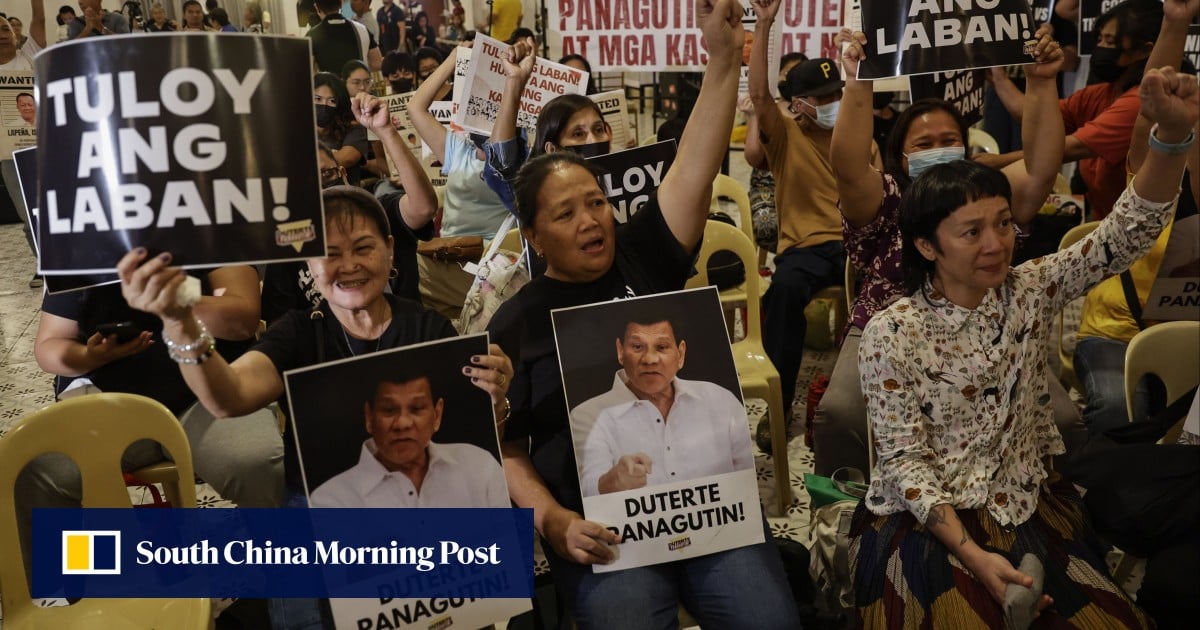
Families of victims of former Philippine president Rodrigo Duterte’s war on drugs hailed a recent ruling by the International Criminal Court (ICC) Appeals Chamber as a “vindication” on Wednesday, April 22, 2026. The court refused to dismiss the crimes against humanity case against Duterte, allowing proceedings to move forward. The decision came after Duterte’s legal team challenged the court’s jurisdiction, arguing that the Philippines had not ratified the Rome Statute at the time of the alleged crimes and therefore the ICC lacked authority to prosecute him.
Duterte has been detained by the ICC in The Hague since March 2025 over killings linked to his anti-drugs campaign during his presidency from 2016 to 2022. The prosecution alleges that his administration’s “war on drugs” policy led to thousands of extrajudicial killings, many carried out by police and unidentified gunmen. Human rights groups have documented widespread violations, including the targeting of minors and vulnerable populations.
The ICC Appeals Chamber’s ruling confirms that the pre-trial chamber’s earlier decision to uphold jurisdiction stands. This means the case will proceed to the trial phase, where prosecutors must present sufficient evidence to support the charges. The victims’ families, many of whom gathered outside the ICC headquarters in The Hague on the day of the ruling, described the outcome as a long-awaited step toward accountability.
“This is not just a legal victory — it’s a moral one,” said one relative of a victim who spoke with international journalists present at the scene. “For years, we were told our loved ones were criminals or collateral damage. Today, the court said their lives mattered.”
The case marks one of the most significant international legal actions against a former head of state in recent years. It centers on whether Duterte bore responsibility for crimes against humanity under Article 7 of the Rome Statute, which includes murder as part of a widespread or systematic attack directed against a civilian population.
According to court filings reviewed by legal observers, the prosecution has submitted over 800 pages of documentation, including police reports, autopsy records, satellite imagery, and testimonies from witnesses and whistleblowers. These materials aim to demonstrate a pattern of state-sanctioned violence that intensified following Duterte’s public calls to “kill” drug suspects.
In response to the ruling, Duterte’s legal team issued a statement maintaining their position that the ICC is overreaching. They argued that the Philippines’ withdrawal from the Rome Statute in 2019 — which took effect one year later — should nullify the court’s authority retroactively. However, the Appeals Chamber rejected this, stating that the alleged crimes occurred while the Philippines was still a state party to the treaty, and thus the court retains jurisdiction.
The ICC’s jurisdiction in this case hinges on the timing of the alleged offenses. Under Article 11 of the Rome Statute, the court may only exercise jurisdiction over crimes committed after a state’s ratification date — and for crimes committed before withdrawal, if the conduct began during membership. The Philippines ratified the Rome Statute in 2011 and formally withdrew in 2019, with the withdrawal taking effect in 2020. The prosecution contends that the peak of the killings occurred between 2016 and 2018, well within the period of Philippine membership.
Human rights organizations such as Amnesty International and Human Rights Watch have long criticized the drug war for its lack of due process and its disproportionate impact on poor urban communities. They have called for independent investigations and urged the Philippine government to cooperate with international mechanisms.
Inside the Philippines, public reaction remains divided. While some continue to praise Duterte for his strong stance on crime, others — particularly civil society groups and legal advocates — view the ICC proceedings as essential for ending impunity. The Philippine government has not officially recognized the ICC’s authority in this matter and has declined to participate in the proceedings.
The next step in the process is the confirmation of charges hearing, where a pre-trial judge will determine whether there is sufficient evidence to proceed to a full trial. No date has yet been set for this hearing, but legal experts expect it to occur within the coming months. The trial itself, if confirmed, could last over a year and involve testimony from dozens of witnesses.
For the victims’ families, the journey toward justice continues. Many have expressed hope that the ICC process will not only establish accountability but also contribute to historical clarity about one of the most controversial periods in recent Philippine history.
As the case advances, the ICC will continue to rely on verified evidence and witness testimony to build its argument. Observers note that the outcome could set a precedent for how international courts address allegations of mass violence linked to national anti-crime campaigns.
Those seeking updates on the proceedings can consult the official ICC website, where public filings, hearing schedules, and press releases are regularly posted. The court emphasizes transparency and encourages public access to non-confidential documents.
We invite readers to share their thoughts on this developing story. What does accountability mean in the context of state-linked violence? How can international justice systems better serve victims and their communities?
Keep reading