
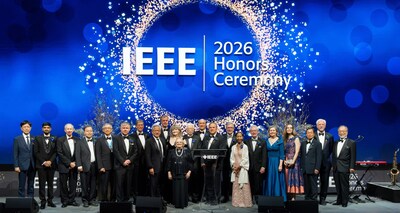
The IEEE honored engineering pioneers and innovators during its annual Honors Ceremony held in New York City on 24 April, recognizing individuals whose contributions have reshaped global communication, computing, and visual technology. The event served as a platform to celebrate technical achievements ranging from the development of the graphics processing unit (GPU) to advancements in digital equity and responsible artificial intelligence.
The ceremony, hosted at Cipriani 42nd Street, highlighted the work of over 20 laureates. Among the notable honorees was Nvidia cofounder and CEO Jensen Huang, who received the IEEE Medal of Honor, the organization’s highest recognition. Huang was specifically lauded for his leadership in the development of GPUs and their application in scientific computing and artificial intelligence. During his acceptance, Huang remarked, “Engineering is a pursuit of what must be possible. [IEEE is] the spirit, the conscience, of our profession.”
Advancing Communication and Digital Equity
Earlier in the day, the program featured a conversation between IEEE president and CEO Mary Ellen Randall and Marian Croak, the recipient of this year’s IEEE Founders Medal. Croak, who serves as vice president of engineering at Google, was recognized for her significant contributions to communication networks. She is widely noted for her pioneering work in Voice over Internet Protocol (VoIP) technology, which transformed telecommunications by converting voice into digital signals for transmission over the internet, thereby enabling modern audio and video conferencing.
Beyond her contributions to networking, Croak was honored for her development of text-to-donate technology, an innovation that allowed for efficient charitable giving via mobile service providers following the devastation of Hurricane Katrina in 2005. Reflecting on her engineering philosophy, Croak stated, “Empathy has always been a driving force in the engineering that I’ve done.”
The Evolution of Microchip Technology
The event also provided an educational look into the history of integrated circuits through the IEEE Global Museum’s exhibit, “Microchips That Shook the World.” The exhibit, curated by IEEE Spectrum special projects editor Stephen Cass and IEEE senior historian Daniel Mitchell, explored the role of microchips in signal processing and telecommunications. Artifacts on display included the Commodore 64, a home computer that served as a centerpiece for many attendees’ childhood memories.

Visitors were also offered a preview of an upcoming immersive video project, “Inside the Microchip,” which utilizes forensic photography and computer-generated renders to visualize the inner workings of the Nvidia NV20 microchip. The project, supported by donations from ASML, the Bill and Dianne Mensch Foundation, and various IEEE societies, is intended to serve as an educational resource for pre-university students later this year.
Artificial Intelligence in Art and Data
The daytime programming explored the intersection of artificial intelligence and the visual arts. IEEE president Kathleen Kramer interviewed artist Refik Anadol, who is preparing to open an AI-focused art museum, Dataland, in Los Angeles on 20 June. Anadol’s work utilizes an open-access model to process millions of images from institutions such as the Smithsonian National Museum of Natural History and the Cornell Lab of Ornithology to create AI-generated art.
Joining the discussion on data-driven storytelling was artist and author Giorgia Lupi, a partner at the design firm Pentagram. Lupi, who uses data to chronicle human experiences, collaborated with IEEE to produce an animated video for the ceremony that illustrated the collaborative pathways of this year’s award recipients. Her work often treats data as an abstraction of reality, exemplified by her previous project, “A Data Love Letter to the Subway,” which visualized travel habits and commuter interactions within the New York City transit system.
Recognizing Semiconductor and Sensor Innovation
The ceremony also honored advancements in hardware that have become ubiquitous in daily life. Eric Fossum, an IEEE Life Fellow, received the IEEE Jun-ichi Nishizawa Medal for his invention of the CMOS image sensor, often referred to as a “camera on a chip.” Originally developed at NASA’s Jet Propulsion Laboratory for space exploration, the technology is now fundamental to the operation of modern smartphones, medical imaging devices, and vehicle sensors. According to estimates by PhotoAiD, more than 92 million selfies are taken globally each day, a feat made possible by the widespread adoption of this sensor technology.

Additionally, Steven P. DenBaars, a professor at the University of California, Santa Barbara, was awarded the IEEE Holonyak Medal for his work in semiconductor optoelectronic technologies. His research has been instrumental in the development of high-resolution LED and laser displays, as well as modern solid-state lighting. During his acceptance, DenBaars emphasized the collaborative nature of the field, noting his interest in the future role of gallium nitride micro LEDs in optical communications.
Following his receipt of the Medal of Honor, Jensen Huang announced that he would donate his cash prize to IEEE TryEngineering, an initiative that provides educational resources and lesson plans for teachers. This gift was matched by the Jen-Hsun and Lori Huang Foundation, with the combined funds earmarked for scholarships for new graduates.
Video highlights and additional photography from the Honors Ceremony are currently available for viewing on the IEEE Awards website. The organization continues to support engineering education and professional development, with future updates and award information to be released through their official channels. We invite readers to share their thoughts on these technological milestones in the comments below.
Related reading