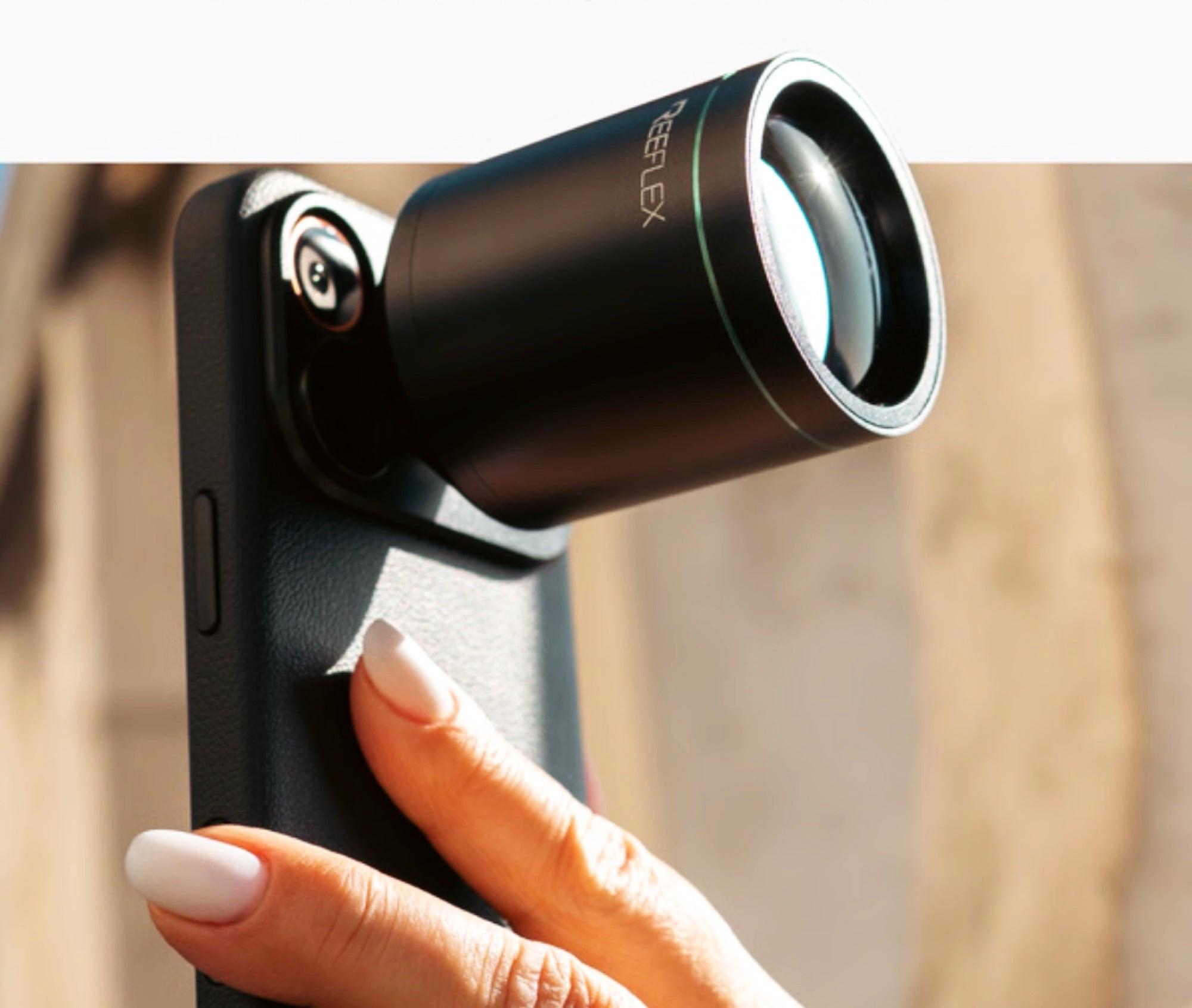
For years, the “zoom war” between smartphone giants has been fought primarily through software and increasingly complex periscope lenses. Whereas the latest flagships from Apple and Samsung offer impressive digital crops, there remains a distinct gap between a smartphone’s processed zoom and the optical compression and subject isolation found in professional DSLR or mirrorless telephoto lenses.
Enter the Reeflex Ultra Tele-Converter, a high-end optical add-on currently seeking funding on Kickstarter. Unlike the flimsy clip-on lenses that often degrade image quality, this accessory is engineered as a serious tool for mobile photographers. By utilizing a multi-element optical system, the Reeflex Ultra aims to provide the iPhone 17 Pro and Samsung Galaxy S26 Ultra with an effective reach of up to 600mm, bridging the gap between mobile convenience and professional-grade distance photography.
As a journalist who has spent nearly a decade tracking the intersection of software and hardware, I find the approach of the Reeflex Ultra particularly interesting. It does not attempt to replace the phone’s camera but rather acts as a force multiplier for existing telephoto systems. By tripling the effective focal length of the device it is attached to, it allows creators to capture distant wildlife, architectural details, and compressed landscapes with a level of clarity that digital zoom simply cannot replicate.
Engineering a “Real Camera” Feel for Smartphones
The Reeflex Ultra is designed to move away from the “gadget” feel of most mobile accessories. The lens is housed in an aerospace-grade aluminum barrel, which provides the necessary stability to hold its internal optics. The physical footprint is substantial: the housing measures 7 centimeters in length and 5.5 centimeters in diameter, weighing in at 308 grams according to product specifications.
Inside the barrel, Reeflex has implemented a four-element optical system. Notably, the inclusion of Lanthanum glass—a material frequently used in high-end professional lenses to reduce chromatic aberration and improve light transmission—suggests a commitment to image quality over mere magnification. This setup is designed specifically to complement modern smartphone image sensors, ensuring that the light hitting the sensor remains sharp even at extreme distances.
To further enhance professional utility, the converter features a magnetic front mount. This allows photographers to quickly snap on proprietary filters, including ND (Neutral Density), polarizing, and UV filters, which are sold separately. For those shooting in bright outdoor conditions, these filters are essential for managing glare and controlling exposure without relying solely on the phone’s internal software processing.
Decoding the 600mm Reach: How it Works
One of the most confusing aspects of smartphone lens accessories is the “equivalent focal length.” It is critical to clarify that the Reeflex Ultra is a 3x lens, not a variable zoom lens. It triples whatever focal length the phone’s active camera is currently using. Because different smartphones have different base telephoto lenses, the resulting reach varies by device.
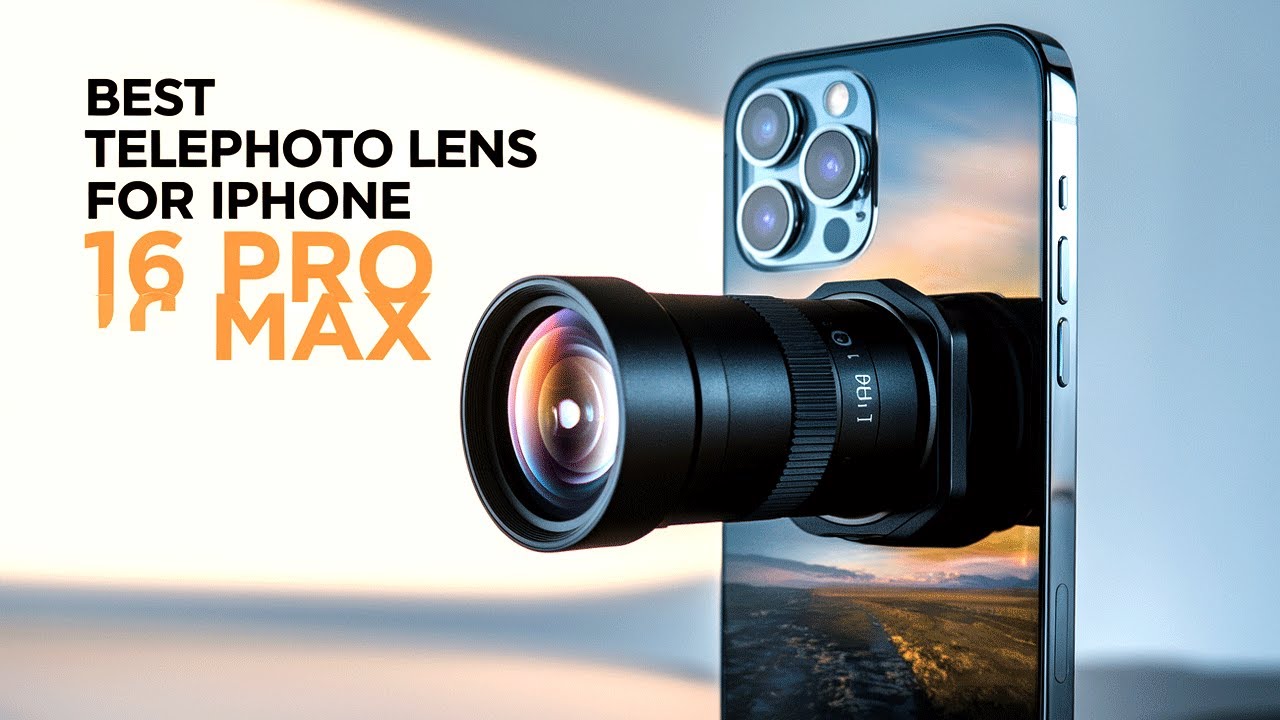
For the iPhone Pro series, the math varies across generations. The iPhone 15 Pro, which has a 77mm equivalent telephoto lens, reaches 231mm when paired with the converter. The iPhone 15 Pro Max, along with the iPhone 16 Pro and 16 Pro Max, achieves a 360mm equivalent reach per Reeflex’s technical data.
The “600mm” claim becomes relevant with the latest hardware. For the iPhone 17 Pro family, the reach depends on the capture mode:
- 48MP Capture Mode: The lens acts as a 300mm equivalent.
- 12MP Pixel Binning Mode: The effective reach doubles to 600mm.
Samsung Galaxy Ultra users see similar dramatic gains. On the Galaxy S23 Ultra, the Reeflex Ultra provides 330mm of reach in one mode and 660mm in another, both utilizing 10-megapixel captures as detailed by PetaPixel. This makes the S26 Ultra, when paired with this accessory, one of the most powerful distance-shooting tools available in a pocketable form factor.
Compatibility and Practical Limitations
Because the Reeflex Ultra is a precision optical tool, it requires a secure, perfectly aligned connection to the phone’s camera lens. To achieve this, the system includes a protective mounting case. However, these cases are limited to specific high-end models. The supported devices include:
- Apple: iPhone 15 Pro/Pro Max, iPhone 16 Pro/Pro Max, and iPhone 17 Pro/Pro Max.
- Samsung: Galaxy S23 Ultra, S24 Ultra, S25 Ultra, and S26 Ultra.
Potential buyers should be aware that this lens is strictly for distance operate. It has a minimum focus distance of 6.8 meters according to its Kickstarter listing. This means it is entirely unsuitable for macro photography or close-up product shots. Its intended use cases are outdoor details, distant street scenes, and compressed landscape compositions where the subject is well away from the photographer.
Quick Comparison: Reach by Device
| Smartphone Model | Base Telephoto (Approx) | Reeflex Ultra Reach |
|---|---|---|
| iPhone 15 Pro | 77mm | 231mm |
| iPhone 16 Pro / Max | 120mm | 360mm |
| iPhone 17 Pro (12MP mode) | 200mm | 600mm |
| Galaxy S23/S26 Ultra (Max mode) | 220mm | 660mm |
Investment and Availability
The Reeflex Ultra is currently in its funding phase on Kickstarter, which allows early adopters to secure the hardware at a discount. The “Super Early Bird” pricing is set at $280, while the planned retail price is expected to be $445 as reported by PartofStyle.
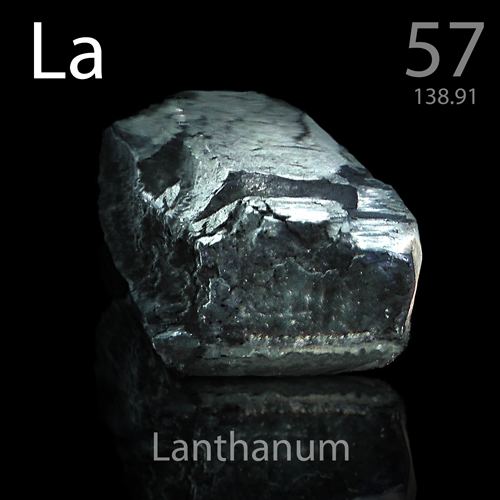
While the price point is significantly higher than standard mobile accessories, it reflects the use of aerospace-grade materials and Lanthanum glass. For the enthusiast who wants to avoid carrying a full-sized telephoto lens for casual outings but still requires the ability to capture distant subjects with optical precision, the investment may be justified.
The next major milestone for the project is the completion of its Kickstarter funding campaign, after which the company will move into the production phase for the initial batch of backers. Official retail availability dates have not yet been announced.
Do you think high-end optical add-ons are the future of mobile photography, or will software-driven “AI zoom” eventually make them obsolete? Let us know in the comments below.
Related reading