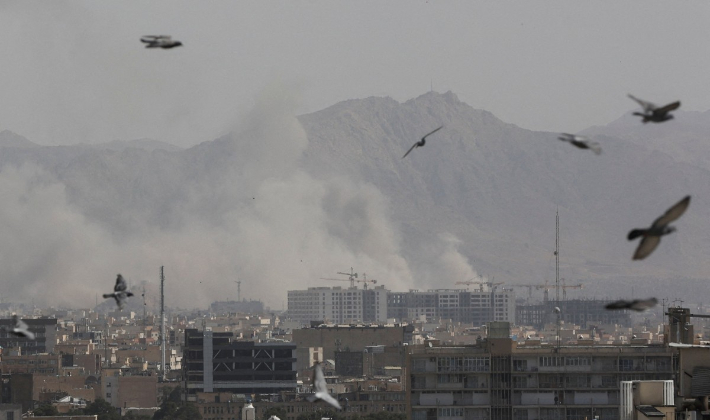
DUBAI, United Arab Emirates – Iran launched retaliatory strikes against multiple countries in the Middle East on Saturday, February 28, 2026, targeting facilities hosting U.S. Military personnel in response to recent joint U.S.-Israeli strikes. The attacks, carried out by the Islamic Revolutionary Guard Corps, have heightened tensions in an already volatile region and prompted immediate responses from several Gulf nations.
The escalation follows a period of increased military activity and diplomatic friction between Iran and its regional adversaries. Even as the full extent of the damage remains unclear, reports indicate that facilities in Qatar, Kuwait, Bahrain, and potentially other nations were targeted with missiles and drones. This latest development marks a significant shift in the dynamic, moving beyond proxy conflicts to direct retaliatory action against countries hosting American forces. The situation is rapidly evolving, and international observers are closely monitoring the response from the United States and Israel.
The attacks represent a direct response to recent military actions attributed to Israel and the United States, though specific details of those operations remain closely guarded. The Iranian government has consistently warned of repercussions for any perceived aggression against its interests or those of its allies. This latest action appears to be a fulfillment of those warnings, signaling a willingness to directly confront regional powers and their U.S. Allies. The timing and scope of the attacks suggest a calculated move designed to demonstrate Iran’s capabilities and resolve.
Targets of the Iranian Retaliation
According to reports, several key military installations were targeted in the coordinated attacks. Qatar’s Al Udeid Air Base, a critical hub for U.S. Central Command, was reportedly among the locations hit. Al Udeid Air Base, located outside Doha, serves as the forward headquarters for CENTCOM, overseeing military operations across a vast region stretching from Egypt to Kazakhstan. Qatar confirmed that its air defenses successfully intercepted multiple attacks using Patriot missile systems.
Kuwait’s Al Salem Air Base, situated roughly 40 kilometers from the Iraqi border, was similarly reportedly targeted. Known as “The Rock” due to its isolated location, Al Salem is a key facility for U.S. Army Central. Camp Arifjan, another significant U.S. Military installation in Kuwait, also appears to have been a target. The U.S. Army utilizes Camp Buehring in Kuwait as a staging post for units deploying into Iraq and Syria.
Bahrain, home to the headquarters of the U.S. Navy’s Fifth Fleet, experienced a direct attack on the fleet’s service center. NPR reported that an automated voice warned of a missile threat, urging personnel to seek shelter. The Fifth Fleet’s area of responsibility encompasses the Gulf, Red Sea, Arabian Sea, and parts of the Indian Ocean, making it a strategically vital asset for the U.S. Military.
The United Arab Emirates’ Al Dhafra Air Base, shared with the UAE Air Force, was also reportedly targeted. This base has been instrumental in supporting missions against the Islamic State and conducting reconnaissance operations throughout the region. Reports also indicated explosions in Saudi Arabia’s capital, Riyadh, and in the UAE cities of Abu Dhabi and Dubai, though details regarding these incidents remain limited.
Regional Responses and International Concerns
Several countries in the region have condemned the Iranian attacks and affirmed their commitment to defending their territories. Jordan announced that it intercepted and destroyed two ballistic missiles targeting its territory, stating that its air defense systems functioned effectively. The swift response from Jordan highlights the growing concern over escalating tensions and the potential for a wider conflict.
The United States has yet to issue a comprehensive statement detailing the extent of the damage and its planned response. However, officials have indicated that they are closely monitoring the situation and will take appropriate measures to protect U.S. Interests and personnel. The U.S. Reportedly deployed dozens of military aircraft to Jordan’s Muwaffaq Salti Air Base in anticipation of potential retaliatory strikes against Iran, according to France 24.
The international community has expressed deep concern over the escalating tensions and called for restraint from all parties involved. Diplomatic efforts are underway to de-escalate the situation and prevent a further deterioration of regional security. However, the prospects for a swift resolution remain uncertain, given the complex geopolitical dynamics and the deeply entrenched animosities between Iran and its regional rivals.
‘Sa’deq’s Promise 4’ and Iranian Messaging
The Islamic Revolutionary Guard Corps has named the retaliatory operation ‘Sa’deq’s Promise 4,’ signaling a continuation of previous actions and a commitment to further responses if necessary. This naming convention suggests a deliberate strategy to project strength and deter future aggression. Iranian officials have vowed to respond forcefully to any perceived threats to the country’s security and interests.
Impact on U.S. Military Presence in the Middle East
The attacks raise serious questions about the security of U.S. Military personnel and assets in the Middle East. The targeted facilities are critical for maintaining U.S. Influence and projecting power in the region. Any significant disruption to these bases could have far-reaching consequences for U.S. Military operations and strategic interests.
The incident is likely to prompt a reassessment of U.S. Force posture in the region and potentially lead to increased security measures at military installations. The U.S. May also consider bolstering its defensive capabilities and enhancing coordination with regional allies to deter future attacks. The long-term implications of these events for U.S. Military presence in the Middle East remain to be seen.
The attacks also highlight the vulnerability of U.S. Bases to Iranian missile and drone capabilities. Despite the effectiveness of defensive systems like the Patriot missile, the sheer number and sophistication of Iranian weaponry pose a significant challenge. This underscores the need for continued investment in advanced defense technologies and a comprehensive strategy to counter Iranian military capabilities.
The situation remains fluid, and further developments are expected in the coming days. The U.S. Central Command (CENTCOM) is expected to provide further updates on the extent of the damage and the response to the attacks. The international community will be closely watching to notice how the situation unfolds and whether it can be contained before it escalates into a wider conflict.
The next key development will be the official response from the United States government, expected within the next 24-48 hours. Readers are encouraged to follow World Today Journal for continued coverage of this developing story and to share their thoughts in the comments section below.