Iran Condemns US Interference Following Supreme Leader’s Death
The death of Ayatollah Ali Khamenei, Iran’s Supreme Leader, has triggered a diplomatic dispute, with Tehran vehemently rejecting what it calls interference from the United States in the process of selecting his successor. The condemnation comes after President Donald Trump asserted his desire to play a role in determining the next leader of the Islamic Republic, a move Iran views as a violation of international law. This follows a U.S.-Israeli military operation that resulted in Khamenei’s death on Saturday, February 28, 2026, according to statements from both Trump and Iranian state television. The situation has raised concerns about regional stability and the potential for further escalation.
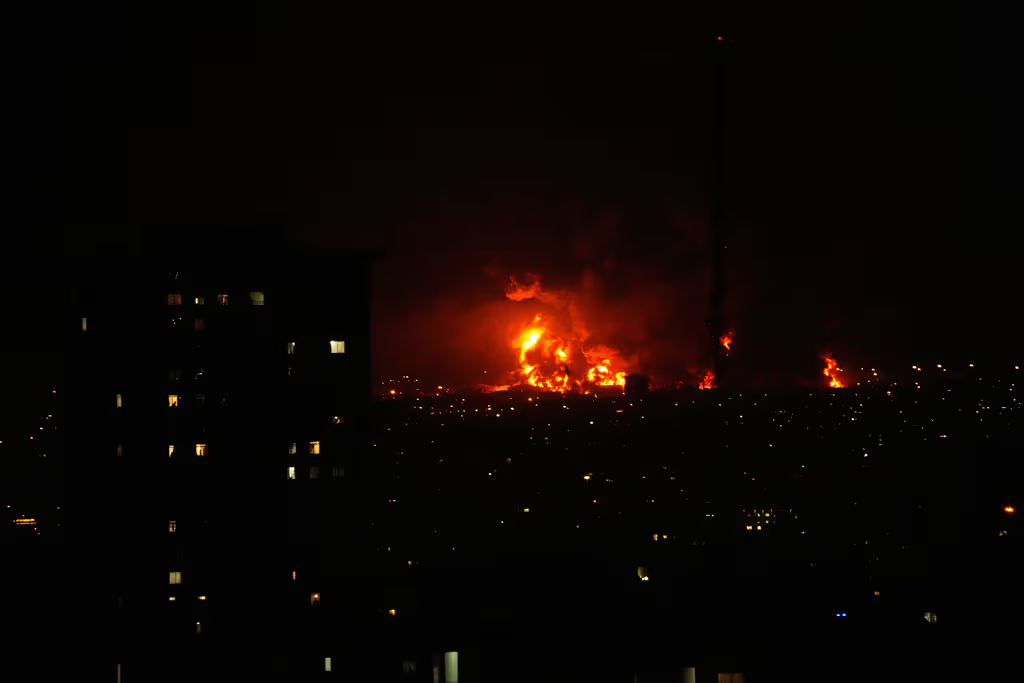
Ayatollah Khamenei, who had ruled Iran for nearly four decades since succeeding Ruhollah Khomeini in 1989, died amid a major military campaign dubbed “Operation Epic Fury,” following months of heightened tensions and warnings from the Trump administration regarding potential military intervention in Iran. The operation involved strikes against air defense capabilities, missile and drone launch sites, and military airfields within Iran. Trump, in a social media post, described Khamenei’s death as “Justice for the people of Iran” and for those harmed by the leader and his “gang of bloodthirsty THUGS.” Celebrations reportedly erupted in parts of Tehran following the news, with residents taking to the streets to applaud and play celebratory music, according to witnesses.
US Calls for Regime Change, Iran Rejects External Influence
President Trump has gone further than simply acknowledging Khamenei’s death, urging Iranian civilians to “take over your government” in a video message released after the strikes. This call for regime change has been met with strong opposition from Iranian officials. Amir Saeid Iravani, Iran’s ambassador to the United Nations, stated that Trump’s comments constitute a “clear violation of the principles of non-interference in the internal affairs of states,” as enshrined in the United Nations Charter. The UN Charter explicitly outlines the principle of state sovereignty and non-intervention.
Iravani emphasized Iran’s sovereignty and independence, asserting that the country will not accept or permit any foreign interference in its internal affairs. He affirmed that the selection of Iran’s leaders will be conducted strictly in accordance with the nation’s constitutional procedures and solely by the will of the Iranian people. This stance underscores Iran’s long-held position of resisting external influence in its political processes. The Iranian constitution outlines a complex process for selecting the Supreme Leader, involving the Assembly of Experts, a body of clerics responsible for choosing the next leader.
Khamenei’s Legacy and the Power Vacuum
Ayatollah Khamenei’s death marks a seismic shift for Iran, a nation governed by a theocratic regime since the 1979 Islamic Revolution. He had previously served as the country’s president from 1981 to 1989 before being appointed by Khomeini as his successor. His leadership was characterized by a staunch defense of the Islamic Republic’s principles and a firm opposition to Western influence. In 2025, during the Iran-Israel conflict, Khamenei vowed that Iran would not surrender, stating, “War will be met with war, bombing with bombing, and strike with strike. Iran will not submit to any demands or dictates,” as reported by Tasnim, Iran’s semi-official state news agency. Tasnim News Agency is a key source of information regarding Iranian government statements.
The death of Khamenei creates a significant leadership vacuum in Tehran, prompting global leaders to grapple with the prospect of wider regional instability. The Assembly of Experts will now be tasked with selecting a recent Supreme Leader, a process that could be fraught with internal divisions and external pressures. The new leader will face numerous challenges, including a struggling economy, ongoing regional conflicts, and international sanctions. The economic situation in Iran has been particularly challenging in recent years, with inflation and unemployment rates remaining high. The country’s nuclear program also remains a point of contention with the international community.
International Reactions and Concerns
While the United States has celebrated Khamenei’s death, many other nations have expressed concern over the escalating tensions in the region. The U.S.-Israeli attack on Iran has been condemned by some countries as a violation of international law and a destabilizing force. The international community is urging restraint and calling for a peaceful resolution to the crisis. The European Union has called for an emergency meeting to discuss the situation and coordinate a response. The European External Action Service is responsible for the EU’s foreign policy.
The potential for retaliatory strikes by Iran or its proxies remains a significant concern. Several regional actors, including Hezbollah in Lebanon and Houthi rebels in Yemen, are aligned with Iran and could potentially be drawn into the conflict. The United States has warned Iran against any further aggression and has vowed to defend its interests and those of its allies in the region. The U.S. Military presence in the Middle East has been increased in recent weeks in anticipation of potential escalation. The situation is further complicated by the ongoing conflicts in Syria and Yemen, which could potentially spill over into a wider regional war.
The Selection Process for the New Supreme Leader
The process of selecting a new Supreme Leader in Iran is governed by the Constitution of the Islamic Republic of Iran. The Assembly of Experts, comprising 88 clerics, is responsible for identifying and appointing the new leader. Candidates must be qualified as a Marja’, a high-ranking Shia cleric with the authority to interpret Islamic law. The Assembly will deliberate and vote on potential candidates, and the final decision is expected to take several days or weeks. The selection process is often shrouded in secrecy, with limited public information available.
Potential candidates for the position of Supreme Leader include several prominent clerics, including Ebrahim Raisi, the current president of Iran, and Ali Larijani, a former speaker of the Iranian parliament. However, the ultimate choice will likely depend on a complex interplay of political factors and the preferences of the various factions within the Iranian establishment. The new leader will inherit a country facing significant challenges, both domestically and internationally, and will be tasked with navigating a turbulent geopolitical landscape.
Key Takeaways
- Ayatollah Ali Khamenei, Iran’s Supreme Leader, has been killed in a U.S.-Israeli military operation.
- Iran has condemned the U.S. For what it calls interference in the selection of Khamenei’s successor.
- The death of Khamenei creates a significant leadership vacuum and raises concerns about regional stability.
- The Assembly of Experts will now begin the process of selecting a new Supreme Leader.
- International reactions have been mixed, with some countries expressing concern over the escalating tensions.
The coming weeks will be critical as Iran navigates this period of transition. The selection of a new Supreme Leader will have profound implications for the country’s future and for the broader region. The international community will be closely monitoring the situation and urging all parties to exercise restraint and pursue a peaceful resolution to the crisis. Further updates will be provided as the situation develops.
Next Steps: The Assembly of Experts is expected to convene within the next week to begin deliberations on selecting a new Supreme Leader. World Today Journal will continue to provide updates on this developing story as they become available.
Share your thoughts on this critical development in the comments below and share this article with your network.
Related reading