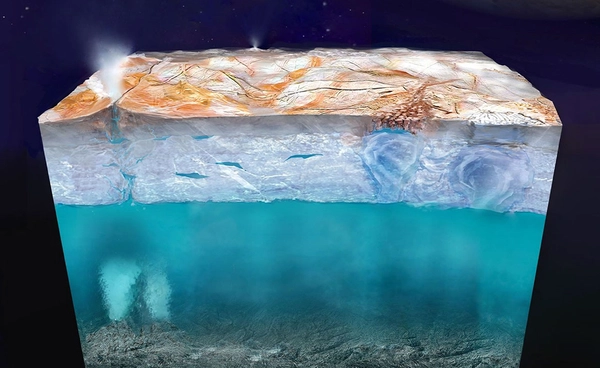
NASA’s Europa Clipper mission aims to determine if Jupiter’s moon Europa can support life, but recent geological analysis suggests the moon’s subsurface ocean may be harder to access than previously believed. While scientists have long known Europa harbors a salty liquid water ocean beneath a frozen crust, new data indicates the ice shell may be thicker and more complex, potentially blocking direct access to the water for future landers or probes.
The search for habitable environments in the outer solar system centers on the “water-rock interface,” where the ocean meets the moon’s rocky mantle. According to NASA, this interaction is critical because it allows for the chemical reactions and mineral exchanges necessary to sustain biological life. However, the thickness of the ice shell—estimated to be between 15 and 25 kilometers (9 to 15 miles) thick—remains a primary obstacle for any mission intending to sample the liquid water directly.
The Europa Clipper mission, which launched in October 2024, is designed to address these uncertainties. Rather than landing, the spacecraft will perform nearly 50 flybys of the moon to map its composition and thickness using ice-penetrating radar and thermal imaging. This approach allows researchers to identify “thin” spots in the ice where the ocean might be closer to the surface.
The Challenge of the Ice Shell Thickness
Geological models of Europa suggest the ice shell is not uniform. Research published via NASA indicates that the shell likely consists of a brittle, cold outer layer and a warmer, more ductile inner layer. This layering creates a significant barrier for robotic exploration; a probe would need to penetrate miles of ice, enduring extreme pressures and temperatures, to reach the liquid ocean.
The difficulty is compounded by the moon’s intense radiation environment. Because Europa orbits within Jupiter’s powerful magnetic field, the surface is bombarded by high-energy particles. This radiation not only threatens the electronics of a lander but also alters the chemistry of the surface ice, making it difficult to distinguish between materials that have been pushed up from the ocean and those modified by space weathering.
To overcome this, the Clipper spacecraft utilizes a Radar for Europa Assessment (REASON) instrument. This tool is specifically designed to peer through the ice and locate pockets of liquid water, known as “perched lakes,” which may exist within the ice shell itself. Finding these lakes would provide a more accessible target for future missions than the deep global ocean.
Why the Subsurface Ocean Matters for Astrobiology
Europa is considered one of the most promising places to search for extraterrestrial life because it possesses the three essential ingredients for life: liquid water, essential chemical elements (carbon, hydrogen, nitrogen, oxygen, phosphorus, and sulfur), and an energy source. The energy is provided by tidal heating—the gravitational tug-of-war between Jupiter and other moons that flexes Europa’s interior, generating heat.
According to the NASA Science Mission Directorate, the presence of a salty ocean suggests that the water is in direct contact with a rocky seafloor. This is a critical distinction from moons like Ganymede, where the ocean may be sandwiched between two layers of ice, preventing the mineral-rich interactions that fuel life on Earth’s ocean floors.
The primary goal of current exploration is to identify “biosignatures”—chemical markers that indicate the presence of biological processes. If the Europa Clipper detects organic compounds or complex salts in plumes of water vapor erupting from the surface, it would confirm that the ocean is communicating with the surface, potentially bypassing the need to drill through kilometers of ice.
Mission Timeline and Expected Deliverables
The Europa Clipper is currently in the cruise phase of its journey. It is scheduled to arrive at the Jupiter system in April 2030. Once it enters orbit around Jupiter, it will begin its series of close-approach flybys, some as low as 25 kilometers above the surface.
The mission’s success depends on several key technical milestones:
- Gravity Mapping: Measuring the moon’s gravitational pull to determine the exact depth of the ocean.
- Thermal Mapping: Using the Europa Thermal Imager (ETI) to find “hot spots” where the ice is thinnest or where water may be venting.
- Chemical Analysis: Using a mass spectrometer to “sniff” the thin atmosphere for organic molecules during low-altitude passes.
These findings will dictate the design of a follow-up “Europa Lander” mission. If the Clipper finds that the ice is too thick for current drilling technology, NASA may pivot toward focusing on the plumes—geysers of water that occasionally erupt into space—which could be sampled without ever touching the surface.
Comparing Europa to Other Ocean Worlds
While Europa is the primary focus, it is part of a broader class of “ocean worlds” in our solar system. Comparing Europa to Enceladus (a moon of Saturn) reveals why the “access” problem is so specific to Jupiter’s moon. Enceladus is much smaller and has active plumes that vent directly from its subsurface ocean into space, making it significantly easier to sample.
| Feature | Europa (Jupiter) | Enceladus (Saturn) |
|---|---|---|
| Ice Shell Thickness | Estimated 15–25 km | Significantly thinner at poles |
| Ocean Contact | Direct contact with rocky mantle | Direct contact with rocky mantle |
| Surface Access | Difficult (thick ice) | Easier (active plumes) |
| Radiation Level | Extremely High | Low to Moderate |
The contrast highlights the stakes for the Clipper mission. While Enceladus provides an easier “sample” of an ocean world, Europa’s sheer size and the depth of its ocean mean it could potentially support a much larger and more diverse ecosystem, provided scientists can find a way through the ice.
The next major milestone for the mission is the series of gravity-assist flybys at Mars and Earth, which will slingshot the spacecraft toward Jupiter. Official updates on the spacecraft’s health and trajectory are provided through the NASA Europa Clipper mission updates page.
Do you think the discovery of life on Europa would change our understanding of biology on Earth? Share your thoughts in the comments below.