
The Italian economy has once again defied the chorus of domestic skepticism, with recent data from the National Institute of Statistics (ISTAT) painting a picture of resilience that challenges the bleak narratives often advanced by opposition leaders. As the country navigates a complex European economic landscape, the latest figures regarding Gross Domestic Product (GDP) and employment levels suggest a trajectory that warrants a closer, evidence-based look, moving beyond political rhetoric to the hard data defining Italy’s current fiscal reality.
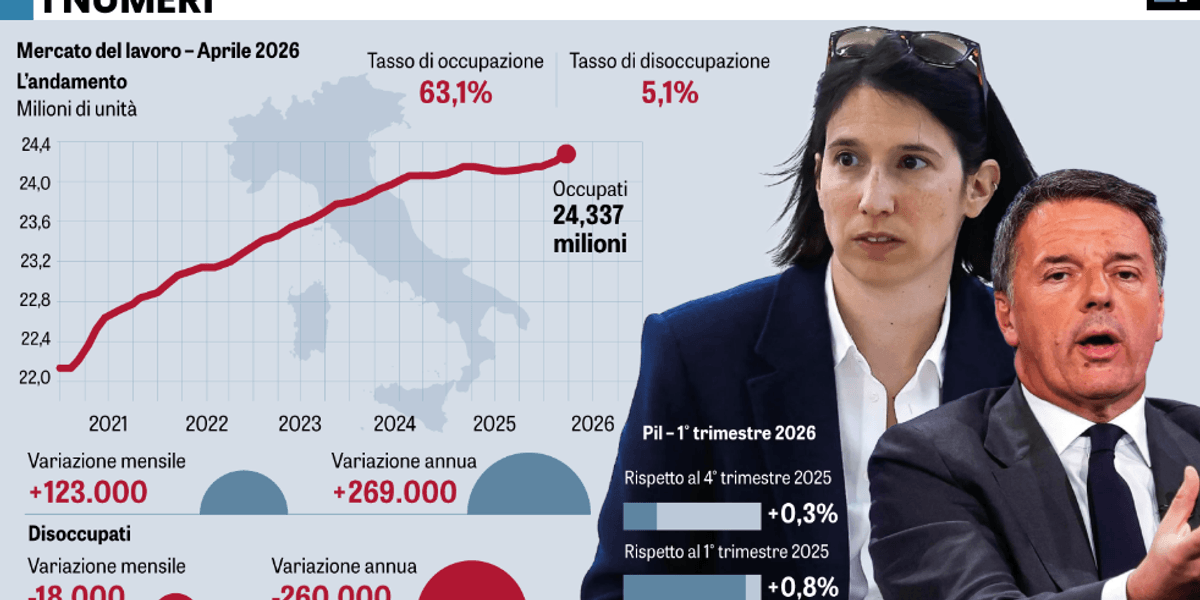
In the first quarter of 2024, the Italian economy demonstrated unexpected vigor, with ISTAT revising its initial GDP growth estimates upward to 0.3% quarter-on-quarter, an increase from the previously reported 0.2% and a clear signal of underlying momentum. This performance, coupled with record-high employment figures, provides a concrete counterpoint to critics such as Matteo Renzi and Elly Schlein, who have frequently characterized the government’s economic management as stagnant or failing. According to the latest ISTAT quarterly national accounts report, the growth was driven primarily by a resurgence in domestic demand and a resilient services sector.
The Data Behind the Resilience
To understand the current economic climate, one must look at the convergence of several key indicators. The rise in employment is perhaps the most striking development; as of the most recent reporting period, the number of employed individuals in Italy has reached historic highs, reflecting a labor market that is absorbing workers at a pace that has consistently outperformed analyst expectations. This trend is corroborated by the official labor market data, which highlights a steady decline in the unemployment rate and a corresponding rise in labor participation among both youth, and women.
While political figures often focus on headline-grabbing critiques regarding the cost of living, the macroeconomic reality suggests a more nuanced story. Inflation, which reached 3.2% in May 2024 (as reported by ISTAT’s monthly consumer price index analysis), remains a significant challenge for households. However, when viewed in the context of GDP expansion, it becomes clear that Italy is managing a difficult transition period with more stability than many of its European counterparts. The discrepancy between the narrative of “economic decline” and the verified statistical growth suggests that the opposition’s focus may be misaligned with the actual performance of the national economy.
Navigating the European Context
Italy’s performance cannot be analyzed in a vacuum. As a member of the Eurozone, the nation is subject to the monetary policies of the European Central Bank (ECB) and the fiscal constraints inherent in the Stability and Growth Pact. The recent upward revision of GDP estimates serves as a reminder that Italy’s industrial and service sectors remain robust, often acting as a buffer against external shocks. For investors and policymakers alike, the ability of the Italian market to “beat the estimates” repeatedly is a signal of structural changes that are beginning to bear fruit, despite the domestic political noise.
The debate between the government and its critics often centers on the efficacy of tax reforms and labor incentives. While leaders like Schlein point to persistent wage stagnation as evidence of failure, the government maintains that its policies have fostered a climate conducive to hiring. The data, at least for the current quarter, supports the government’s claim that the employment landscape is strengthening. Whether this growth is sustainable in the face of persistent inflationary pressures remains a point of contention for economists, but the immediate numbers favor those arguing for a more optimistic outlook.
Key Economic Takeaways
- GDP Growth: ISTAT confirmed a 0.3% increase in GDP for the first quarter of 2024, an upward revision from earlier projections.
- Employment Records: Italy has hit record-high employment levels, significantly outperforming market forecasts for labor market absorption.
- Inflationary Pressures: Consumer prices rose by 3.2% in May, a factor that continues to weigh on household purchasing power and remains a focal point for economic policy.
- Market Performance: Independent data confirms that the Italian economy is exhibiting a resilience that contradicts the narrative of stagnation often put forward by political opposition.
For those tracking these developments, the next critical checkpoint will be the release of the updated ISTAT economic outlook for the second quarter, which will provide further clarity on whether the current growth trend is accelerating or stabilizing. As Italy continues to navigate the complexities of post-pandemic recovery, the gap between political rhetoric and fiscal reality will remain a defining feature of the national discourse.

We invite our readers to join the conversation. Do you believe the current economic indicators accurately reflect the reality on the ground, or is there a disconnect between the data and the daily experience of Italian families? Share your thoughts and insights in the comments section below as we continue to track these essential metrics.