
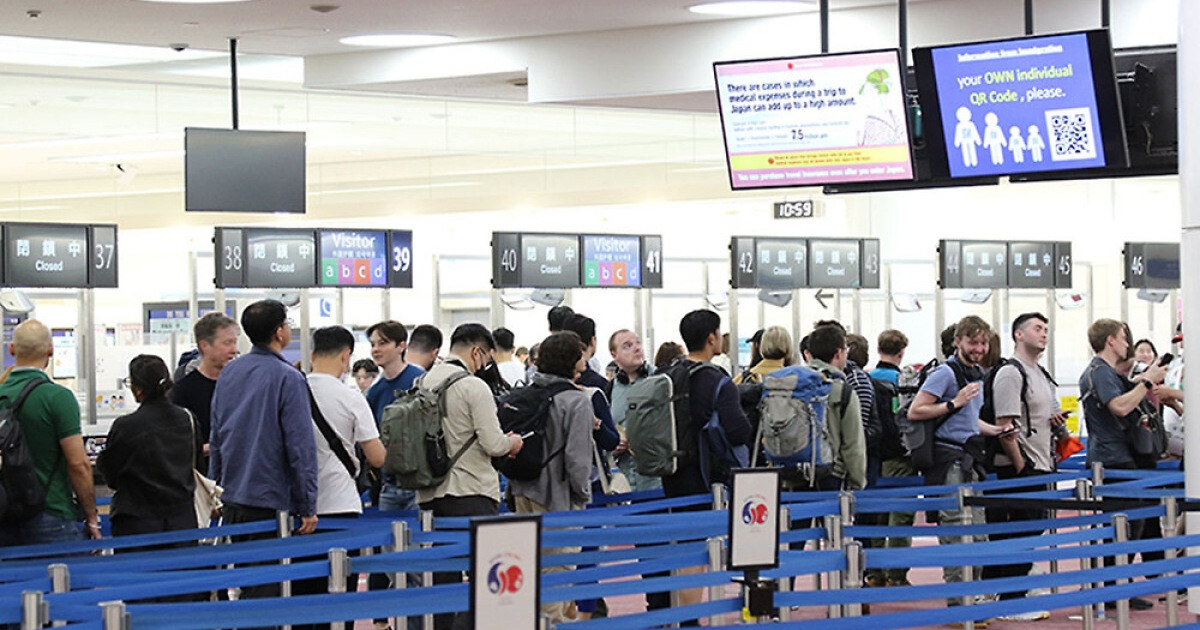
South Korean outbound tourism has surpassed Japan’s in recent years, with Korean travelers now numbering roughly twice as many as their Japanese counterparts despite Japan’s larger population. This shift reflects divergent post-pandemic recovery patterns between the two Northeast Asian neighbors, shaped by economic pressures, currency fluctuations, and evolving travel preferences.
According to verified data from Japan’s Immigration Services Agency, Japanese outbound travelers totaled 14.73 million in 2024, representing just 70% of the 20.08 million recorded in 2019 before the COVID-19 pandemic. In contrast, South Korea’s outbound tourism reached 29.55 million in the same period, exceeding its pre-pandemic level of 28.71 million and marking a historical high. These figures come from official statistics released by Japan’s Ministry of Justice and the Korea Tourism Organization, highlighting a stark reversal in regional travel dynamics.
The disparity is particularly notable given Japan’s population of approximately 124 million—about 2.4 times South Korea’s 51 million—yet Korean residents now account for nearly double the number of overseas trips. Analysts point to the prolonged weakness of the Japanese yen as a primary factor suppressing outbound demand, while simultaneously boosting inbound tourism to Japan as foreign visitors benefit from favorable exchange rates.
This trend was confirmed in a November 2024 survey by Japan Travel Bureau (JTB), which polled 2,067 residents aged 15 to 79 nationwide. The study found that “travel costs being too high” (36.5%), “lack of household financial flexibility” (26.5%), and “yen depreciation” (21.2%) were the top three reasons cited for not traveling abroad—all economic in nature. These findings align with broader observations that currency volatility has made international travel increasingly burdensome for Japanese households despite rising wages in some sectors.
Meanwhile, South Korea’s tourism rebound has been driven by pent-up demand, relatively stable household finances, and strong interest in destinations such as Southeast Asia, Europe, and the United States. Data from the Korea Tourism Organization shows consistent month-over-month growth in outbound departures since early 2023, with no signs of slowing as of mid-2024. Popular routes include flights to Bangkok, Hanoi, Paris, and Los Angeles, reflecting a diversified appetite for international experiences.
The contrasting trajectories have prompted discussion among policymakers and industry leaders in both countries. In Japan, officials from the Japan Tourism Agency have acknowledged that while inbound tourism is recovering strongly—welcoming over 25 million foreign visitors in 2024—the decline in outbound travel raises concerns about domestic consumption patterns and household economic resilience. Some economists suggest that the yen’s depreciation, while beneficial for exporters and inbound tourism, may be inadvertently discouraging overseas spending by Japanese consumers.
In South Korea, tourism officials have celebrated the milestone as a sign of renewed consumer confidence and global engagement. The Korea Tourism Organization has launched targeted marketing campaigns promoting off-season travel and lesser-known destinations to sustain momentum. Industry representatives note that Korean travelers are increasingly prioritizing cultural immersion, culinary exploration, and wellness-focused itineraries over traditional sightseeing tours.
Looking ahead, neither country has announced specific policy changes aimed at reversing these trends. Yet, both governments continue to monitor monthly outbound and inbound tourism statistics closely. The next official update on Japan’s outbound travel figures is expected in mid-2025 when the Immigration Services Agency releases its annual report for the fiscal year. Similarly, the Korea Tourism Organization is scheduled to publish its comprehensive 2024 outbound tourism analysis in the second quarter of 2025.
For readers interested in tracking these developments, official sources include the Japan Immigration Services Agency’s monthly outbound travel statistics and the Korea Tourism Organization’s international tourism reports, both updated regularly and available in English. These datasets provide the most reliable foundation for understanding how travel behaviors are evolving in one of the world’s most dynamic regions.
As global travel continues to normalize after years of disruption, the diverging paths of Japan and South Korea offer valuable insights into how macroeconomic forces, currency markets, and household economics shape consumer behavior. The story underscores that tourism recovery is not uniform—even among geographically and culturally proximate nations—and that the true measure of post-pandemic resilience extends beyond visitor arrivals to include the willingness and ability of residents to explore the world beyond their borders.
We invite our readers to share their observations and experiences regarding international travel trends in Northeast Asia. Have you noticed shifts in travel patterns among friends, family, or colleagues? What factors do you believe are most influential in shaping decisions to travel abroad—or to stay home? Join the conversation in the comments below and help deepen our collective understanding of this evolving landscape.