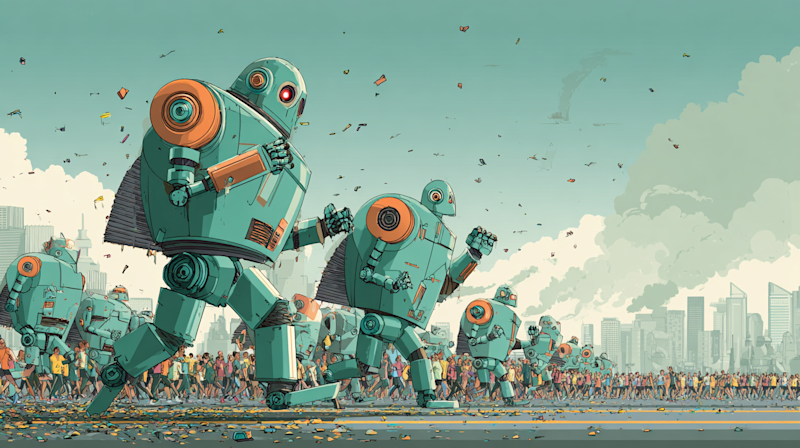
Long-running AI agents are pushing the limits of enterprise orchestration systems, revealing critical gaps in how organizations manage autonomous software that operates for hours or even days. As models like Kimi K2.6 demonstrate extended capabilities in tasks such as code generation and system monitoring, the infrastructure needed to support them has not kept pace. This growing mismatch between agent endurance and orchestration design is prompting a reevaluation of how AI systems are deployed, governed, and maintained in production environments.
The core issue lies in the assumption that AI agents function within short, predictable timeframes. Most existing orchestration frameworks were built for agents that complete tasks in seconds or minutes, not for those that run continuously over extended periods. When agents operate for hours or days, challenges emerge around state maintenance, tool integration, and environmental adaptation. These systems must continuously interact with APIs, databases, and external tools while preserving context across thousands of steps — a demand that current platforms often struggle to meet reliably.
Moonshot AI’s Kimi K2.6 model has been highlighted for its ability to sustain autonomous execution over long durations. According to the company’s technical documentation shared with VentureBeat, K2.6 successfully built a full SysY compiler from scratch in 10 hours — a task characterized as equivalent to a team of four engineers working for two months — and passed all 140 functional tests without human intervention. In another case, the model was deployed to overhaul an eight-year-old open-source financial matching engine, executing over 1,000 tool calls across 13 hours to modify more than 4,000 lines of code with precision. Most notably, one internal team used K2.6 to run an agent autonomously for five consecutive days, managing monitoring, incident response, and system operations without interruption.
These achievements underscore the model’s capacity for stateful, continuous execution — a feature that distinguishes it from earlier approaches relying on predefined roles or bounded workflows. Unlike Anthropic’s Claude Code, which uses a lead agent to direct subagents based on user-defined rules, or OpenAI’s Codex, which follows similar structured patterns, Kimi K2.6 relies on the model itself to determine orchestration dynamically. This approach enables the management of up to 300 sub-agents executing across 4,000 coordinated steps simultaneously, as stated in Moonshot’s blog post announcing the release.
However, practitioners warn that increased agent longevity exposes deeper systemic fragility. Maxim Saplin, writing in a personal blog post on Dev.to, noted that while subagents remain useful, the orchestration layer itself is still brittle. “It means orchestration is still fragile. Right now, it feels more like a product and training problem than something you can solve by writing a sufficiently stern prompt,” he wrote, emphasizing that prompt engineering alone cannot resolve underlying architectural limitations.
The risks extend beyond technical failure. Mark Lambert, chief product officer at ArmorCode, warned in an email to VentureBeat that agentic systems are now generating code and system changes faster than most organizations can review, remediate, or govern. “This will require more than just additional scanning. Organizations will need stronger AI governance that provides the context, prioritization, and accountability teams need to manage Kimi and other AI-generated risk before they turn into accumulated exposure,” he said, highlighting a growing governance gap that outpaces deployment speed.
Kunal Anand, chief product officer at F5, echoed these concerns, describing the shift to long-running agents as a fundamental architectural evolution. “We went from scripts to services to containers to functions, and now to agents as persistent infrastructure,” he stated in an email to VentureBeat. This transition creates new categories — such as agent runtime, agent gateway, agent identity provider, and agent mesh — for which standardized naming and best practices are still lacking. Anand added that the traditional API gateway model must evolve to understand goals and workflows, not just endpoints and HTTP verbs, signaling a broader transformation in how systems interact.
Availability of Kimi K2.6 has expanded through multiple channels. The model is accessible on Hugging Face, via Moonshot’s API, through the Kimi Code interface, and within the standalone Kimi app. This distribution strategy aims to reach both developers experimenting with agent-based workflows and enterprise teams evaluating long-horizon AI for production use.
As enterprises begin to explore long-horizon agents for complex, real-world challenges — tasks that Moonshot AI says typically require weeks or months of collective human effort — the need for robust orchestration, state management, and governance frameworks becomes increasingly urgent. Without corresponding advances in infrastructure, the potential of models like Kimi K2.6 may be constrained not by their capabilities, but by the systems meant to support them.
For updates on Kimi K2.6 and related developments in agent orchestration, users can follow official announcements from Moonshot AI through its Hugging Face model page, API documentation, or blog. The model remains under active development, with future improvements likely to focus on enhancing reliability, transparency, and control in extended agent operations.
What are your thoughts on the readiness of current orchestration platforms for long-running AI agents? Have you encountered challenges in managing state or governance in extended agent workflows? Share your experiences in the comments below, and consider sharing this article with colleagues navigating similar transitions in AI infrastructure.
Related reading