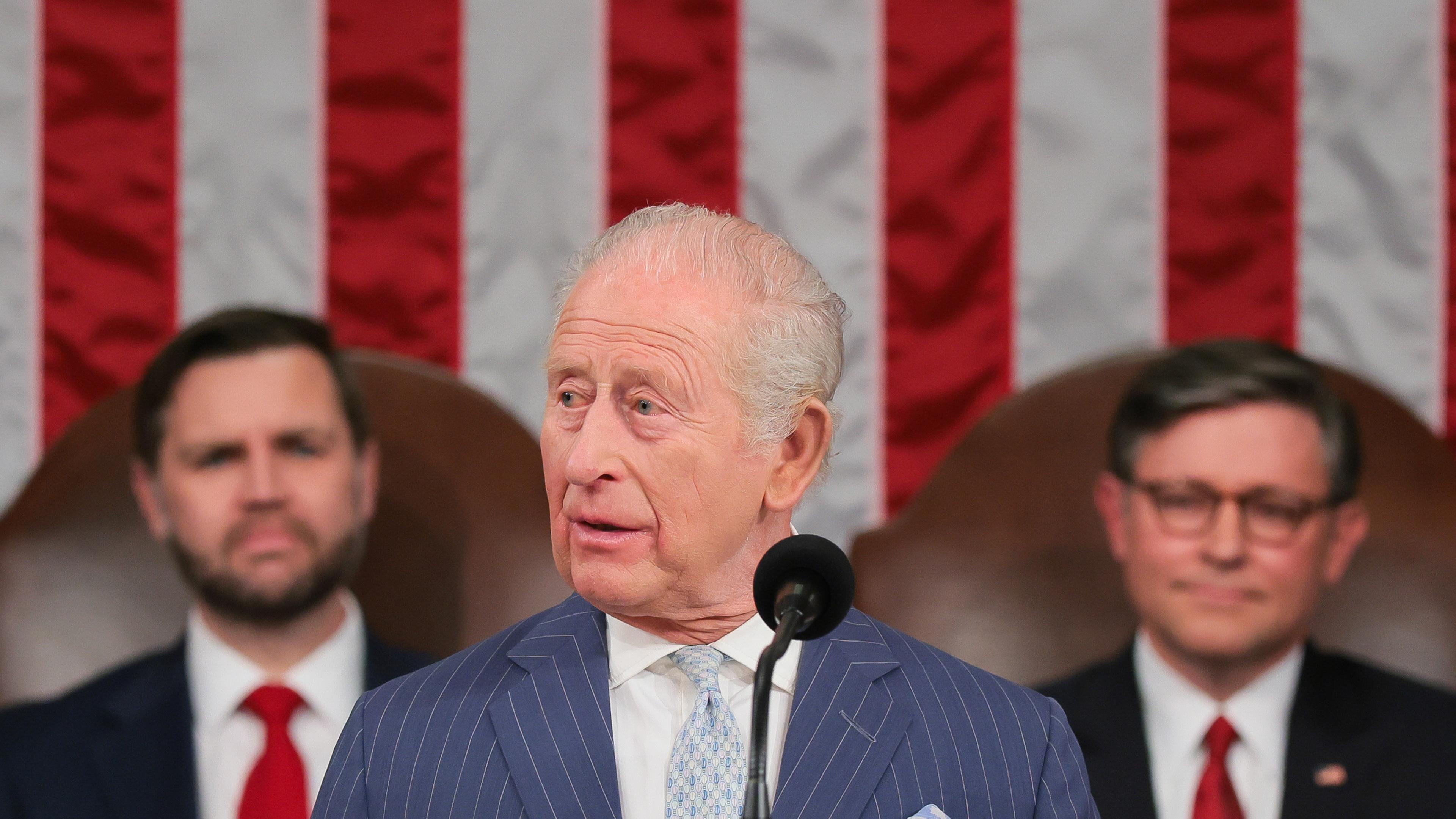
King Charles Hails U.K.-U.S. Bond as ‘More Important Than Ever’ in Historic Congress Address
In a rare and historic moment, King Charles III addressed a joint session of the United States Congress on Tuesday, marking only the second time a British monarch has spoken before the legislative body. The King’s speech, delivered in a pinstripe suit and light blue tie, celebrated the enduring “special relationship” between the U.K. And the U.S. Even as subtly—but unmistakably—diverging from President Donald Trump on critical issues like NATO, executive power, Ukraine, and climate change. His remarks, which drew multiple standing ovations, underscored the alliance’s resilience even as geopolitical tensions test its foundations.
Charles framed his address as a reflection on the 250th anniversary of America’s independence, emphasizing the shared history that predates the Revolutionary War. “I am the nineteenth in our line of Sovereigns to study, with daily attention, the affairs of America,” he noted, tracing the relationship back four centuries. Yet his speech was not merely ceremonial. Against the backdrop of Trump’s recent threats to withdraw the U.S. From NATO and his administration’s rollback of environmental protections, the King’s words carried a pointed message: the transatlantic partnership is “more important today than it has ever been.”
While Charles avoided direct criticism of Trump, his remarks on NATO’s mutual defense obligations, the limits of executive power, and the urgency of climate action were widely interpreted as a diplomatic rebuttal to the U.S. President’s policies. The speech also highlighted the King’s long-standing advocacy for Ukraine and environmental conservation, areas where his priorities align more closely with Congressional Democrats than with the current White House. As the royal couple prepares for a state dinner at the White House later Tuesday—the first formal white-tie event there since Queen Elizabeth II’s visit in 2007—the address served as a reminder of the U.K.’s role as both ally and moral counterweight to U.S. Policy.
A Speech of Reconciliation—and Subtle Rebuke
King Charles opened his address by acknowledging the “bitter divisions” of 250 years ago, framing the U.S.-U.K. Relationship as a story of “reconciliation, renewal, and remarkable partnership.” His words resonated in a Congress deeply divided over foreign policy, particularly regarding NATO and Ukraine. The King’s emphasis on shared values—rooted in English legal traditions like the Magna Carta—drew applause from lawmakers, including Republicans who have clashed with Trump over his expansive employ of executive authority.
Charles’s reference to the Magna Carta, which he noted has been cited in at least 160 U.S. Supreme Court cases since 1789, was a clear nod to the principle of checks and balances. The King described it as “the principle that executive power is subject to checks and balances,” a concept that dates back to 1215, when the Magna Carta was signed in Runnymede, England. His remarks came as Trump has faced criticism for deploying military and Border Patrol agents into U.S. Cities without congressional approval and for bypassing Congress on federal spending—a point Charles did not address directly but one that was unmistakable in its timing.
Senate Majority Leader Chuck Schumer, a Democrat, later called the speech a “reminder” to Trump that “friends and allies matter.” Republican Senator Lindsey Graham, meanwhile, praised the King’s “wit, humor, history, and appreciation,” though he acknowledged the irony of a British monarch unifying a fractured Congress. “It was a bit odd that the unifying feeling had to come from the King of England… but so be it!” Graham wrote on X (formerly Twitter).
NATO: A Defense of Collective Security
One of the most striking moments of the speech came when Charles defended NATO, invoking the alliance’s collective defense clause—Article 5—which has been invoked only once in its history: after the September 11, 2001, terrorist attacks. “Your pain and shock were felt around the whole world,” Charles said. “We answered the call together—as our people have done so for more than a century, shoulder to shoulder.”

The King’s remarks carried added weight given Trump’s recent threats to withdraw the U.S. From NATO amid tensions over the Iran war. In early April 2026, Trump reportedly explored legal options to pull the U.S. Out of the alliance, a move that would have profound implications for global security. Charles’s speech, which included a planned visit to the 9/11 Memorial in Recent York on Wednesday, was a clear reaffirmation of the U.K.’s commitment to NATO’s mutual defense obligations—a commitment that has been a cornerstone of transatlantic security since the alliance’s founding in 1949.
NATO’s Article 5 stipulates that an attack on one member is considered an attack on all, a principle that has deterred conflict in Europe for decades. The U.K. Was among the first NATO members to deploy troops alongside U.S. Forces in Afghanistan following the 9/11 attacks, underscoring the alliance’s role in responding to global threats. Charles’s defense of NATO was not just symbolic; it was a strategic signal to Congress and the White House that the U.K. Views the alliance as indispensable, particularly as Russia’s war in Ukraine continues to destabilize Europe.
Ukraine: A Call for “Unyielding Resolve”
Charles’s support for Ukraine was another area where his priorities diverged from Trump’s. The King, who welcomed Ukrainian President Volodymyr Zelensky to Buckingham Palace in March 2026, used his speech to urge Congress to maintain its support for Ukraine’s defense against Russia’s invasion. Addressing House Speaker Mike Johnson directly, Charles invoked the global response to 9/11: “Today, Mr. Speaker, that same unyielding resolve is needed for the defense of Ukraine and her most courageous people.”
The King’s plea came as Trump and Congressional Republicans have grown increasingly skeptical of continued U.S. Funding for Ukraine. In recent months, Trump has proposed a plan to end the war that critics argue would effectively cede territory to Russia. Charles’s remarks were a diplomatic effort to rally bipartisan support for Ukraine, framing its defense as a moral and strategic imperative akin to the global response to 9/11.
The U.K. Has been one of Ukraine’s strongest supporters since Russia’s full-scale invasion in 2022, providing military aid, training, and diplomatic backing. Charles’s speech reinforced the message that Ukraine’s fight is not just a regional conflict but a test of the West’s commitment to collective security—a message that resonated with many lawmakers, including Republicans who have historically supported strong U.S. Defense alliances.
Climate Change: A Veiled Plea for Action
King Charles, a lifelong environmental advocate, used his platform to issue a veiled but urgent call for climate action. “Our generation must decide how to address the collapse of critical natural systems,” he warned. “We ignore at our peril the fact that these natural systems—in other words, nature’s own economy—provide the foundation for our prosperity and our national security.”
The King’s remarks were widely seen as a response to Trump’s environmental policies, which have included withdrawing the U.S. From the Paris Climate Agreement and rolling back air and water regulations. Trump has also expanded oil drilling on public lands, a move that has drawn criticism from environmental groups and international allies. Charles’s focus on climate change—an issue he has championed for decades—highlighted the growing divide between the U.K. And U.S. On environmental policy.

In a lighter moment earlier in the day, Charles met with a group of tech leaders at Blair House in Washington, D.C., where he discussed AI guardrails and environmental sustainability. Among those present were Amazon founder Jeff Bezos, Apple CEO Tim Cook, NVIDIA CEO Jensen Huang, Google President Ruth Porat, and Salesforce CEO Marc Benioff. During the meeting, Charles and Bezos exchanged stories about the challenges of building transformative companies, with the King comparing Amazon’s early struggles to those of J.K. Rowling, whose *Harry Potter* manuscripts were famously rejected by multiple publishers.
What Happens Next?
King Charles and Queen Camilla’s state visit to the U.S. Continues through the week, with stops in New York City and Virginia. On Wednesday, the King will visit the 9/11 Memorial to pay his respects to the victims of the 2001 attacks, a poignant reminder of the alliance’s shared sacrifices. The royal couple will also attend a state dinner at the White House on Tuesday evening, hosted by President and First Lady Trump—the first formal white-tie event at the White House since Queen Elizabeth II’s visit in 2007.
For Congress, the King’s speech may serve as a catalyst for renewed debate on NATO funding, Ukraine aid, and climate policy. While his remarks were diplomatic in tone, they underscored the growing rift between the U.K. And U.S. On key issues—a rift that could have lasting implications for global security and environmental policy.
As the world watches the U.S.-U.K. Relationship evolve, one thing is clear: King Charles’s address was more than a ceremonial gesture. It was a call to action, a defense of shared values, and a subtle but unmistakable challenge to the Trump administration’s foreign policy priorities.
Key Takeaways
- Historic Address: King Charles III became only the second British monarch to address a joint session of the U.S. Congress, marking the 250th anniversary of America’s independence.
- NATO Defense: The King reaffirmed the U.K.’s commitment to NATO’s mutual defense obligations, a direct contrast to Trump’s threats to withdraw the U.S. From the alliance.
- Checks and Balances: Charles invoked the Magna Carta to emphasize the importance of limiting executive power, a principle that has come under strain during Trump’s presidency.
- Ukraine Support: The King urged Congress to maintain its support for Ukraine, framing its defense as a moral and strategic imperative.
- Climate Urgency: Charles called for global action on climate change, a priority that aligns with the U.K.’s environmental policies but diverges from Trump’s rollback of regulations.
- Diplomatic Tone: While avoiding direct criticism of Trump, the King’s speech was widely interpreted as a diplomatic rebuttal to the president’s foreign policy stances.
What do you think about King Charles’s address to Congress? Share your thoughts in the comments below and join the conversation on social media.
Worth a look
- Europe Air Conditioning Sales Surge Amid Record Summer Heat Waves
- Lapin Police to Conduct Searches for 2006 Missing Men This Summer/Fall: Possible Ongoing Investigations
- Explore America 250: Historic Sites and Landmarks in New York State (archyde.com)
- Rarest Astrological Day: Saturn Stations Retrograde and Lunar Nodes Switch Signs in Historic 24-Hour Window (newsdirectory3.com)