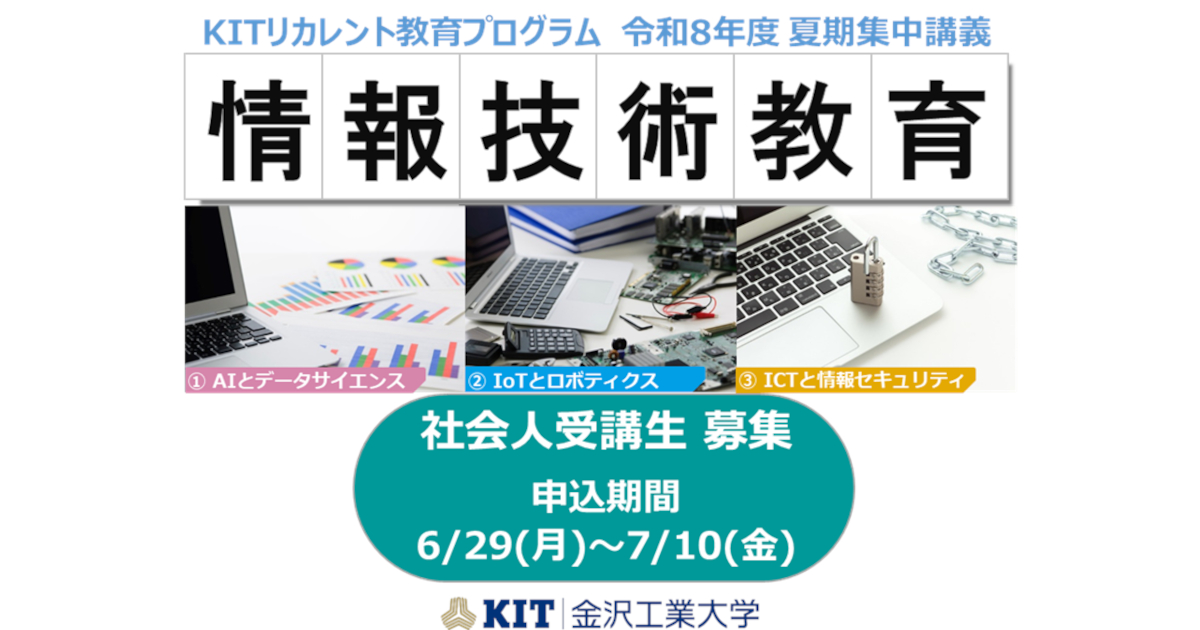
As the global economy undergoes a profound digital transformation, the demand for high-level technical literacy has transcended the traditional university classroom. In Japan, Kanazawa Institute of Technology (KIT) continues to address this skills gap through its specialized KIT Recurrent Education Program, which offers working professionals a structured pathway to master fields such as Artificial Intelligence (AI) and the Internet of Things (IoT). For the upcoming academic cycle, the institution has confirmed that applications for its intensive summer courses will open on June 29, 2026.
This initiative represents a growing trend in higher education: the integration of lifelong learners into degree-granting environments. By allowing working professionals to engage directly with both faculty and full-time students, the program aims to bridge the divide between theoretical academic research and the practical, real-world application of information technology. For those seeking to navigate the complexities of modern digital infrastructure, this program offers a rigorous, hands-on approach to skill acquisition that is increasingly vital in today’s competitive labor market.
Bridging the Skills Gap: Why Recurrent Education Matters
The concept of “recurrent education”—a term popularized in the 1970s—has gained renewed urgency in the mid-2020s. With rapid advancements in machine learning, data analytics, and connected hardware, many professionals find their existing skill sets becoming obsolete at an accelerated rate. According to the World Economic Forum’s Future of Jobs Report, the ability to adapt to new technologies is now a top priority for global employers. Programs like the one offered at KIT are designed to provide the foundational knowledge necessary to pivot or advance within tech-heavy sectors, providing a structured environment that online-only courses often lack.
The KIT curriculum is notable for its emphasis on “co-learning.” By placing professionals in the same physical or virtual space as undergraduate and graduate students, the university fosters an environment where industry experience meets cutting-edge research. This cross-pollination of ideas is intended to accelerate the development of practical solutions, ensuring that the technology studied—whether it be smart-city sensors or generative AI models—has a clear path to deployment in industrial settings.
Program Structure and Summer Intensive Focus
The summer intensive component of the KIT program is designed for maximum impact within a condensed timeframe. Participants can expect to move from foundational theory to practical application, a methodology that aligns with the institution’s long-standing reputation for engineering excellence. For the 2026 summer session, the curriculum will focus heavily on the intersection of AI and IoT, often referred to as AIoT. This field is critical for industries ranging from manufacturing and logistics to healthcare, where the real-time processing of data from connected devices is transforming operational efficiency.
Prospective students should note that the application window, which commences on June 29, 2026, is highly competitive. Applicants are typically required to demonstrate a baseline proficiency in mathematics and logic, though the program is structured to accommodate varying levels of technical background. As outlined by the Ministry of Education, Culture, Sports, Science and Technology (MEXT) in its recent guidelines on lifelong learning, such programs are increasingly supported by national policy to ensure Japan maintains its edge in global innovation.
Key Components of the 2026 Summer Curriculum
- Foundational AI Literacy: Understanding the mechanics of neural networks and data processing.
- IoT Systems Architecture: Learning how to integrate sensors, gateways, and cloud platforms.
- Project-Based Learning: Collaborating with peers to solve a specific industrial or social problem using AIoT.
- Ethics and Policy: Examining the regulatory landscape of emerging technologies, including data privacy and algorithmic bias.
The Economic Impact of Professional Reskilling
From an economic perspective, the investment in human capital through recurrent education is a driver of long-term productivity. When professionals refine their skills, they are not only increasing their own earning potential but also contributing to the overall agility of the national economy. My research into global labor markets suggests that the most resilient economies are those that treat education as a continuous process rather than a singular event completed in one’s early twenties.

For those considering an application, We see essential to look beyond the immediate technical gains. The networking opportunities provided by a university-led program are often as valuable as the coursework itself. Engaging with a faculty of experts and a cohort of ambitious peers provides a unique vantage point on where the industry is heading. As we observe the evolution of the global workforce, the ability to “learn, unlearn, and relearn” will be the defining characteristic of the successful 21st-century leader.
Next Steps for Prospective Applicants
The path forward for those interested in the KIT program involves careful preparation. With the application opening date of June 29, 2026, now on the horizon, candidates should begin reviewing their academic transcripts and professional portfolios. While exact enrollment quotas are determined closer to the date, early preparation is advised. Interested parties should monitor the official Kanazawa Institute of Technology admissions portal for the most recent updates regarding tuition, specific course prerequisites, and the final application deadline.
As this story develops, I will continue to track how these educational models adapt to the changing needs of the global tech sector. If you have questions regarding the application process or want to share your own experience with professional reskilling, please feel free to leave a comment below or share this article with your professional network. Accurate, accessible information is the key to navigating the future of work.
Related reading