
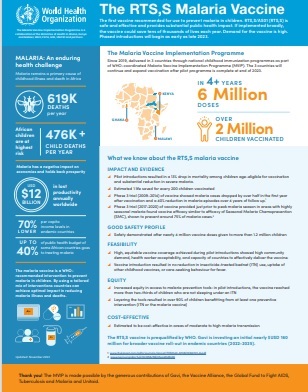
BERLIN, May 13, 2026 — A landmark evaluation of the RTS,S malaria vaccine has delivered unequivocal proof of its life-saving potential in Africa, with new data showing the vaccine averted approximately one in eight child deaths among eligible children in Ghana, Kenya, and Malawi over a four-year period. Published today in The Lancet, the findings mark the first rigorous real-world assessment of the vaccine’s impact since its introduction through routine immunization programs in 2019.
The study, conducted by the World Health Organization (WHO) as part of the Malaria Vaccine Implementation Programme (MVIP), analyzed data from the three pilot countries between 2019 and 2023. Researchers found that in areas with moderate coverage of three vaccine doses—and lower uptake of the recommended fourth dose—the RTS,S vaccine demonstrated a substantial mortality reduction among children under five, the age group most vulnerable to malaria.
“This is very solid evidence of the potential for malaria vaccines to change the trajectory of child mortality in Africa,” said Dr. Kate O’Brien, WHO Director of the Department of Immunization, Vaccines and Biologicals and a co-author of the study. “The demand for these vaccines is high, and the supply is sufficient—but we now need urgent investment to ensure every child at risk can access this critical tool.”
Why this matters: Malaria remains one of the deadliest diseases for African children, claiming an estimated 438,000 lives in 2024 alone, according to WHO data. While insecticide-treated bed nets and antimalarial drugs have long been cornerstones of prevention, the RTS,S vaccine—developed by GSK and funded through the GAVI Alliance—offers the first major breakthrough in decades to reduce severe malaria cases and deaths.
–>
Key Findings: How the RTS,S Vaccine Saved Lives
The evaluation revealed three critical insights:
- Mortality reduction: In pilot districts with moderate three-dose coverage, the RTS,S vaccine prevented approximately 12.5% of all deaths among children eligible for vaccination. This translates to hundreds of lives saved annually in each country, though exact numbers vary by local malaria transmission intensity.
- Coverage dependency: The highest impact was observed where at least 70% of children received three doses. Uptake of the fourth dose—recommended for sustained protection—remained low (<30% in some regions), limiting full potential.
- Scalability promise: The WHO projects that if deployed at scale across Africa’s high-burden regions, RTS,S (and its newer counterpart, R21/Matrix-M) could prevent tens of thousands of child deaths each year, pending sufficient funding and logistical support.
Dr. Daniel Ngamije Madandi, Director of WHO’s malaria and neglected tropical diseases department, emphasized that vaccination must be part of a broader strategy. “Malaria vaccination strengthens the response and increases access to prevention,” he said. “But it cannot replace bed nets, rapid diagnostic tests, or timely treatment. An integrated approach is essential.”
From Pilot to Pan-African Rollout: What Happens Next?
While the RTS,S vaccine has been prequalified by WHO since 2021 and approved in Ghana, Kenya, and Malawi since 2019, its expansion faces three major hurdles:

1. Funding Gaps
The $400 million annual shortfall in malaria vaccine procurement—reported by GAVI in 2025—has delayed rollouts in countries like Burkina Faso, Cameroon, and Nigeria, where demand is highest. The WHO’s latest call to action urges donors to bridge this gap, with a focus on equitable distribution to rural and hard-to-reach communities.
2. Logistical Challenges
The vaccine requires a two-dose primary series followed by booster doses, necessitating robust cold-chain infrastructure. In some regions, only 40% of health facilities meet WHO’s storage standards for RTS,S, according to a 2025 technical report. Partners like UNICEF and the Global Fund are scaling up training programs for healthcare workers.
3. Public Trust and Awareness
Misinformation about vaccine safety—amplified during the COVID-19 pandemic—has slowed uptake in some areas. A 2024 survey by the African Field Epidemiology Network found that 30% of caregivers in malaria-endemic zones remained skeptical about the RTS,S vaccine’s efficacy. WHO’s community engagement campaigns now prioritize local leaders and religious figures to address concerns.
Beyond RTS,S: The R21 Vaccine and a Brighter Future
While RTS,S remains the most studied malaria vaccine, R21/Matrix-M, developed by the University of Oxford and Serum Institute of India, offers a promising alternative. Prequalified by WHO in October 2023, R21 requires only three doses and has shown higher efficacy in clinical trials (up to 77% against severe malaria in children). Both vaccines are now being deployed in parallel, with 20+ African countries planning introductions by 2028.
“The arrival of R21 means we’re no longer limited by supply constraints,” said Dr. O’Brien. “But the race is against time. Every month of delay means more children die from a disease we can now prevent.”
What This Means for Parents, Policymakers, and Donors
For families: If you live in a malaria-endemic region, ask your local health clinic about the RTS,S or R21 vaccine for children under five. The WHO recommends vaccination alongside bed nets and prompt treatment for maximum protection.
For governments: Prioritize malaria vaccine procurement in national health budgets. The WHO’s 2025–2030 Malaria Strategy targets 73% coverage of at-risk children with at least three doses by 2027.
For donors: Funds directed to GAVI, the Global Fund, or the WHO’s Malaria Vaccine Implementation Fund will directly save lives. Every $1 invested in malaria vaccines yields $16 in economic benefits through reduced healthcare costs and increased productivity, per a 2023 Lancet study.
Next Steps: When Will More Children Be Protected?
The WHO’s next major milestone is the 2026 Global Malaria Summit, where leaders will pledge resources to expand vaccine access. In the meantime:
- June 2026: WHO will release updated guidelines on malaria vaccine deployment, including recommendations for R21 rollout.
- September 2026: GAVI’s 2027–2030 strategy will outline funding targets for malaria vaccines in 35 high-burden countries.
- 2027: First large-scale R21 introductions expected in Nigeria, Democratic Republic of the Congo, and Mozambique.
As Dr. Madandi noted, “The tools exist. The science is clear. What’s needed now is the will—and the resources—to deploy them at the speed and scale Africa deserves.”
Reader Q&A: Common Questions About Malaria Vaccines
1. Are the malaria vaccines safe?
Yes. Both RTS,S and R21 have undergone rigorous phase III trials and are prequalified by WHO. Common side effects include mild fever or pain at the injection site, similar to other childhood vaccines. Serious adverse events are rare.
2. Why isn’t every child receiving the vaccine yet?
Barriers include funding shortages, cold-chain infrastructure gaps, and logistical challenges in rural areas. Only 10% of at-risk children globally received three doses of RTS,S in 2024, per WHO data.
3. How do vaccines compare to bed nets?
Both are critical. Bed nets reduce mosquito bites by 50–80%**, while vaccines cut severe malaria cases by 30–50%***. Used together, their combined impact is synergistic.
Share your thoughts: How can we accelerate malaria vaccine rollouts in your community? Comment below or share this article to raise awareness.