
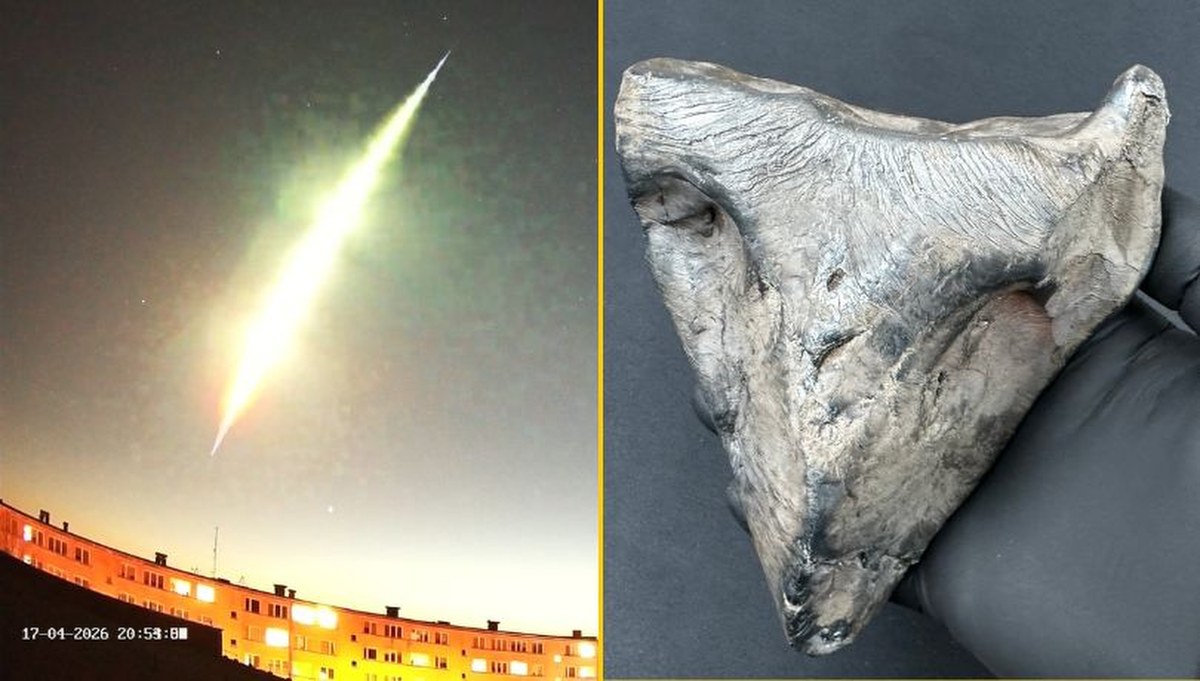
On April 17, 2026, a bright fireball streaked across the night sky over central Poland, drawing attention from observers and automated sky-monitoring systems alike. The event, classified as a bolide — an exceptionally bright meteor — was captured by multiple cameras belonging to the Skytinel bolide network, which operates across Poland and neighboring countries. Witnesses reported seeing a sudden flash of light illuminate the landscape around 8:53 p.m. Local time, particularly over the Greater Poland and Łódź voivodeships.
In the days that followed, researchers and amateur skywatchers from the Skytinel network analyzed video recordings, spectral data, and eyewitness accounts to reconstruct the object’s trajectory. Their calculations pointed to a likely impact zone near the village of Zadzim, located approximately 30 kilometers southwest of Łódź in central Poland. On April 22, after several days of coordinated ground searches using metal detectors, drones, and grid-based search patterns, a team led by local enthusiasts Anna and Paweł Walczak discovered a metallic object buried about 40 centimeters beneath the soil in a small, elliptical depression.
The recovered specimen, weighing 2.9 kilograms, was quickly identified as an iron meteorite — a rare type of space rock composed primarily of iron and nickel. Experts from the University of Warsaw Astronomical Observatory, including Professor Andrzej Udalski, confirmed that the meteorite’s composition, trajectory, and timing matched the bolide observed on April 17. The object is believed to be a fragment of a larger meteoroid that partially disintegrated upon entering Earth’s atmosphere, with this piece surviving the journey to the ground.
Initial classification placed the meteorite within the IIAB chemical group of iron meteorites, based on preliminary analysis of its nickel content and crystalline structure. Such meteorites are thought to originate from the differentiated cores of ancient asteroids that were shattered by collisions early in the solar system’s history. The discovery provides scientists with a tangible sample for studying the formation and evolution of planetary bodies.
On April 25, researchers began specialized laboratory testing to measure short-lived radioactive isotopes within the meteorite, such as manganese-53 and aluminum-26. These isotopes, produced by cosmic ray exposure in space, decay over time and can reveal how long the object was exposed to solar and galactic radiation before reaching Earth. The testing process, expected to grab several weeks, will help determine the meteorite’s cosmic ray exposure age and offer insights into its orbital history prior to impact.
The Skytinel network, which facilitated both the detection and recovery of the meteorite, continues to monitor atmospheric events across Eastern Europe. Its combination of automated cameras, spectrographs, and ground-based observation teams enables rapid response to fireball events, increasing the chances of locating freshly fallen meteorites before they are altered by weather or human activity. This case marks one of the network’s most successful recoveries to date, highlighting the value of coordinated citizen science in planetary science.
As of April 24, 2026, the meteorite remains under temporary curation by the research team while preparations are made for its transfer to a permanent scientific repository. No decision has been publicly announced regarding its final destination, though discussions are ongoing with Polish academic institutions and meteorite collections. Further updates on isotopic analysis results are expected in late May or early June 2026.
For those interested in following developments related to this discovery or similar astronomical events, the Skytinel network provides public updates through its official website and social media channels. Observers are encouraged to report any unusual sky phenomena, as timely reporting significantly improves the likelihood of recovering meteorite fragments.
Have you witnessed a bright meteor or fireball recently? Share your experience in the comments below, and consider reporting it to organizations like Skytinel or the International Meteor Organization to help advance scientific understanding of near-Earth objects.