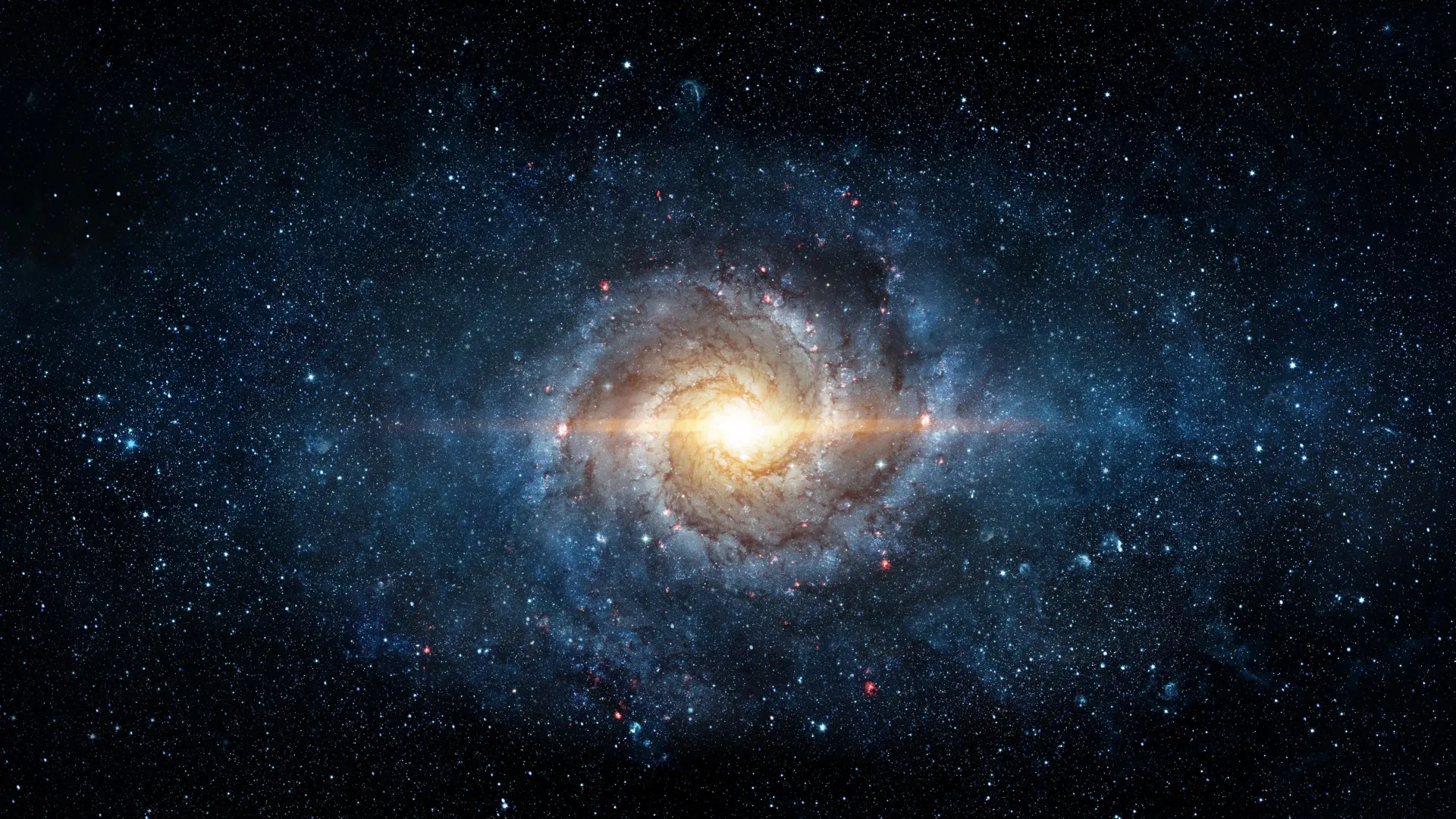
Unveiling the Milky Way‘s Secrets: AI-Powered Simulation Achieves Unprecedented Detail and Speed
(Last Updated: November 16, 2025)
For decades, astrophysicists have dreamed of a detailed, accurate simulation of the Milky Way - a virtual galaxy mirroring the complexity of our own, down to the behavior of every star.That dream is now a reality. A groundbreaking collaboration led by Keiya Hirashima at the RIKEN Center for Interdisciplinary Theoretical and Mathematical Sciences (iTHEMS) in Japan, with partners from The University of tokyo and Universitat de Barcelona in Spain, has created the first Milky Way simulation capable of tracking over 100 billion individual stars across 10,000 years of galactic evolution. This achievement, presented at the international supercomputing conference SC ’25, isn’t just a leap forward for astrophysics; it signals a paradigm shift in how we approach complex scientific modeling, with potential implications for fields like climate science and weather prediction.
Why Simulate the Milky Way - and Why Has It Been So Difficult?
Understanding the formation and evolution of galaxies like our own is fundamental to understanding the universe itself. detailed simulations allow researchers to test theories about galactic structure, star formation, and the distribution of dark matter – all by directly comparing the simulation’s output to real-world observational data.
However, the sheer scale and complexity of the Milky Way have presented insurmountable challenges… until now. Accurately simulating a galaxy requires modeling a multitude of interacting physical processes:
* Gravity: The fundamental force governing the movement of stars and gas.
* Fluid Dynamics: Describing the behavior of interstellar gas, crucial for star formation.
* Chemical Evolution: Tracking the creation and distribution of elements throughout the galaxy.
* Supernova Explosions: Modeling the violent deaths of stars and their impact on the surrounding surroundings.
These calculations must be performed across vast distances and over billions of years.Previous simulations, while valuable, were limited by computational power. They typically represented systems with the equivalent mass of only about one billion suns – a tiny fraction of the Milky Way’s 100+ billion stars. This meant using “particles” that represented groups of stars, averaging out individual stellar behavior and sacrificing accuracy, especially when studying smaller-scale phenomena.
The core problem lies in the necessary timestep – the interval between computational steps. To accurately capture rapid events like supernova explosions, simulations need incredibly small timesteps. Shrinking this timestep, however, dramatically increases computational demands.Estimates suggest that simulating the Milky Way star-by-star using traditional methods would require over 36 years of continuous supercomputer time to model just one billion years of galactic evolution. Simply adding more processing power isn’t a solution; energy consumption skyrockets and efficiency diminishes beyond a certain point.
The Breakthrough: Deep Learning Meets Astrophysical Simulation
Hirashima’s team overcame these limitations by ingeniously integrating deep learning with traditional numerical simulations. Their approach centers around a ”surrogate model” – a deep learning algorithm trained on high-resolution simulations of supernova explosions.
Here’s how it effectively works:
- Supernova training: The AI was fed extensive data from detailed supernova simulations, learning to accurately predict how gas spreads and evolves in the 100,000 years following an explosion.
- surrogate Integration: Rather of recalculating the complex physics of each supernova event within the larger galactic simulation, the AI predicts the outcome, substantially reducing computational load.
- Hybrid Approach: This allows the simulation to capture the overall galactic behavior while still accurately modeling the fine details of individual supernovae and other small-scale events.
The team rigorously validated their method by comparing its results against large-scale runs on Japan’s Fugaku supercomputer and The University of Tokyo’s Miyabi Supercomputer System, confirming its accuracy and reliability.
The Results: Speed and Resolution Beyond Anything Previously achieved
The impact of this hybrid approach is remarkable. The new simulation achieved true individual-star resolution for a galaxy containing over 100 billion stars, and did so with unprecedented speed.
* Traditional Simulation (1 million years): ~315 hours
* AI-powered Simulation (1 million years): Just 2.78 hours!
This translates to simulating 1 billion years of galactic evolution in approximately 115 days – a staggering improvement over the 36 years required by conventional methods. This speed allows researchers to explore a wider range of scenarios and test theories with greater efficiency.
Beyond the Milky Way: A New Era for Computational Science
The implications of this breakthrough extend far beyond astrophysics. The same challenges of linking small-scale physics with large-scale behavior are prevalent in numerous other scientific disciplines.
Fields poised to benefit from this AI-accelerated simulation approach include:
* Climate modeling: Predicting