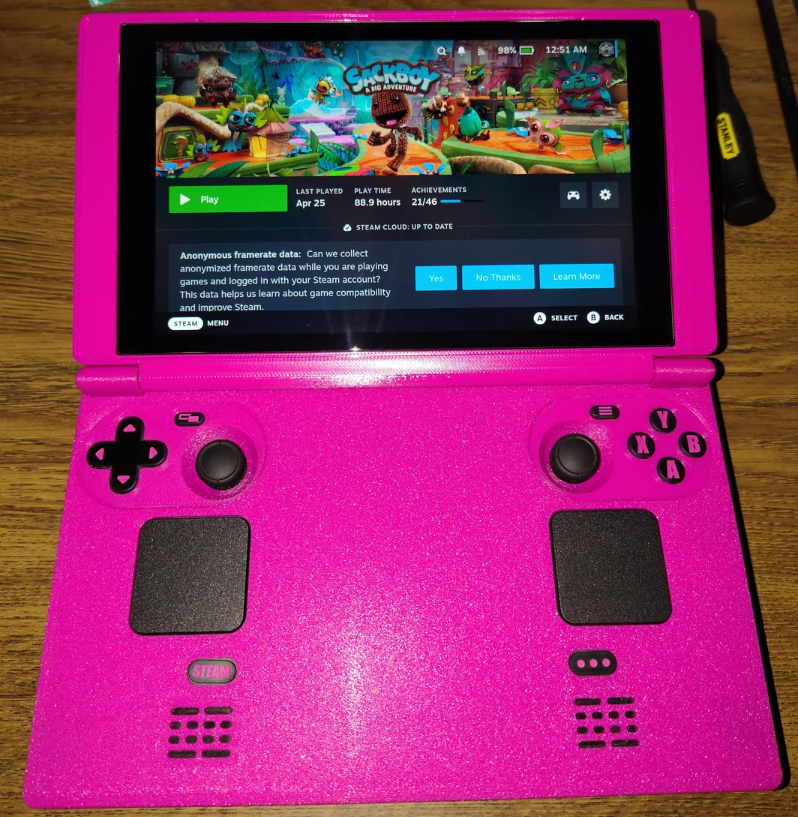
The intersection of nostalgic industrial design and cutting-edge hardware often produces the most fascinating results in the consumer electronics world. For many, the Nintendo DS defined an era of portable gaming, introducing a clamshell form factor that protected the screen and offered a tactile “snap” that felt purposeful. Today, that vintage aesthetic has found a second life in the modern modding community, most notably through a project that transforms Valve’s powerful Steam Deck into a foldable handheld.
Known as the “Flip Deck,” this ambitious modification reimagines the Steam Deck not as a tablet-style handheld, but as a foldable device. The project, shared by a modder operating under the handle MadMario0_0 (also known as Pixel Nerd) on Reddit, represents a significant engineering feat that goes far beyond a simple cosmetic change. It is a full-scale reconfiguration of the device’s internals to fit a 3D-printed clamshell chassis.
As a technology editor with a background in software engineering, I have seen countless “case swaps” in the gaming community. However, the Flip Deck stands out because it maintains the core functionality of the original hardware while fundamentally altering its physical footprint. It is a testament to the openness of the Steam Deck’s architecture and the persistence of the “maker” culture that continues to drive innovation in the gaming space.
This modification is not merely a tribute to the DS; it is a functional exploration of how portable gaming hardware can be adapted to different user preferences. By combining the raw power of a PC-based handheld with the portability and protection of a folding design, the Flip Deck offers a glimpse into an alternative evolution of the handheld market.
The Engineering Behind the Flip Deck
Creating a foldable version of a device designed as a solid slab requires more than just a new plastic shell. The Steam Deck’s internal components are tightly packed to maximize thermal efficiency and battery life. To achieve the “Flip Deck” form factor, the modder had to carefully disassemble an LCD-model Steam Deck and relocate its internals into a custom-designed housing.
One of the most challenging aspects of this build was the input system. The original Steam Deck thumbsticks and face buttons are integrated into the chassis in a way that does not naturally lend itself to a narrower, foldable base. To resolve this, MadMario0_0 developed custom printed circuit boards (PCBs) for the thumbsticks and buttons. This allowed the controls to be repositioned to fit the new dimensions without sacrificing the responsiveness or feel of the original inputs.

According to the creator’s documentation on Reddit, the resulting device is fully functional. This includes the preservation of the ambient light sensor and the back buttons, which are often the first things to be sacrificed in high-level mods. The shell itself is 3D-printed, featuring a striking pink colorway that evokes the playful aesthetic of early 2000s handhelds.
The physical dimensions of the Flip Deck also differ from the stock unit. The modder noted that the device is 4mm smaller and 100mm shorter than the original Steam Deck. While these changes make the device more compact in certain dimensions, the addition of the hinge and the reinforced chassis means it remains a substantial piece of hardware—far larger and heavier than the original Nintendo DS units it seeks to emulate.
Bridging Retro Design and Modern Power
The appeal of the Flip Deck lies in the contrast between its “vintage” appearance and its modern capabilities. The Steam Deck, developed by Valve, is designed to run AAA PC games on the go, utilizing a custom AMD APU. Placing this power inside a clamshell design addresses one of the primary complaints about modern slab-style handhelds: screen vulnerability.
In a standard handheld, the screen is exposed whenever the device is carried. The clamshell design provides an inherent layer of protection, allowing the user to close the device and slip it into a bag without needing a separate bulky carrying case. This “flip” mechanism also provides a psychological boundary between gaming and non-gaming time—a physical “off switch” that is missing from modern tablets and smartphones.
Beyond the hardware, the Flip Deck highlights the versatility of the SteamOS environment. Because the software is based on Linux, it is highly adaptable to different hardware configurations. The modder’s ability to maintain full functionality—from the trackpads to the sensors—demonstrates that the Steam Deck’s internal wiring is robust enough to handle significant spatial reconfiguration.
Valve’s Role in the Modding Ecosystem
The existence of the Flip Deck is a direct result of Valve’s approach to hardware. Unlike many console manufacturers that employ strict “walled garden” policies and anti-tamper mechanisms, Valve has historically embraced the community’s desire to tinker. By creating a device that is relatively accessible to enthusiasts, Valve has fostered an ecosystem where users feel empowered to improve or alter their hardware.
This relationship is symbiotic. While Valve provides the platform, the modding community acts as a decentralized R&D department. Projects like the Flip Deck provide Valve with real-world data on how users interact with the hardware and what form factors might be desirable in future iterations. Whether it is the addition of OLED screens or the exploration of foldable chassis, the community’s creativity often precedes official product roadmaps.
However, such modifications are high-risk. The process of creating custom PCBs and 3D-printing a chassis requires a high level of technical proficiency in both electrical engineering and CAD (Computer-Aided Design). For the average consumer, these modifications void all warranties and carry a significant risk of permanently damaging the device.
The Future of Handheld Customization
The Flip Deck is more than just a curiosity; it is a signal of where the enthusiast market is heading. We are seeing a growing trend of “form-factor hacking,” where users are no longer satisfied with the one-size-fits-all approach of major manufacturers. From adding mechanical keyboard switches to handhelds to creating foldable shells, the goal is total personalization.

As 3D printing technology becomes more accessible and PCB fabrication services become cheaper and faster, we can expect to see more “Frankenstein” consoles. The ability to take a high-performance chipset and house it in a body that fits a user’s specific ergonomic needs is the ultimate goal of the modding community.
For those interested in following the development of such projects, the best resources remain community-driven forums and subreddits where builders share their schematics and lessons learned. While we may not see an official “Steam Deck Flip” from Valve anytime soon, the community has already proven that the concept is not only possible but entirely functional.
The next major milestone for the Steam Deck community will likely be the continued exploration of screen upgrades and battery efficiency mods. As the hardware ages, the focus will shift from changing the shape of the device to extending its lifespan and performance.
Do you think a clamshell design would be a viable official option for future handheld consoles, or is the “slab” design here to stay? Share your thoughts in the comments below.
Keep reading