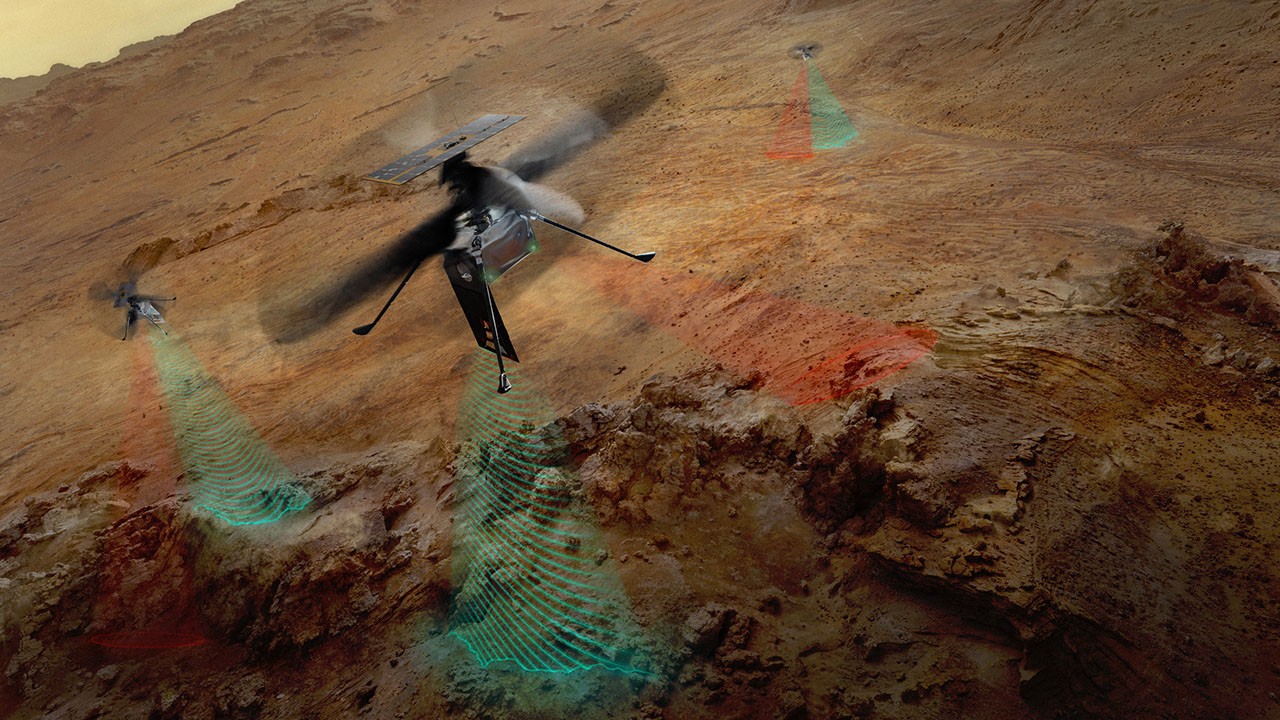
NASA’s upcoming SkyFall Mars mission, slated for a December 2028 launch, will deploy three low-altitude helicopters equipped with specialized, flexible Vivaldi radar antennas designed to detect shallow subsurface water ice down to 16 feet beneath the Martian regolith.
Mars exploration is about to get a lot closer to the ground. NASA’s Jet Propulsion Laboratory is developing the SkyFall mission, an ambitious undertaking that will send a trio of mini rotorcraft to explore the Red Planet. Unlike orbiting spacecraft whose instruments struggle to peer through the uppermost layers of surface material, SkyFall’s helicopters will rely on low-altitude flights and featherweight radar systems to scan the shallow subsurface for accessible water ice.
The mission builds directly on the success of the Ingenuity Mars Helicopter, a technology demonstrator that proved powered flight was possible in the rarefied Martian atmosphere by completing 72 flights over nearly three years. While Ingenuity’s primary goal was proving atmospheric flight, SkyFall is designed to perform science-gathering operations, helping plan rover routes and identifying resources that future human explorers might rely on for drinking water, oxygen, and rocket fuel.
Engineering the Vivaldi Radar Cape for Martian Landings
Detecting water ice hidden just feet below the rocky, dusty surface requires specialized hardware. According to mission scientists, remote detection of shallow subsurface ice can only be accomplished by flying low and slow above the terrain. To achieve this, engineers equipped the helicopters with ground-penetrating radar systems utilizing a type of flexible antenna known as the Vivaldi, a design originally invented in 1978.
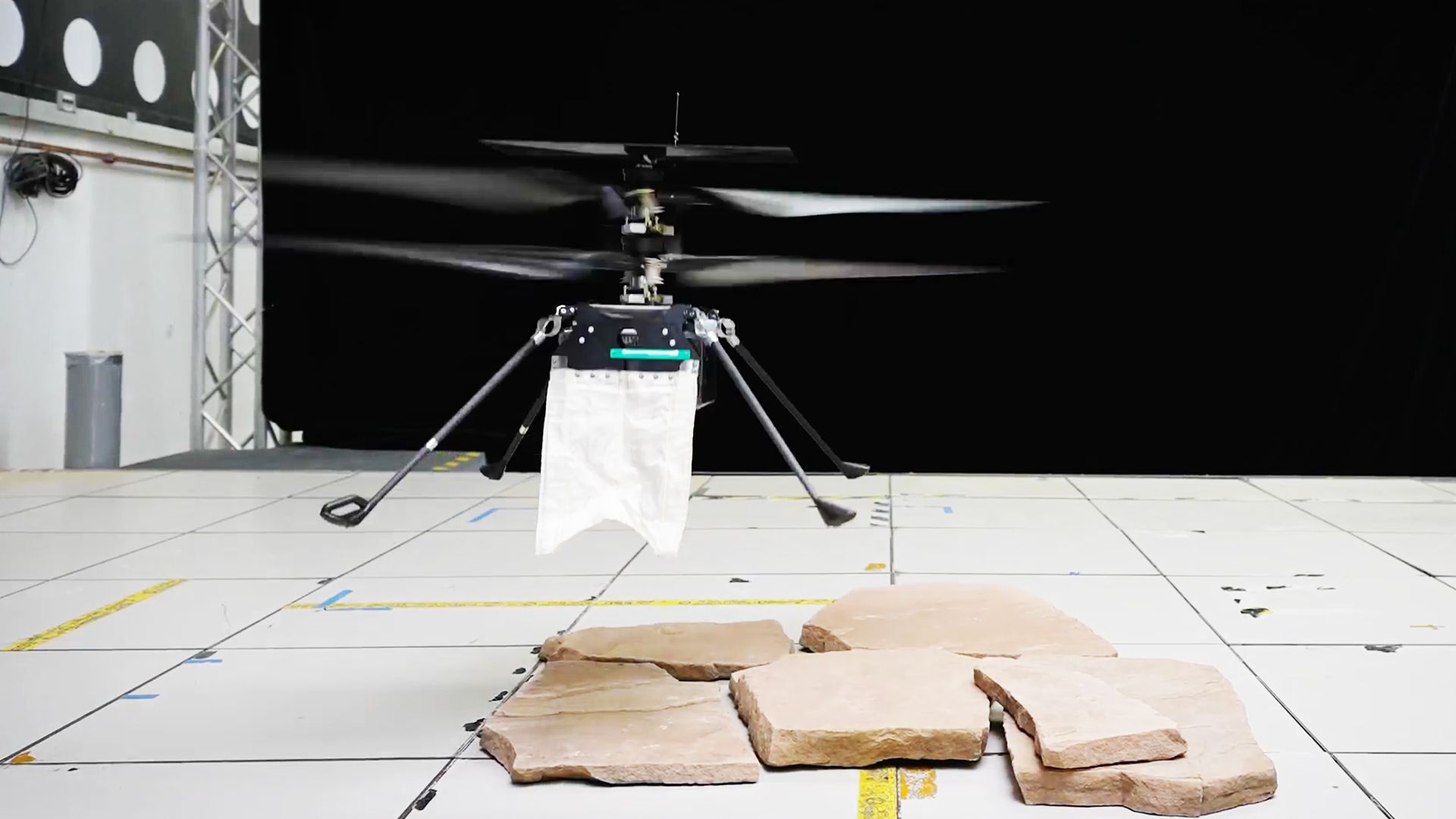
Miniaturizing the radar equipment presented a distinct physical puzzle. Because the SkyFall drones sit a mere 6 inches above the ground when resting on the surface, the radar antenna had to be carefully scaled down without sacrificing sensitivity or functionality. Even after downsizing, the flexible antenna remains roughly one and a half times longer than the helicopter’s legs.
“That means during landing, the Vivaldi has to bend out of the way — and if it lands on a rock, it bends even further. But when the helicopter takes off again, the antenna must spring back into place for data collection. Because SkyFall is expected to make dozens of flights exploring Mars, we needed an antenna that could repeatedly handle those pressures without losing its shape in flight.”
Christine Gebara, SkyFall ground-penetrating radar mechanical lead at JPL
To survive the physical trauma of repeated touchdowns on unpredictable terrain, the development team sheathed the antenna in a layer of polyester followed by layers of Vectran. This ultra-strong, flexible material previously served as the landing airbag cushion for NASA’s Spirit and Opportunity rovers during their 2004 touchdowns. Engineers further reinforced the assembly with flexible fiberglass tape springs and a lightweight magnesium mounting structure, bringing the total weight of each radar cape to a miniscule 5 ounces.
JPL Environmental Testing Simulates Extreme Martian Conditions
Before clearing the hardware for flight, the engineering team subjected the radar capes to punishing trials inside the Environmental Test Laboratory at the Jet Propulsion Laboratory in Southern California. The testing regimen was designed to mimic the harshest realities of the Martian environment, where daily temperatures can fluctuate by up to 170 degrees Fahrenheit.
Engineers bent the antenna repeatedly to simulate post-landing orientations, ran the hardware through dramatic thermal shifts corresponding to the Martian day-night cycle, and paused periodically to verify that signal transmission capabilities remained intact. By the conclusion of the evaluation, the featherweight antenna had successfully endured 200 simulated Mars landings without degradation.
Launch Timeline and AeroVironment Partnership for Late 2028
The SkyFall project is managed by the Jet Propulsion Laboratory for NASA’s Science Mission Directorate in Washington, with the overall Mars Exploration Program operating under Caltech. AeroVironment of Arlington, Virginia, which partnered with JPL to design and build the Ingenuity rotorcraft, is co-designing and co-manufacturing the new fleet of helicopters.
The mission is scheduled to launch in December 2028 aboard NASA, carrying the trio of advanced rotorcraft toward the Red Planet to begin their subsurface surveys.
Keep reading