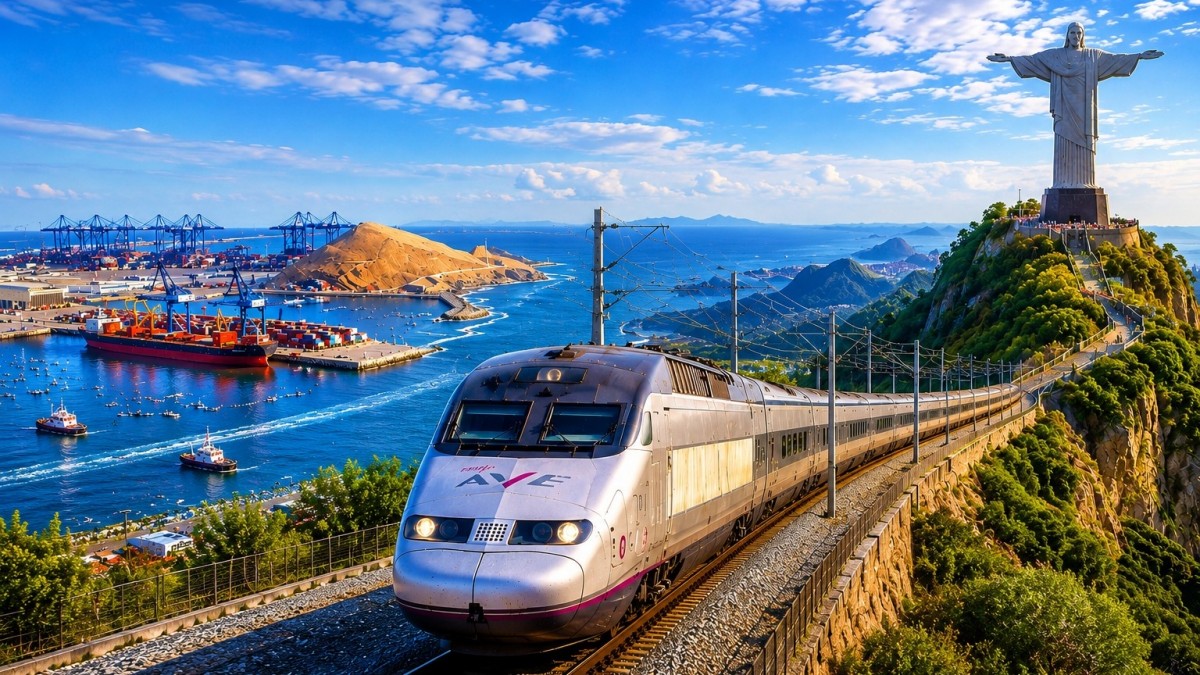
As the global economy recalibrates its supply chains, a massive infrastructure ambition is taking shape across the heart of South America. The proposed bi-oceanic rail corridor, a project spanning approximately 3,750 kilometers, seeks to physically bridge the Atlantic and Pacific oceans, creating a direct logistical artery designed to accelerate trade between South American producers and the burgeoning markets of East Asia.
This initiative, which has been discussed in various iterations for over a decade, aims to connect ports in Brazil with those in Peru, traversing the interior of the continent. While the project is often framed as a transformative step for regional connectivity, it remains a complex endeavor involving significant geopolitical negotiations, engineering challenges across the Andes, and substantial funding requirements. According to reports from the Economic Commission for Latin America and the Caribbean (ECLAC), such transcontinental corridors are essential for reducing transport costs, which currently remain among the highest in the world for agricultural and raw material exports.
The Vision: Linking Two Oceans
The core concept of the bi-oceanic corridor is to streamline the export of commodities—predominantly soy, minerals, and grains—from the Brazilian interior to Asian markets. By bypassing the traditional, longer maritime routes that require navigating through the Panama Canal or around Cape Horn, planners argue that the rail link could significantly reduce transit times. The proposed route generally outlines a path starting in the Atlantic port region of Brazil, moving through Bolivia, and terminating at a Pacific port in Peru.
However, the project is not a single, unified construction contract but rather a series of interconnected national infrastructure developments. As highlighted by the Inter-American Development Bank (IDB), the integration of physical infrastructure in South America requires harmonizing technical standards across borders, a process that is historically sluggish and subject to shifting political priorities in Brasília, La Paz, and Lima.
Strategic Geopolitical Implications
The interest from international partners, particularly China, has been a central narrative in the development of this corridor. Given China’s role as the primary trading partner for many South American nations, the state-backed investment in regional logistics is viewed as a strategic move to secure long-term access to food and energy resources. Analysts from the Council on Foreign Relations have noted that while Chinese investment offers a solution to the continent’s “infrastructure gap,” it also brings concerns regarding debt sustainability and the environmental impact of constructing high-capacity rail lines through sensitive ecological zones, including the Amazon basin and the Andean highlands.

For the countries involved, the project is frequently marketed as a driver of industrialization. By creating a rail-based backbone, the hope is that internal regions, currently isolated from international trade, will see a rise in local manufacturing and processing centers. Yet, critics often point to the high capital expenditure required—often estimated in the billions of dollars—and question whether the projected volume of trade justifies the environmental and financial risks.
Key Challenges and Regional Realities
The path to a fully functional bi-oceanic rail corridor is fraught with logistical hurdles. The geography of the Andes presents one of the most formidable engineering challenges globally, requiring steep gradients and extensive tunneling systems. The political landscape in the region has seen frequent changes in administration, each bringing varying levels of commitment to the project.
According to the World Bank, regional integration in Latin America is often hindered by a lack of consistent regulatory frameworks. For a rail corridor to be effective, there must be seamless customs cooperation, standardized track gauges, and unified safety protocols across four distinct national jurisdictions. As of late 2023 and early 2024, discussions continue at the ministerial level, but no singular, binding treaty has been finalized that encompasses the entire length of the proposed route.
Projected Benefits vs. Implementation Reality
- Transit Efficiency: Reduction in maritime travel distance, theoretically lowering shipping costs for bulk commodities.
- Regional Development: Potential to integrate landlocked regions of Bolivia and the Brazilian interior into the global value chain.
- Trade Diversification: Strengthening the South America-Asia trade axis, specifically targeting the demand for commodities in China and neighboring markets.
- Infrastructure Gap: Addressing the historical under-investment in cross-border rail, which currently favors road and air transport.
What Happens Next?
The future of the bi-oceanic corridor remains a subject of ongoing diplomatic dialogue. Interested parties are currently awaiting the results of updated feasibility studies regarding the environmental impact and the long-term economic viability of the mountain-crossing segments. Future updates will likely stem from the Union of South American Nations (UNASUR) or bilateral summits between the participating nations, where infrastructure financing and environmental compliance are expected to be the primary agenda items.
As this story develops, we will continue to monitor official government filings and regional development reports to provide the most accurate assessment of the project’s progress. We invite our readers to join the conversation in the comments section below—how do you view the balance between regional economic integration and the environmental preservation of the Andes?