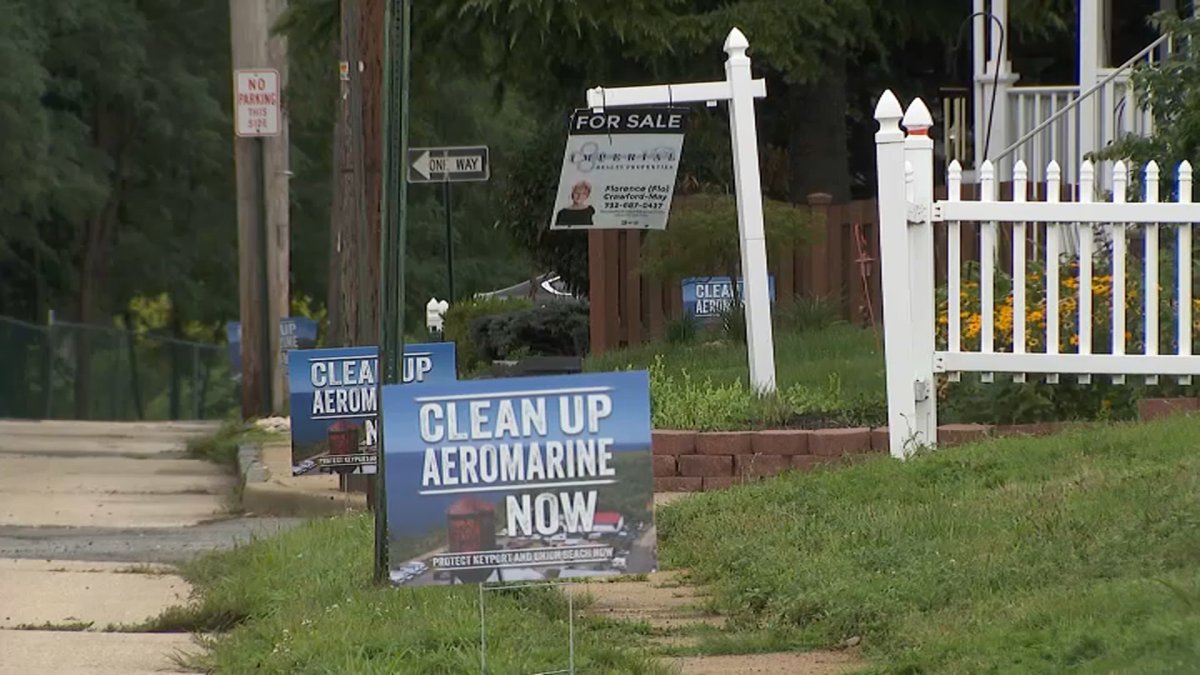
Residents in Keyport and Union Beach, New Jersey, are demanding expanded state environmental testing following the emergence of more than 400 cancer cases within the local community, with dozens of diagnoses concentrated along a single street. Families impacted by the illnesses gathered for a community crisis meeting to address growing fears that toxic runoff from the old Aeromarine landfill site may be contaminating local ground soil and the Raritan Bay.
The gathering opened with a moment of silence and prayer dedicated to individuals in Keyport who have died from cancer or are currently battling the disease. For families living along the Raritan bayshore, the session served as an urgent call to action, pushing state regulators to widen the scope of toxicological testing beyond the immediate boundaries of the property.
“The DEP is telling us that, yeah, it’s contaminated up there still. The levels are high, not acceptable levels. But there’s still no pathway of those chemicals coming down to us,” local resident Sal Liguori said during the meeting.
Liguori’s concerns are rooted in personal tragedy and ongoing health battles. He lost his son to cancer in 2022 and has since been diagnosed with both leukemia and lymphoma.
Historical Contamination Findings at the Aeromarine Site
State testing records indicate that environmental hazards have long been documented at the Aeromarine landfill property. When the site was last officially tested by regulators in 2010, investigators detected known carcinogens, including benzene and polychlorinated biphenyls (PCBs), lingering on the property.
Despite those historical findings, state environmental officials maintain there is currently no verified exposure pathway or evidence proving that hazardous chemicals from the landfill have migrated down into residential neighborhoods. That official stance has done little to ease the anxieties of residents living in the shadow of the industrial site.
“It’s about money. They don’t want to spend money. So they’re going to do everything they can to run away from it,” Liguori said regarding the state’s reluctance to expand testing operations into surrounding neighborhoods.
Local families emphasize that uncertainty surrounding the potential migration of toxins leaves them with more questions than answers. The community’s push for comprehensive testing aims to establish a definitive baseline of soil and water safety for homes situated near the waterfront.
Personal Toll on Families and Young Survivors
The human cost of the suspected cluster extends across generations, touching families who never expected to face severe pediatric and adult illnesses. Lyla Henn, a 16-year-old cancer survivor, shared her experience with the crowd after battling a rare form of bone cancer when she was just 12 years old.
“I’m 16. I shouldn’t be here. I should be doing normal high schooler things, but instead i’m here begging the state to pick up the slack here,” Lyla Henn said.
While Lyla and her mother, Nicole Henn, note that direct causation between the landfill and their health struggles remains unproven, they argue that thorough testing in and around residential properties is the only way to safeguard the community’s future. Comprehensive environmental screening, they contend, would either confirm their fears or provide much-needed peace of mind.
“It makes you think and question and say, ‘What are we doing here?’ Like, let’s get the testing done. Let’s test beyond the footprint of this site and see what happens,” Nicole Henn said.
Next Steps and Independent Testing Timeline
Frustrated by the pace and scope of state-led oversight, local organizers plan to reach out to the office of Mikie Sherrill to demand direct intervention and expanded environmental testing protocols.
In the interim, residents are taking matters into their own hands by commissioning independent analysis. An independent testing expert is scheduled to reveal water and soil sample results at a follow-up community meeting on August 7.
“Listen, I hope I’m wrong. I don’t want to be right. I’m not even saying I’m right, right now, until we actually prove it ourselves like 1000%, but we’re doing enough work to lean toward that direction,” Liguori said ahead of the upcoming disclosures. “I want to be wrong. I want them to come and just test here themselves so they could just see it, if they’re that confident.”
Related reading