
NVIDIA is intensifying its focus on robotics and physical AI, signaling a strategic shift toward enabling intelligent systems that can perceive, reason, and act in the real world. At SIGGRAPH 2024, the company unveiled a series of announcements that underscore this commitment, including new RTX Pro Servers designed for AI-accelerated workloads, expansions to the Nemotron AI model family, and the release of advanced world simulation SDKs and libraries. These developments reflect NVIDIA’s broader vision of building the computational foundation for next-generation autonomous systems, from industrial robots to humanoid agents capable of complex reasoning and interaction.
The pace of innovation in this space, as described by NVIDIA leadership, is “incredible,” driven by converging advances in AI modeling, high-performance computing, and physically accurate simulation. Central to this effort is the Nemotron family of open models, which NVIDIA positions as a key resource for developers building specialized AI agents with reasoning capabilities. Unlike closed models, Nemotron emphasizes transparency, with open weights, training data, and reproducible recipes available on platforms like Hugging Face, enabling the community to inspect, customize, and deploy models across edge, cloud, and data center environments.
Among the highlights from SIGGRAPH was the introduction of RTX Pro Servers, a new line of enterprise-grade systems optimized for AI inference, graphics rendering, and simulation workloads. These servers are built to support demanding applications such as real-time world modeling, digital twin creation, and AI-powered robotics control loops. By integrating NVIDIA’s latest GPU architecture with AI software stacks, the RTX Pro Servers aim to reduce latency and increase throughput for developers creating immersive, interactive environments—critical for training and testing robotic systems in virtual spaces before deployment in the physical world.
Equally significant are the advancements in world simulation technologies, particularly through NVIDIA’s Isaac Sim and Omniverse platforms. At SIGGRAPH, the company showcased updated SDKs and libraries that enhance the realism and scalability of virtual environments used to train AI agents. These tools allow developers to simulate complex physical interactions—such as object manipulation, locomotion, and sensor feedback—with high fidelity, accelerating the sim-to-real transfer process. As noted in NVIDIA’s developer resources, these simulation capabilities are increasingly vital for reducing the cost and risk associated with real-world robotics testing, especially in industrial and healthcare settings.
Nemotron AI Models: Open Foundations for Agentic AI
The Nemotron family, introduced as part of NVIDIA’s broader AI software ecosystem, represents a deliberate move toward open, efficient, and specialized models for agentic workflows. According to NVIDIA’s official developer portal, Nemotron models are designed to excel in tasks requiring reasoning, tool leverage, instruction following, and scientific reasoning—capabilities essential for AI agents operating in dynamic environments. The family includes three primary tiers: Nano, optimized for edge and PC deployments; Super, tailored for single-GPU systems with high throughput; and Ultra, built for multi-GPU data center applications demanding peak reasoning accuracy.
What distinguishes Nemotron from many proprietary models is its commitment to openness. As stated in the GitHub repository for the project, the training data, model weights, and technical reports detailing recreation steps are freely available, allowing developers to verify and build upon the models before production deployment. This transparency supports innovation in areas like retrieval-augmented generation (RAG), multi-agent coordination, and tool calling—functions that enable AI systems to interact with external APIs, databases, and robotic hardware.
Nemotron models are optimized for deployment via NVIDIA NIM (Neural Inference Microservices), which package models as portable, GPU-accelerated services compatible with frameworks like vLLM, SGLang, Ollama, and llama.cpp. This flexibility ensures that developers can run Nemotron models across a wide range of hardware, from Jetson-powered edge devices to HGX-based data center servers, without significant reengineering. The integration with TensorRT-LLM also enables compute efficiency gains through model pruning and quantization, helping lower inference costs although maintaining high accuracy.
Simulation and Synthetic Data: Accelerating Robotics Development
NVIDIA’s investment in world simulation SDKs and libraries addresses a critical bottleneck in robotics development: the necessitate for vast amounts of diverse, labeled training data. By generating synthetic data in physically accurate virtual environments, developers can train AI models on edge cases, rare scenarios, and dangerous conditions that would be impractical or unsafe to replicate in the real world. This approach not only improves model robustness but also reduces reliance on costly real-world data collection and labeling efforts.
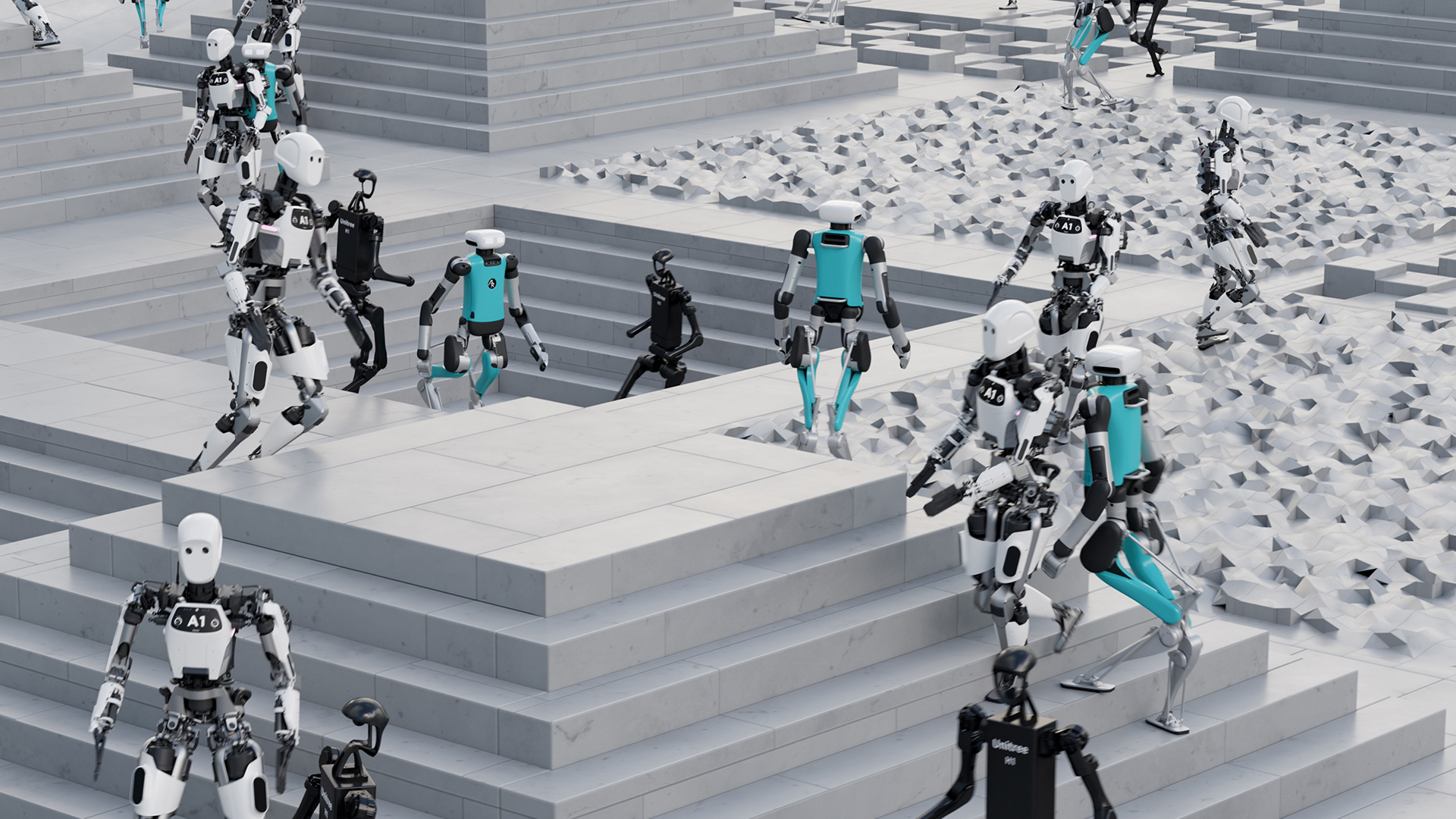
The updated simulation tools showcased at SIGGRAPH include enhancements to Isaac Sim’s sensor simulation, articulation systems, and photorealistic rendering, enabling more faithful replication of real-world physics and sensor noise. These improvements are particularly valuable for training perception and control policies in robots that rely on cameras, lidar, force sensors, and tactile feedback. The integration with Omniverse allows for multi-user, collaborative simulation workflows, where teams can simultaneously design, test, and refine robotic systems in shared virtual spaces.
NVIDIA emphasizes that these simulation capabilities are not limited to industrial robotics but extend to areas such as autonomous vehicles, healthcare robotics, and even humanoid agents designed for domestic or service-oriented tasks. By providing a unified platform for simulation, training, and deployment, NVIDIA aims to create an end-to-end pipeline that shortens the development cycle from concept to real-world operation.
Implications for Developers and Industry
The convergence of open AI models, high-performance infrastructure, and advanced simulation tools positions NVIDIA as a central enabler of the physical AI revolution. For developers, the availability of transparent, efficient models like Nemotron reduces barriers to entry for building sophisticated agentic systems. Enterprises benefit from scalable infrastructure—such as RTX Pro Servers and HGX systems—that can handle the computational demands of training and deploying large-scale AI models in production.
Industries ranging from manufacturing and logistics to healthcare and agriculture stand to gain from these advances. In factories, AI-powered robots equipped with reasoning capabilities can adapt to changing assembly lines, perform quality inspection, and collaborate safely with human workers. In logistics, autonomous mobile robots can navigate dynamic warehouse environments using real-time perception and path planning. In healthcare, simulation-trained agents could assist in patient care, rehabilitation, or hospital logistics, provided they meet stringent safety and reliability standards.
Nonetheless, the deployment of physical AI systems raises important considerations around safety, accountability, and ethical use. As robots gain greater autonomy in decision-making, ensuring predictable behavior and fail-safe mechanisms becomes paramount. NVIDIA has acknowledged these challenges, emphasizing that its tools are designed to support responsible innovation, with built-in support for validation, monitoring, and compliance workflows.
What’s Next for NVIDIA in Robotics and Physical AI
Looking ahead, NVIDIA’s roadmap suggests continued investment in both hardware and software layers of the robotics stack. The company has indicated plans to further expand the Nemotron family with specialized variants for vision, speech, and safety-critical applications. Updates to Isaac Sim and Omniverse are expected to introduce more advanced physics modeling, support for soft-body dynamics, and enhanced integration with ROS (Robot Operating System), the dominant framework in academic and industrial robotics.

Developers interested in exploring these tools can access official documentation, tutorials, and use-case examples through NVIDIA’s Developer website and the Nemotron GitHub repository. These resources include step-by-step guides for training models, deploying them via NIM microservices, and building end-to-end agentic workflows that incorporate tool use, reasoning, and simulation-based validation.
As the line between digital and physical intelligence continues to blur, NVIDIA’s strategy reflects a belief that the future of AI lies not just in generating text or images, but in enabling machines to understand and interact with the world in meaningful ways. With its focus on open models, efficient computation, and realistic simulation, the company is working to provide the foundational tools needed to turn that vision into reality.
For ongoing updates on NVIDIA’s robotics and AI initiatives, readers can follow the company’s official blog and developer newsroom. Share your thoughts on how physical AI is shaping the future of technology in the comments below.