
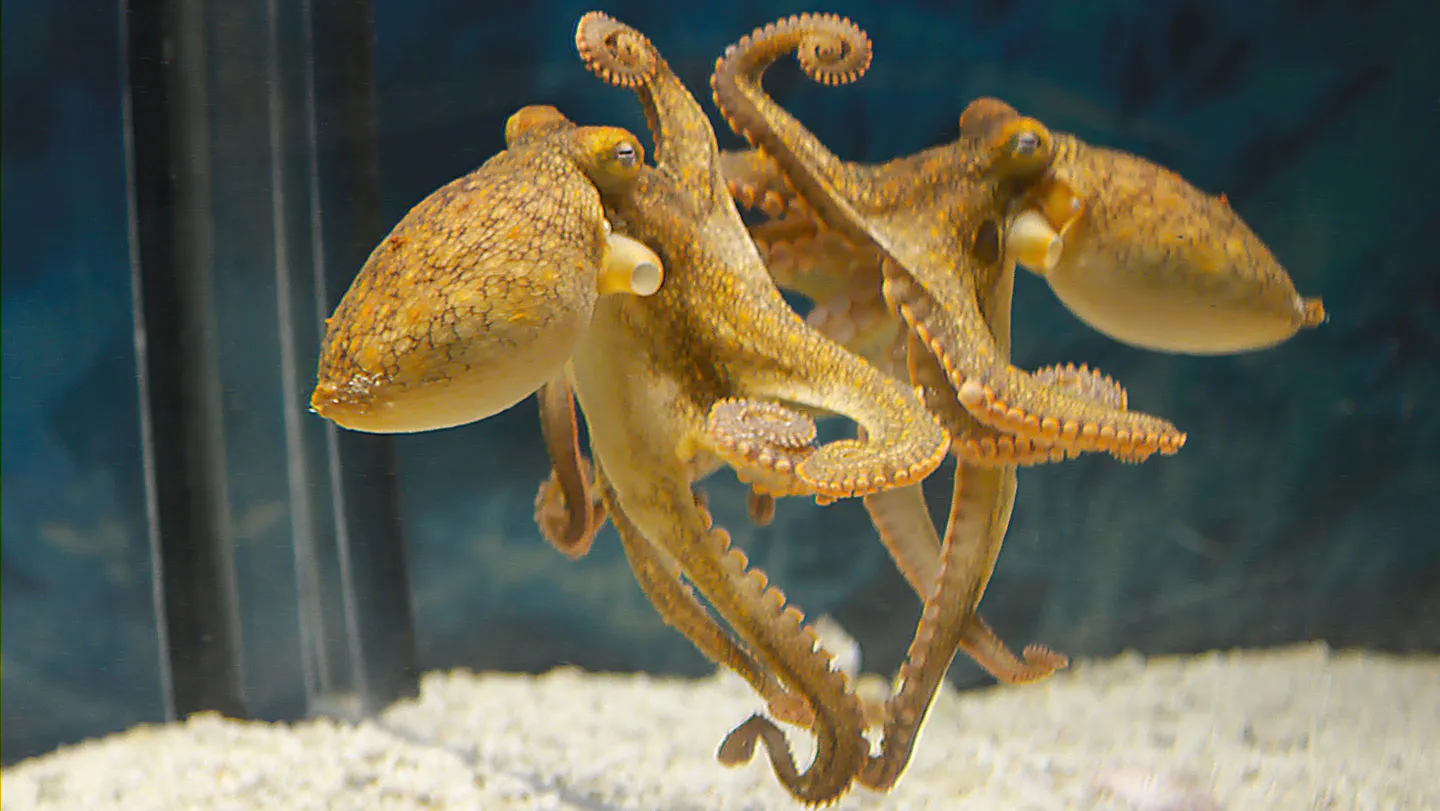
Octopuses possess the cognitive ability to locate prey using only its reflection, a finding that provides new insight into the complex spatial awareness of cephalopods. Researchers have demonstrated that these marine invertebrates can successfully navigate toward a target even when the object is hidden behind an opaque barrier, provided its image is visible in a mirror. This behavior suggests a sophisticated level of mental representation previously under-studied in non-human, non-primate species.
The study, published in the journal Ethology, details how common octopuses (Octopus vulgaris) utilized mirror reflections to track and capture crabs. According to the peer-reviewed research, the octopuses did not simply react to the movement of the reflection; they demonstrated an understanding of the spatial relationship between the reflected image and the physical location of the prey. This indicates that the animals can integrate visual information from a mirror to inform their predatory decision-making.
Understanding Cephalopod Spatial Cognition
To test the animals’ cognitive processing, researchers set up an experimental tank where a crab was placed behind a screen, making it invisible to the octopus. A mirror was then positioned to reflect the crab’s movement. The octopuses consistently moved toward the location of the actual crab rather than the mirror itself. This distinction is significant, as it suggests the animals are not merely chasing a visual stimulus but are calculating the trajectory required to reach the physical object.
This capability is often associated with higher-order cognitive functions, such as perspective-taking or mental mapping. In standard biological testing, such as the mirror self-recognition test—a common metric for self-awareness—most animals fail to recognize their own reflection. However, the performance of the octopus in this spatial task highlights that their visual processing systems are highly adapted for complex environments. The findings are documented in the study titled “Mirror-image-based spatial navigation in the common octopus”, which confirms that the octopuses could distinguish between the reflection and the real-world object while maintaining focus on the target.
The Evolution of Marine Intelligence
The intelligence of octopuses has long been a subject of interest in marine biology, particularly due to their unique nervous system architecture. Unlike vertebrates, where the majority of neurons are concentrated in the brain, a significant portion of an octopus’s nervous system is distributed throughout its arms. This decentralized structure allows for rapid, independent sensory processing.
According to the Oxford Academic Journal of BioScience, the evolutionary pressure to survive in complex reef environments has likely driven the development of these advanced problem-solving skills. By utilizing reflected light, these animals demonstrate a capacity for “spatial inference”—the ability to infer the location of an object that is not directly in their line of sight. This behavior is essential for hunting in the crevices of rocky reefs, where direct sightlines are often obstructed by coral or sediment.
Broader Implications for Comparative Psychology
The ability to use a mirror to locate prey is a rare trait in the animal kingdom. While primates and certain bird species, such as magpies, have shown advanced mirror-related behaviors, the inclusion of cephalopods in this category challenges existing models of cognitive evolution. The researchers note that the octopus’s reliance on visual cues is particularly notable given that they are colorblind, yet they remain highly sensitive to contrast and movement.

Further research is required to determine whether this behavior extends to self-recognition or if it remains purely functional for predatory success. The Nature Portfolio provides extensive context on the ongoing study of cephalopod nervous systems, noting that their rapid adaptation to experimental environments makes them unique subjects for studying the evolution of intelligence. Scientists are currently planning subsequent trials to observe whether octopuses can generalize this mirror-based navigation to more complex, multi-step obstacle courses.
Future Research and Observations
The next phase of investigation will focus on whether octopuses can learn to use mirror reflections to identify potential threats or navigate unfamiliar territory, rather than just hunting for food. These studies are expected to provide more data on the limits of cephalopod spatial memory and their ability to update their mental maps in real-time. As with all ongoing behavioral studies, updates will be provided by the research team as new experimental phases conclude.
Readers interested in the latest developments in marine biology and animal cognition can follow official updates from the Association for the Study of Animal Behaviour. We invite our readers to share their thoughts on these findings in the comments section below or join the discussion on our social media channels.