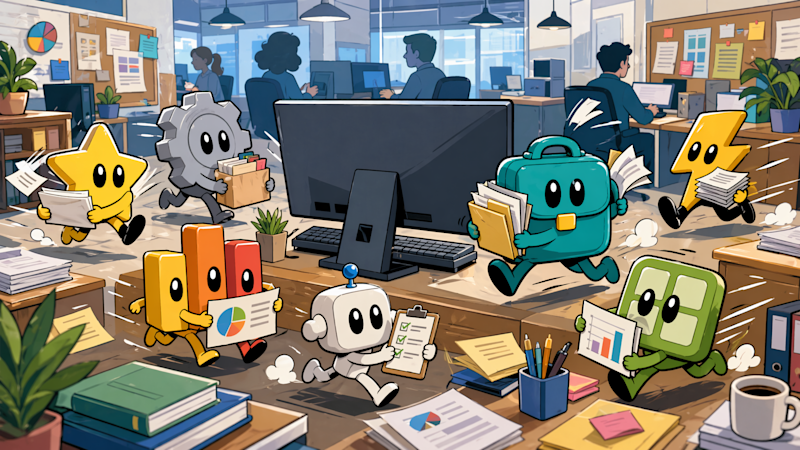
OpenAI has unveiled Workspace Agents, a new feature designed to transform how businesses use artificial intelligence in daily operations. The tool builds on the company’s earlier custom GPTs but shifts toward persistent, multi-step AI workers that can operate across platforms like Slack, Salesforce and Google Drive without constant user input. Announced in April 2026, the feature is positioned as a step toward AI systems that function more like digital coworkers than simple chatbots.
Workspace Agents are available to customers on ChatGPT Business, Enterprise, Education, and Teacher plans. They can be created from scratch or selected from templates and then deployed into third-party applications where work already happens. Unlike earlier versions that required users to stay in the chat loop, these agents can run in the cloud, follow schedules, and retain memory across tasks. This allows them to handle recurring workflows such as generating weekly reports, summarizing meeting notes, or updating customer records without manual triggers.
The underlying technology powering Workspace Agents is Codex, OpenAI’s cloud-based coding environment. Codex enables the agents to write and execute code, interact with files and databases, and maintain context over extended periods. This marks a shift from pure language model responses to systems capable of performing tangible actions — such as reconciling spreadsheets, generating charts, or filing support tickets — based on defined business processes.
According to OpenAI, the agents are designed with enterprise governance in mind. Administrators can control who can build, publish, or run agents, and set limits on which external tools they can access. Actions like sending emails or modifying documents default to requiring human approval, though this can be adjusted. The system also distinguishes between user-based authentication — where the agent acts with the permissions of the individual invoking it — and service-account mode, which uses a shared credential but carries higher data exposure risks if misconfigured.
Early adopters named by OpenAI include HR technology firm Rippling, financial services provider Better Mortgage, bank BBVA, and HR platform Hibob. Ankur Bhatt, who leads AI engineering at Rippling, said in the announcement that a sales consultant was able to build a functional agent without engineering support. The agent automatically researches accounts, summarizes call transcripts from Gong, and posts summaries into Slack — a task that previously took representatives five to six hours per week.
Workspace Agents will be available at no additional cost for the first two weeks following launch, after which usage will be billed based on computational credits. OpenAI indicated that future updates will include more automation triggers, improved dashboards for tracking usage, and deeper integration with its developer tools such as AgentKit and Frontier — platforms introduced in late 2025 and early 2026 to support enterprise AI management.
The launch comes amid growing competition in the enterprise AI space. Microsoft offers Copilot Studio within its Microsoft 365 suite, Google promotes Agentspace through its cloud division, and Salesforce has restructured around its Agentforce platform. Anthropic also introduced Claude Managed Agents as a competing offering. Despite the crowded field, OpenAI positions Workspace Agents as a natural evolution for its existing business customers, many of whom were previously directed to adopt custom GPTs.
The company frames this shift as part of a broader move toward AI systems that operate continuously within organizational workflows rather than waiting for prompts. By enabling agents to act where work occurs — inside communication tools, CRM systems, or document repositories — OpenAI aims to reduce friction in cross-tool processes that have long slowed down teams.
For organizations interested in testing the feature, OpenAI provides setup guidance through its official facilitate center and an educational module on its website. The company notes that while individual users may continue using legacy custom GPTs for the foreseeable future, business and education customers will eventually need to migrate their existing tools to the Workspace Agents framework to remain supported.
As of this writing, Workspace Agents are enabled by default in qualifying workspaces, though administrators can disable them pending review. Organizations using Enterprise Key Management (EKM) for data encryption currently do not have access to the feature, a limitation OpenAI says it is working to address.
Those looking to stay updated on future developments can monitor OpenAI’s official blog and enterprise-focused announcements, where the company typically shares roadmap updates and security advisories related to its AI products.
What do you think about the rise of AI agents in the workplace? Share your thoughts in the comments below, and feel free to pass this along to colleagues exploring how automation might fit into their team’s workflow.