Magnetic Muscles & Folded Futures: How Origami Robots are Revolutionizing Medicine & Beyond
Raleigh,NC – A groundbreaking new approach to soft robotics,combining the ancient art of origami with cutting-edge magnetic materials,is poised to transform fields ranging from targeted drug delivery to space exploration. Researchers at North Carolina State University have developed a technique to embed powerful, yet incredibly thin, magnetic ”muscles” directly into origami-inspired robots, enabling precise, controlled movement without compromising the structures’ inherent flexibility and efficiency.This innovation promises less invasive medical procedures, adaptable robots for challenging environments, and a new era of possibilities for miniature robotics.
The Challenge of Movement in Soft Robotics
Soft robots, constructed from flexible materials like elastomers, offer critically important advantages over traditional rigid robots – they’re safer for interaction with humans, can navigate confined spaces, and adapt to complex terrains. however, powering and controlling their movement has been a persistent challenge. Traditional methods often rely on bulky, external magnets or complex internal mechanisms, limiting their practicality and effectiveness.
“The key was finding a way to integrate actuation – the ability to create movement – within the soft robot itself, without adding significant weight or hindering its natural folding and unfolding capabilities,” explains Xiaomeng Fang, Assistant Professor in the Wilson College of Textiles and led author of the research published in Advanced Functional Materials.
A Breakthrough in Magnetic Actuation: printing the Power Within
Fang and her team have overcome this hurdle by developing a novel method for creating soft magnetic actuators. Instead of attaching rigid magnets to the robot’s surface, they’ve pioneered a technique to print a thin film embedded with a high concentration of ferromagnetic particles directly onto the origami structure.
“traditionally, you’d see researchers using refrigerator magnets on the surface of a soft robot,” Fang clarifies. “Our approach allows us to integrate the magnetic functionality seamlessly, minimizing the impact on the robot’s overall form and maximizing its maneuverability.”
This breakthrough was achieved by addressing a critical limitation in previous attempts to utilize ferromagnetic particles. Increasing the particle concentration to generate sufficient magnetic force typically resulted in a dark, opaque rubber that blocked the UV light necessary for solidification. The team ingeniously solved this problem by adding a heated plate beneath the printing surface, supplementing the UV curing process with thermal energy.
“Adding the hot plate allowed us to dramatically increase the concentration of ferromagnetic particles,unlocking a significantly higher level of magnetic force,” Fang states.”This was the real turning point.”
Targeted Drug Delivery: A New hope for Ulcer Treatment
The potential applications of this technology are vast, but the team’s initial focus has been on biomedical applications. they designed a prototype robot utilizing the renowned Miura-Ori origami pattern – a design known for its ability to fold a large surface area into a compact form. This pattern is ideally suited for delivering medication to hard-to-reach areas within the body.
“The Miura-Ori design allows the robot to be ingested as a small, easily swallowed object,” Fang explains. “once inside the body, it can unfold to its full size, maximizing its surface area for drug delivery.”
In laboratory tests simulating the human stomach, the origami robot successfully navigated to a mock ulcer site, deployed its unfolded structure, and released a controlled dose of medication. The robot was guided and secured in place using external magnetic fields,offering a safe,non-invasive option to traditional treatments. this approach promises to minimize side effects and allow patients to maintain their daily routines during treatment.
Beyond Medicine: A Crawling Robot for Diverse Terrains
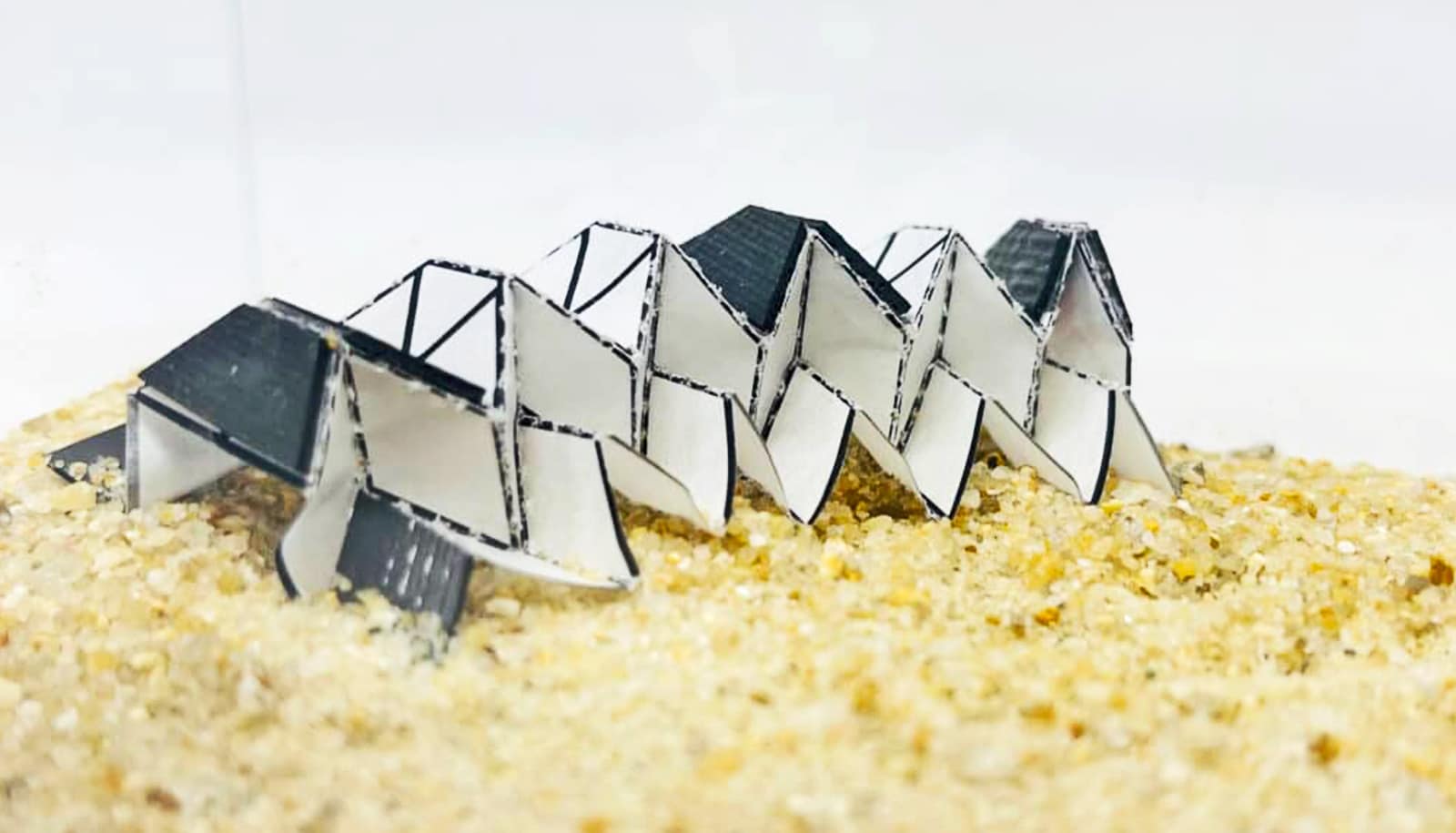
The versatility of the magnetic origami robots extends beyond drug delivery. Researchers also created a second robot, again based on a Miura-Ori pattern, designed for crawling locomotion. By strategically placing magnetic “muscles,” they were able to create a stepping motion.Contraction of the muscles lifts the front of the robot while drawing in the rear, creating a forward “step” when the magnetic field is released.
This crawling robot demonstrated impressive capabilities,successfully navigating obstacles up to 7 millimeters high and adapting to various terrains,including sand. The speed and agility of the robot are easily adjustable by controlling the strength and frequency of the applied magnetic field.
The Future is Folded: Expanding the Horizons of Origami Robotics
The success of these two prototypes underscores the immense potential of combining soft magnetic actuators with origami structures. Fang envisions a future where these robots are deployed in a wide range of applications.
“There are countless origami designs we can leverage, and these magnetic muscles can definitely help solve problems in fields as diverse as biomedicine, space exploration, and even search and rescue operations,” Fang concludes. “We’