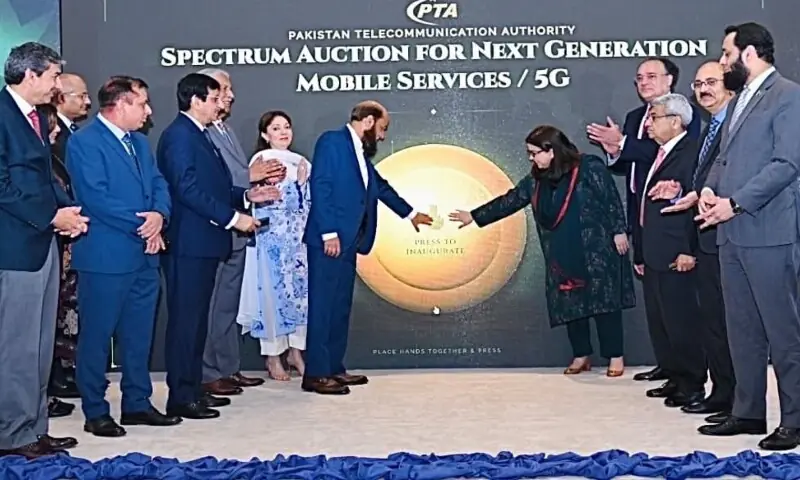
Islamabad, Pakistan – Pakistan’s government has concluded a landmark 5G spectrum auction, raising $507 million from the sale of 480 megahertz of spectrum. The auction, finalized Tuesday in Islamabad, saw fierce competition among the country’s three major telecommunications companies – Jazz, Ufone, and Zong – as they vie for position in the emerging 5G market. This sale represents a significant step towards expanding digital connectivity across Pakistan, a nation of over 240 million people, and is expected to fuel innovation in areas ranging from artificial intelligence to remote education.
The successful auction comes at a crucial time for Pakistan’s economy, which is currently navigating a period of austerity measures and seeking to leverage digital technologies for growth. Finance Minister Muhammad Aurangzeb emphasized the government’s commitment to fostering a digital ecosystem, stating that “faster, cheaper, better” connectivity is not merely a technological goal, but a fundamental driver of economic opportunity and job creation. The funds generated from the auction will contribute to the national treasury and support ongoing economic stabilization efforts.
The auction process involved offering spectrum in several key frequency bands, including 700 MHz, 1800 MHz, 2100 MHz, 2300 MHz, 2600 MHz, and 3500 MHz. Jazz emerged as the largest purchaser of spectrum, acquiring a total of 190 MHz, followed by Ufone with 180 MHz and Zong with 110 MHz. Specifically, Jazz secured 20 MHz in the 700 MHz band, 50 MHz in the 2300 MHz band, 70 MHz in the 2600 MHz band, and 50 MHz in the 3500 MHz band. Ufone purchased 60 MHz in the 2600 MHz band and 120 MHz in the 3500 MHz band, while Zong obtained 60 MHz in the 2600 MHz band and 50 MHz in the 3500 MHz band. All three companies were required to acquire at least 100 MHz of spectrum to participate.
Expanding Connectivity and the Promise of 5G
The introduction of 5G technology promises significantly faster data speeds, lower latency, and increased network capacity compared to existing 4G networks. This will unlock a range of new possibilities for consumers and businesses alike. For consumers, 5G will enable seamless streaming of high-definition video, immersive gaming experiences, and faster download speeds. For businesses, 5G will facilitate the adoption of technologies such as the Internet of Things (IoT), artificial intelligence (AI), and cloud computing, leading to increased efficiency and innovation.
Amir Ibrahim, CEO of Jazz, announced that the company plans to launch 5G test trials on 180 towers starting Wednesday, with a particular focus on expanding services to rural and sparsely populated areas. This commitment to rural connectivity is crucial, as a significant portion of Pakistan’s population still lacks access to reliable internet services. The government also aims to improve 4G connectivity nationwide alongside the rollout of 5G, recognizing the importance of providing affordable and accessible internet access to all citizens.
Spectrum Allocation and the Role of the PTA
The auction was overseen by the Pakistan Telecommunication Authority (PTA), the country’s regulatory body for the telecommunications sector. The PTA offered 190 MHz of spectrum in lots of 10 MHz each, but demand from bidders exceeded supply, leading to the release of an additional 110 MHz. The PTA also increased the bid price for the 2600 MHz band by five percent of its base price to maximize revenue. The process involved multiple rounds of bidding, with companies strategically vying for the most valuable spectrum assets.
The allocation of spectrum is a critical component of developing a robust telecommunications infrastructure. Spectrum is a finite resource, and its efficient allocation is essential for maximizing its economic and social benefits. The PTA’s role in ensuring a fair and transparent auction process is vital for attracting investment and promoting competition in the telecommunications market. According to the PTA, the auction process was designed to benefit all stakeholders and ensure that the spectrum is used in a way that maximizes its value to the Pakistani people.
Addressing Connectivity Gaps and Future Investments
IT Minister Shaza Fatima Khawaja highlighted the historical challenges Pakistan has faced in terms of spectrum availability, noting that the country has been operating on 274 MHz of spectrum since 1997. In comparison, Bangladesh, with a population two-thirds the size of Pakistan’s, has 600 MHz of available spectrum. The successful auction is expected to double Pakistan’s spectrum availability, significantly improving connectivity and paving the way for future technological advancements. Khawaja stated that improvements in 4G services are expected within four to five months, with 5G services being rolled out in the five major cities within five to six months.
Beyond the 5G spectrum auction, the Pakistani government is pursuing several other initiatives to enhance digital connectivity. These include investing in satellite-based internet to provide coverage in remote areas, linking Pakistan with international cable systems to become an internet transit country, and expanding fiber optic networks nationwide. The government has also abolished right-of-way charges to encourage the deployment of fiber infrastructure, becoming the first country in Asia to do so. These efforts demonstrate a comprehensive approach to bridging the digital divide and ensuring that all Pakistanis have access to the benefits of the digital economy.
Key Takeaways
- $507 Million Raised: The 5G spectrum auction generated $507 million for the Pakistani government.
- Jazz Leads in Spectrum Acquisition: Jazz acquired the most spectrum, totaling 190 MHz.
- Improved Connectivity Expected: 4G services are expected to improve within months, with 5G rollout planned for major cities.
- Increased Spectrum Availability: Pakistan’s spectrum availability will double as a result of the auction.
- Government Commitment to Digitalization: The government is investing in multiple initiatives to expand digital connectivity nationwide.
Looking ahead, the successful completion of the 5G spectrum auction marks a pivotal moment for Pakistan’s digital transformation. The increased spectrum availability and the planned rollout of 5G services are expected to drive economic growth, create new opportunities, and improve the quality of life for millions of Pakistanis. The government’s commitment to fostering a digital ecosystem, coupled with the investments made by telecommunications companies, positions Pakistan to become a key player in the global digital economy. The next key milestone will be the commencement of 5G test trials by Jazz and the subsequent launch of commercial 5G services in major cities.
What are your thoughts on Pakistan’s 5G rollout? Share your comments below and let us know how you think this will impact the country’s future. Don’t forget to share this article with your network!
Worth a look