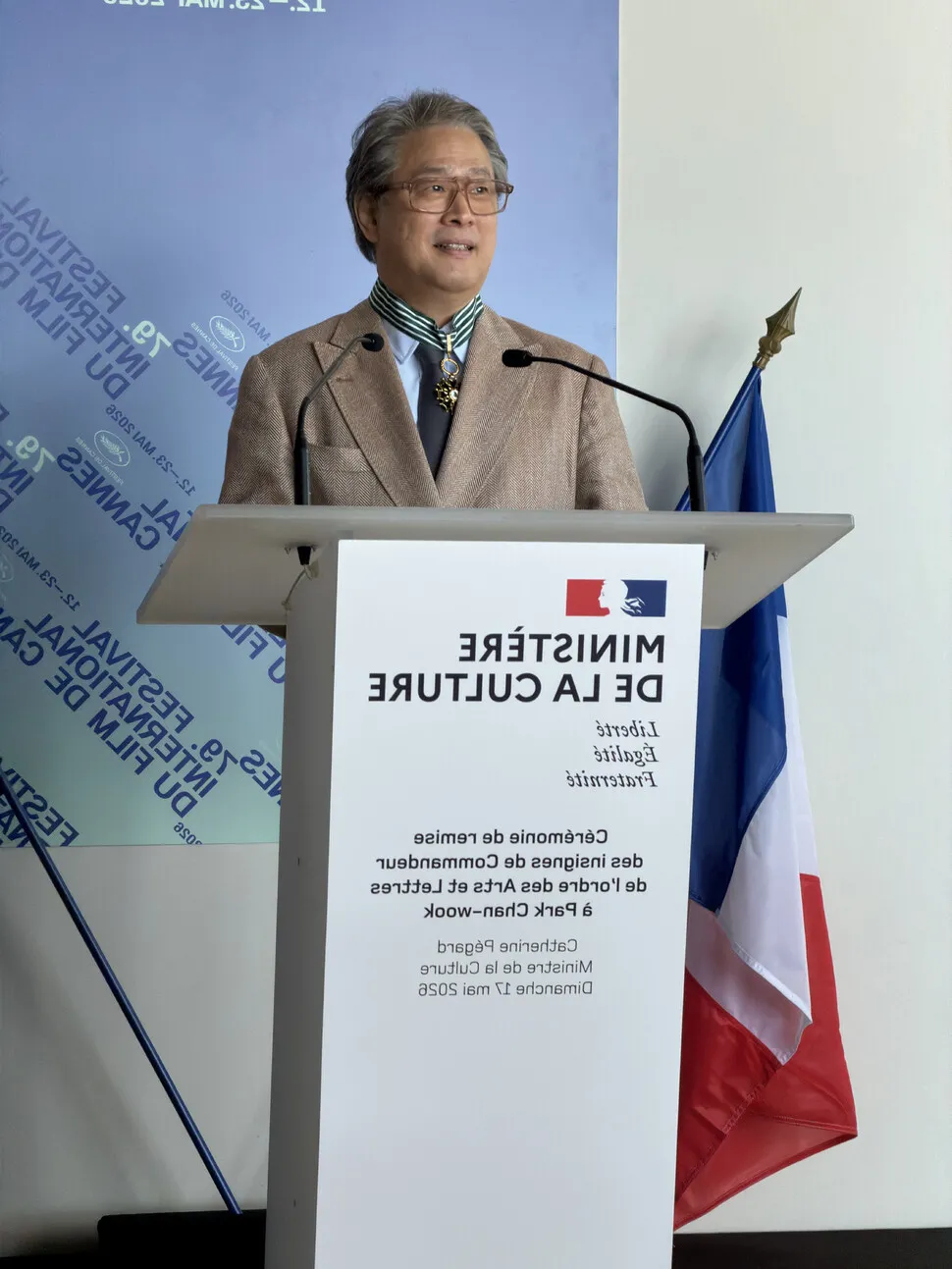
In a landmark recognition of South Korean cinematic mastery, director Park Chan-wook has been appointed as a Commandeur of the National Order of the Legion of Honour, the highest French order of merit. This prestigious promotion marks a historic moment for global cinema, as Park becomes the first South Korean filmmaker to achieve this specific rank within the order, cementing his status as a pivotal figure in the intersection of Eastern storytelling and Western artistic appreciation.
The appointment, conferred by the French government, recognizes Park’s extraordinary contributions to the arts and his role in elevating the global profile of cinema. The Park Chan-wook Legion of Honour distinction is not merely a personal achievement but a symbolic validation of the “Korean Wave” (Hallyu) transitioning from popular cultural exports to recognized high art within the traditional bastions of European culture.
For decades, France has maintained a profound relationship with cinema, treating the medium as the “seventh art.” By elevating Park to the rank of Commandeur, France acknowledges a body of work that challenges narrative conventions and pushes the boundaries of visual language. This honor places Park in an elite circle of international artists and intellectuals who have significantly influenced French cultural life or promoted the values of the French Republic on a global stage.
Understanding the Prestige of the Legion of Honour
Established by Napoleon Bonaparte in 1802, the National Order of the Legion of Honour is the highest French order of merit, both military and civil. Unlike many national honors, the Legion of Honour is structured in tiers, reflecting a progression of merit and service. The hierarchy typically ascends from Chevalier (Knight) to Officier (Officer), then to Commandeur (Commander), followed by Grand Officier and Grand Croix.
The jump to the rank of Commandeur is a significant leap in prestige. While several international figures are appointed as Chevaliers, the promotion to Commandeur is reserved for those who have demonstrated sustained, exceptional influence over a long period. In the context of the arts, this rank signifies that the recipient is no longer just a respected practitioner but a master whose work has fundamentally shaped the discourse of their medium.
For Park Chan-wook, this recognition follows a career defined by a rigorous exploration of guilt, revenge, and the complexities of human desire. His ability to blend visceral imagery with philosophical depth has long resonated with French critics and audiences, who historically prize the “auteur” theory—the idea that the director is the primary creative force and “author” of the film.
A Career Defined by Artistic Provocation and Precision
Park Chan-wook’s journey to the French cultural zenith began long before this appointment. His international breakthrough came with the “Vengeance Trilogy,” most notably with Oldboy (2003), which won the Grand Prix at the Cannes Film Festival. The film’s shocking narrative and stylized violence captivated global audiences and established Park as a director capable of marrying genre cinema with high-art sensibilities.

Since then, Park has continued to evolve, moving from the raw intensity of his early work to the sophisticated, meticulously crafted aesthetics seen in The Handmaiden (2016) and Decision to Leave (2022). The latter, which won the Best Director award at the 2022 Cannes Film Festival, further solidified his bond with France. The film’s nuanced approach to longing and loss was hailed by critics as a masterclass in restraint and visual storytelling.
The relationship between Park and the Cannes Film Festival is central to this honor. Cannes is not just a venue for screening films but a cultural barometer for the industry. Park’s recurring presence at the festival—both as a competitor and as a recognized master—has made him a familiar and revered figure in the French cinematic landscape. His work embodies the “Korean New Wave,” a movement that has seen South Korean directors like Bong Joon-ho and Lee Chang-dong gain unprecedented global traction.
Cultural Diplomacy and the ‘Korean Wave’ in High Art
The appointment of Park as a Commandeur serves as a powerful tool of cultural diplomacy. In recent years, the relationship between France and South Korea has strengthened across various sectors, from technology and luxury goods to the arts. The French Ministry of Culture has increasingly looked toward East Asia to diversify its cultural dialogue, and Park Chan-wook stands as the ideal bridge.
This recognition reflects a broader shift in how the world perceives South Korean creativity. For years, the “Korean Wave” was associated primarily with K-pop and K-dramas—commercial successes that dominated streaming platforms. However, the ascent of Park Chan-wook and the historic Oscar win for Parasite have shifted the conversation toward the intellectual and artistic rigor of Korean cinema.
By awarding Park the Legion of Honour, France is acknowledging that South Korean cinema is not just a trend, but a permanent and influential part of the global cinematic canon. It validates the idea that stories rooted in specific Korean social anxieties and landscapes can achieve a universal resonance that transcends linguistic and cultural barriers.
Park’s Vision for the Future: A French Connection
Following the announcement, Park expressed deep gratitude for the honor, noting the long-standing relationship he has cultivated with France through the Cannes Film Festival. He described his connection to the country as one that reached its “peak” through his experiences at the festival, where his work was first embraced by a wider European audience.
Significantly, the director has expressed a desire to expand his creative horizons by filming a project in France. This ambition suggests that the Legion of Honour is not a capstone to his career, but rather a catalyst for new collaborations. A Park Chan-wook production set in France would likely be a major cultural event, blending his signature South Korean psychological depth with French settings and perhaps French talent.
Such a project would represent the ultimate synthesis of the two cultures. Given Park’s obsession with space, architecture, and the way environments reflect the internal state of his characters, the historic and varied landscapes of France would provide a rich canvas for his visual experimentation.
Comparing the Impact: Korean Cinema on the World Stage
To understand the weight of this award, it is helpful to look at how other Korean artists have been recognized by the French state. While other Korean nationals have received the Legion of Honour in various capacities—including business, diplomacy, and other arts—Park’s promotion to Commandeur specifically as a filmmaker is unprecedented.
This distinction separates him from those who are recognized for “contribution” and places him among those recognized for “mastery.” It mirrors the trajectory of other global auteurs who have been embraced by France, such as Akira Kurosawa or Federico Fellini, who found in France a sanctuary of intellectual support and critical acclaim that often preceded their acceptance in their own home countries.
Key Takeaways: Park Chan-wook’s Historic Honor
- Rank: Appointed as Commandeur of the National Order of the Legion of Honour.
- Significance: First South Korean filmmaker to reach this specific high rank in the order.
- Context: Recognizes a career spanning from the visceral Oldboy to the refined Decision to Leave.
- Cultural Impact: Signals the transition of Korean cinema from a popular trend to a recognized pillar of high art.
- Future Outlook: Park has expressed a keen interest in filming a future project within France.
The Auteur’s Legacy and Global Influence
Park Chan-wook’s influence extends beyond the screen; he has influenced a generation of filmmakers globally who seek to balance commercial viability with uncompromising artistic vision. His work is characterized by a “calculated extremity”—the use of shocking moments not for mere provocation, but to reveal a deeper, often painful truth about the human condition.
The French appreciation for Park stems from this intellectual rigor. In France, cinema is studied with the same intensity as literature or philosophy. Park’s films, which often deal with the cyclical nature of violence and the impossibility of true redemption, provide ample material for the kind of analytical discourse that thrives in French cinema circles.
Park’s technical precision—his use of color, symmetry, and sound—aligns with the French tradition of valuing the formal elements of filmmaking. Whether it is the claustrophobic hallways of a revenge plot or the misty landscapes of a romantic mystery, every frame in a Park Chan-wook film is intentional. This dedication to the craft is exactly what the Legion of Honour seeks to reward.
What This Means for Future Korean Artists
For aspiring filmmakers in South Korea and across Asia, Park’s appointment serves as a blueprint for international success. It demonstrates that staying true to a unique, personal voice—even one that is challenging or unconventional—can lead to the highest levels of global recognition.
It also opens doors for future collaborations. The “Commandeur” title carries significant weight in European institutional circles, potentially easing the path for co-productions between Korean and European studios. As the boundaries of the film industry become more fluid, the formal recognition of a director’s status can facilitate the funding and support needed for ambitious, cross-border artistic ventures.
As the global audience continues to embrace non-English language content, the institutionalization of this success through awards like the Legion of Honour ensures that the influence of Korean cinema is recorded not just in box office numbers, but in the official history of art.
The next major milestone for Park Chan-wook will be the announcement of his next project. With the eyes of the French cultural establishment now firmly upon him, the industry awaits to see if he will realize his goal of filming in France, potentially creating a work that serves as a cinematic dialogue between Seoul and Paris.
World Today Journal encourages readers to share their thoughts on Park Chan-wook’s body of work in the comments below. Which of his films do you believe best exemplifies the mastery recognized by the French government?