
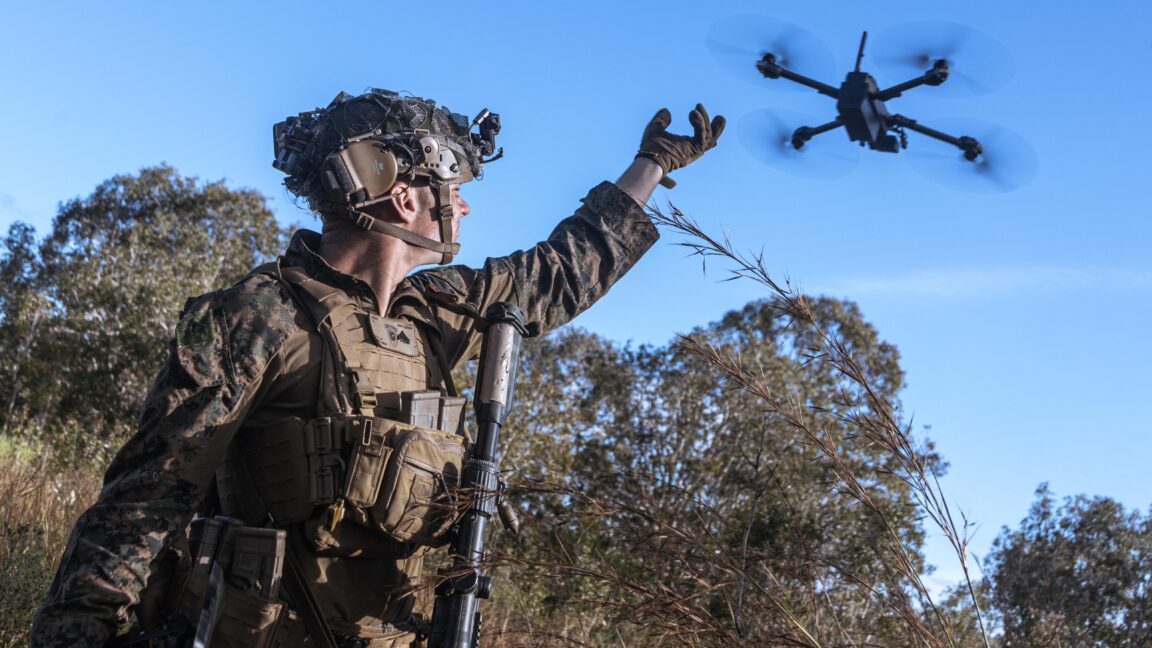
The Pentagon’s fiscal year 2027 budget proposal includes a $53.6 billion request for drone and autonomous warfare technologies, according to Department of Defense budget materials released in April 2026. This amount, allocated to the Defense Autonomous Warfare Group (DAWG), represents the largest single investment in drone warfare in U.S. History and exceeds the entire annual defense budgets of most countries worldwide.
The request comes as part of a broader $1.5 trillion defense budget proposal for FY 2027, which President Donald Trump submitted to Congress on April 3, 2026. Defense officials describe the drone funding as critical for expanding unmanned aerial systems production, training operators, building sustainment logistics, and enhancing counter-drone protections at military installations globally.
Established in late 2025, DAWG received approximately $226 million in the FY 2026 budget. The proposed FY 2027 increase would represent a more than 230-fold budget expansion for the organization, reflecting the Pentagon’s strategic shift toward autonomous systems as a cornerstone of future warfare.
Drone Funding Compares to Top Global Military Spenders
The $53.6 billion drone allocation would rank among the top 10 largest national defense budgets in the world if treated as a standalone country’s military expenditure. Based on 2026 defense spending data from the International Institute for Strategic Studies (IISS), this amount exceeds the annual defense budgets of Ukraine ($64.8 billion in 2025, per IISS Military Balance 2026), South Korea ($50.2 billion), and Israel ($24.3 billion).
Only the United States, China, Russia, India, Saudi Arabia, the United Kingdom, Germany, France, Japan, and South Korea currently allocate more than $50 billion annually to their militaries. The Pentagon’s drone request alone would surpass the combined defense budgets of several NATO allies, including Canada ($26.9 billion), the Netherlands ($15.3 billion), and Poland ($17.2 billion) in 2026.
DAWG Drives Autonomous Warfare Integration
The Defense Autonomous Warfare Group oversees the integration of unmanned systems across all military branches, focusing on interoperability between air, ground, and maritime drones. DAWG’s mandate includes developing common control protocols, standardizing payload interfaces, and creating joint training programs for drone operators from the Army, Navy, Air Force, and Marine Corps.
According to Pentagon planning documents referenced in the FY 2027 budget justification, DAWG will manage three primary lines of effort: procurement of next-generation unmanned aerial vehicles (UAVs), expansion of counter-unmanned aircraft systems (C-UAS) to defend bases and convoys, and development of autonomous logistics networks for resupply in contested environments.
The budget request specifically allocates funds for:
- Production and procurement of drones across all domains (air, land, sea)
- Training programs for drone operators and maintenance personnel
- Establishment of drone sustainment hubs and forward logistics nodes
- Research and development of swarming capabilities and AI-enabled targeting
- Deployment of fixed-site and mobile counter-drone systems to protect troops and infrastructure
Congressional Review Amid Fiscal Concerns
The $1.5 trillion defense topline faces skepticism in Congress, where lawmakers from both parties have questioned the scale of the increase relative to domestic needs. The nonpartisan Committee for a Responsible Federal Budget (CRFB) estimates the proposal would add more than $3.2 trillion to the national debt over the next decade, pushing the U.S. National debt—already near $39 trillion in early 2026—toward unprecedented levels.
Defense analysts note that while the drone investment aligns with lessons from recent conflicts in Ukraine and the Red Sea, where inexpensive drones have disrupted traditional military operations, the rapid expansion raises questions about oversight, acquisition timelines, and industrial base capacity. The defense industrial base has faced challenges scaling up production of precision munitions and electronic components amid global supply chain constraints.
Congressional hearings on the FY 2027 defense budget are scheduled to begin in the House and Senate Armed Services Committees in May 2026, with testimony expected from Pentagon acquisition officials, independent analysts, and representatives from the defense industry. The final budget will require approval from both chambers of Congress before the start of the fiscal year on October 1, 2026.
Strategic Implications for Future Conflict
Military planners emphasize that the drone investment reflects a fundamental shift in U.S. Warfighting doctrine toward distributed operations and human-machine teaming. Autonomous systems are seen as essential for reducing risk to personnel in high-threat environments, enabling persistent surveillance, and providing scalable firepower at lower unit costs than manned platforms.
However, experts caution that increased reliance on drones introduces new vulnerabilities, including electronic warfare susceptibility, cyber threats to control links, and challenges in distinguishing combatants from civilians in complex urban environments. The Pentagon has concurrently requested funding for electronic hardening of drone systems and improved AI-based target discrimination algorithms.
The expansion of counter-drone systems under DAWG acknowledges the growing threat posed by adversary unmanned systems, which have demonstrated effectiveness in recent conflicts against convoys, bases, and naval vessels. Investments in radar, electro-optical sensors, kinetic interceptors, and electronic warfare jammers aim to create layered defenses for U.S. Forces.
As the Pentagon prepares for potential great power competition, particularly in the Indo-Pacific region, drone capabilities are viewed as critical for overcoming China’s anti-access/area denial (A2AD) strategies. Long-range, stealthy drones could penetrate defended airspace to gather intelligence or strike high-value targets while minimizing exposure to advanced air defense systems.
For ongoing updates on the FY 2027 defense budget process, readers can monitor the Congressional Budget Office’s cost estimates, the House and Senate Appropriations Committees’ defense subcommittee proceedings, and official releases from the Office of the Under Secretary of Defense (Comptroller).
Stay informed about developments in defense technology and national security policy by sharing this article and joining the conversation in the comments below.