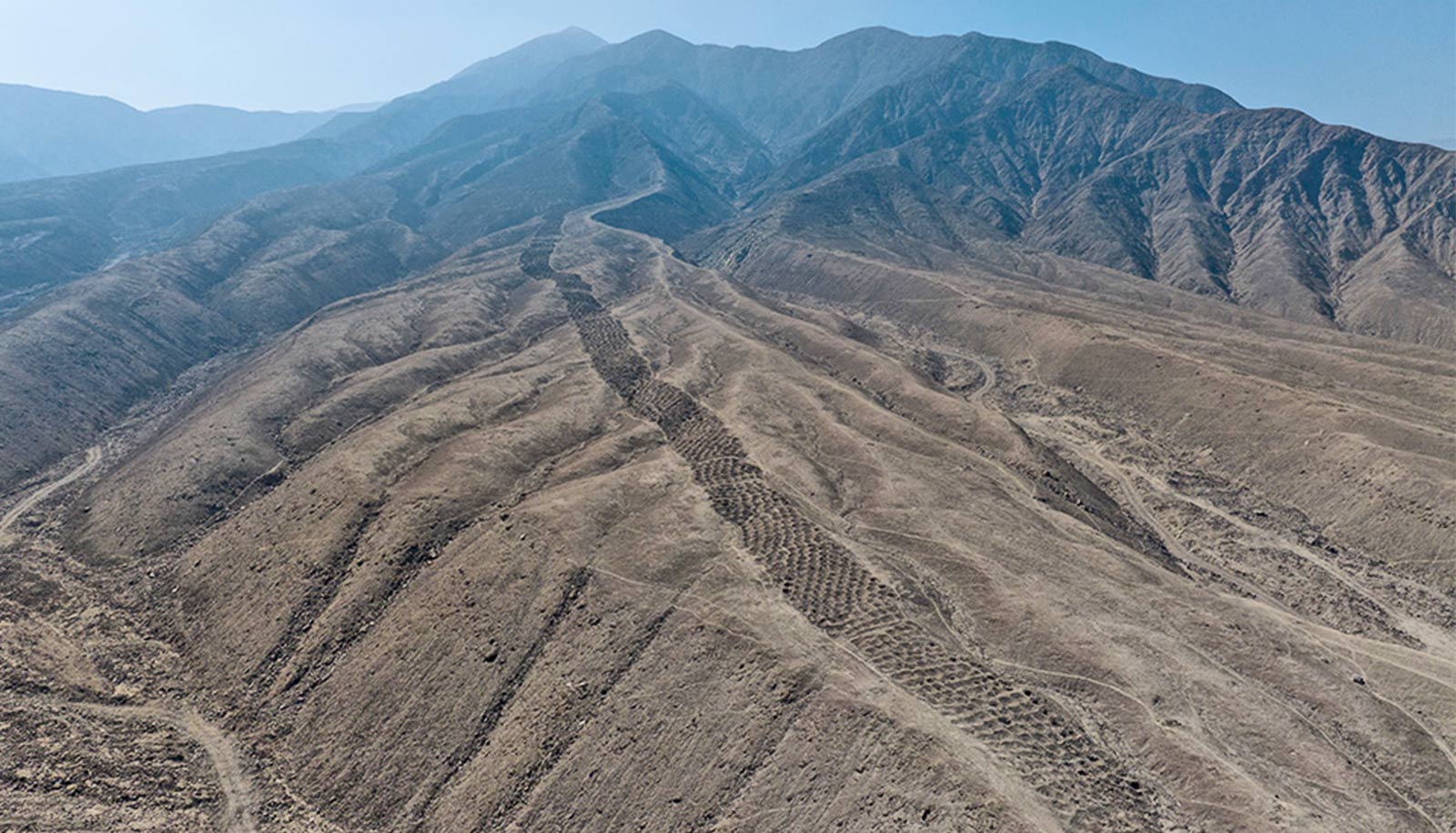
debunking Ancient alien Theories: New Research reveals the practical Purpose of Peru‘s “Band of Holes”
For decades, the enigmatic “Band of Holes” – a vast network of over 600 circular depressions etched into the peruvian landscape near Monte Sierpe - has fueled speculation ranging from ancient astronomical observatories to, more sensationally, landing strips for extraterrestrial visitors. Now, a groundbreaking new study, published with data from the University of South Florida, the University of Sydney, and UCLA, decisively refutes these fantastical claims, offering compelling evidence that the site served a far more grounded, yet equally captivating, purpose: a sophisticated system of accounting and trade management utilized by pre-Inca and Inca civilizations.
This isn’t simply a dismissal of fringe theories; it’s a restoration of historical agency to the Indigenous peoples who built and utilized this remarkable site. As archaeologist Charles Stanish, a leading expert on Andean civilizations with over 30 years of experience, explains, “One of the benefits of scientific work is the debunking of unsubstantiated claims that in many ways deprive Indigenous peoples of rightful ownership of their past.” This research represents a crucial step in reclaiming that narrative.
From Speculation to Science: Uncovering the Truth Behind Monte Sierpe
The challenge in understanding monte sierpe stemmed from its sheer scale and the difficulty in accurately mapping its structure. Located in a transitional ecological zone between the Andes highlands and the coastal plains, and positioned strategically near the intersection of pre-Hispanic roads and between two known Inca administrative centers, the site’s full pattern remained obscured by persistent haze and a lack of readily apparent artifacts. Previous attempts at interpretation were hampered by these limitations, leaving the door open for pseudoscientific explanations.
The turning point arrived with the advent of affordable, high-resolution drone technology. “Even from the mountain above, you can’t see its full pattern because of the permanent haze in the area,” Stanish notes. “But with access to precision, low-altitude images, it was immediately clear that this site was profoundly important and had to be scientifically studied.”
This technological leap allowed researchers to reveal a purposeful and mathematically structured layout,organized in segmented rows that strikingly mirrored khipus – the Inca’s complex knotted-string devices used for counting and recordkeeping. This aerial evidence was then corroborated by meticulous microbotanical analysis of sediment extracted from the holes themselves.
Evidence of Trade and Accounting: What the Soil Reveals
the microbotanical analysis, lead by Jacob Bongers of the University of Sydney, uncovered traces of crops like maize, alongside remnants of wild plants traditionally used for weaving and packaging. This suggests that the holes weren’t simply random indentations, but were periodically lined with plant materials and used to store goods transported in woven baskets or bundles.
“These data support the hypothesis that during pre-Hispanic times,local groups periodically lined the holes with plant materials and deposited goods inside them,using woven baskets or bundles for transport,” Bongers explains.
Taken together, the evidence paints a picture of Monte Sierpe as a monumental system of accounting, likely integral to Inca tribute collection and regional trade administered by the state. The site likely functioned first as a regulated marketplace under the pre-Inca Chincha Kingdom, and was later adapted and integrated into the Inca Empire’s sophisticated administrative network.
A Landscape Designed for interaction
The implications of this finding extend beyond simply identifying the site’s function. It reveals a deliberate effort by past communities to modify their landscapes to facilitate interaction and economic exchange. Bongers emphasizes, “Our findings expand our understanding of barter marketplaces and the origins and diversity of Indigenous accounting practices within and beyond the ancient Andes.”
The location of Monte Sierpe,bridging the ecological and cultural divide between the highlands and the coast,further supports this interpretation. It served as a crucial meeting point for groups from both regions, fostering trade and potentially mediating cultural exchange.
Future Research and the Ongoing Story of Monte Sierpe
The current research is not the end of the story, but rather a crucial foundation for future investigations. Researchers are now focusing on identifying the specific types and origins of the plant remains found within the holes, including those with potential medicinal properties.
“With every identification of a new plant type,the Band of Holes becomes more intriguing,” Stanish says. “Further study could help researchers better understand what was being stored or traded at the site, and what that suggests about the economic and cultural networks that once linked the Andes.”
This ongoing research promises to unlock even deeper insights into the complex economic and social systems of the ancient Andes, solidifying Monte Sierpe’s place not as a mystery to be solved through speculation, but as a testament
Related reading