
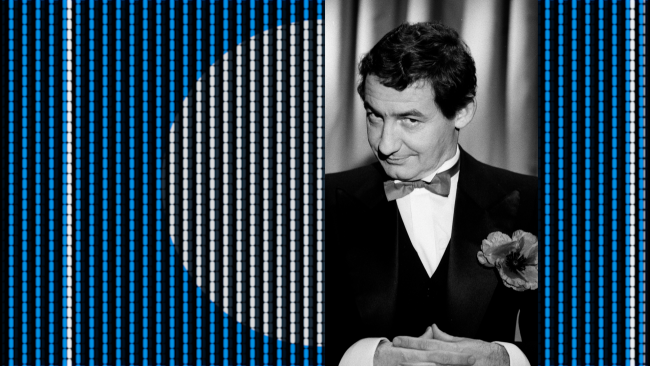
Pierre Desproges remains a singular figure in the landscape of French satire, a man whose acerbic wit and uncompromising style challenged the boundaries of television in the 1980s. For those looking to revisit his legacy, the program Rembob’INA on LCP-Assemblée nationale offers an in-depth examination of the late humorist, titled Pierre Desproges, l’inclassable trublion. This documentary broadcast provides a retrospective on a career defined by its intellectual rigor and provocative delivery, cementing his reputation as an “unclassifiable troublemaker” who fundamentally altered the tone of French public discourse.
The broadcast highlights the archival work of the Institut national de l’audiovisuel (INA), which serves as the primary repository for the footage featured in the retrospective. The program explores how Desproges, through his work on shows like Le Tribunal des flagrants délires, utilized his platform to dissect societal norms with a surgical, often cynical, precision. By revisiting these clips, the documentary contextualizes his impact on subsequent generations of comedians who have cited his influence in their own approaches to political and social commentary.
The Legacy of a Satirical Icon
Desproges, who passed away in 1988, is frequently remembered for his mastery of the French language and his ability to weaponize irony against the establishment. The Rembob’INA series, which focuses on the preservation and analysis of television history, utilizes this specific episode to examine the unique conditions of 1980s French television that allowed a performer of Desproges’s nature to thrive. According to the Institut national de l’audiovisuel, the preservation of such archives is essential for understanding the evolution of media culture and the role of the satirist within the democratic process.

The documentary does not merely present a highlight reel; it investigates the intellectual underpinnings of his humor. Desproges often adopted a persona that was deeply misanthropic yet intellectually demanding, forcing his audience to confront uncomfortable truths about their own prejudices. This approach was not without controversy, as his sketches frequently pushed the limits of what was considered acceptable on public television during that era. The program provides a lens through which to view these moments, balancing his status as a national cultural fixture with the inherent volatility of his comedic style.
Television and the Evolution of Political Satire
The role of LCP-Assemblée nationale in airing such content highlights the ongoing relevance of historical media to contemporary political life. By showcasing the work of figures like Desproges, the channel—which is dedicated to the coverage of parliamentary proceedings and political life—draws a line between the past and the present state of public debate. The LCP-Assemblée nationale programming grid frequently features content that bridges historical context with modern-day political analysis, ensuring that the influence of figures like Desproges is not lost to time.
For viewers interested in the mechanics of his success, the documentary points to his collaboration with other iconic figures of the time, such as Luis Rego. These partnerships were instrumental in creating the chaotic, yet structured, environment of his most famous sketches. The interplay between the absurdity of the situations he created and the rigid, formal structure of the courtroom setting in Le Tribunal des flagrants délires served as a masterclass in comedic timing and rhetorical subversion. This structural irony remains a cornerstone of how modern analysts study the history of French television.
Understanding the Impact
Why does Desproges still matter in the 21st century? His work serves as a benchmark for the “inclassable” (unclassifiable) nature of true satire. Unlike contemporary comedians who often rely on rapid-fire social media commentary, Desproges utilized the slow-burn approach of the monologue and the long-form sketch to build his arguments. His legacy is one of intellectual resistance, a reminder that the primary tool of the satirist is not merely to mock, but to expose the contradictions inherent in power structures.

The archival footage curated for the retrospective underscores a period where television was a primary vehicle for national debate, a role that has since shifted into the decentralized digital space. However, the themes he addressed—justice, human fallibility, and the absurdity of political posturing—remain as pertinent today as they were four decades ago. As the media landscape continues to fragment, the ability to look back at such definitive performances provides a necessary anchor for understanding the trajectory of public discourse and the enduring power of the written and spoken word in France.
For official updates regarding the availability of this program and future archival broadcasts, viewers are encouraged to consult the official LCP schedule for information on streaming and re-runs. Engaging with these historical documents ensures that the voices that shaped our collective culture continue to inform the debates of the present.