
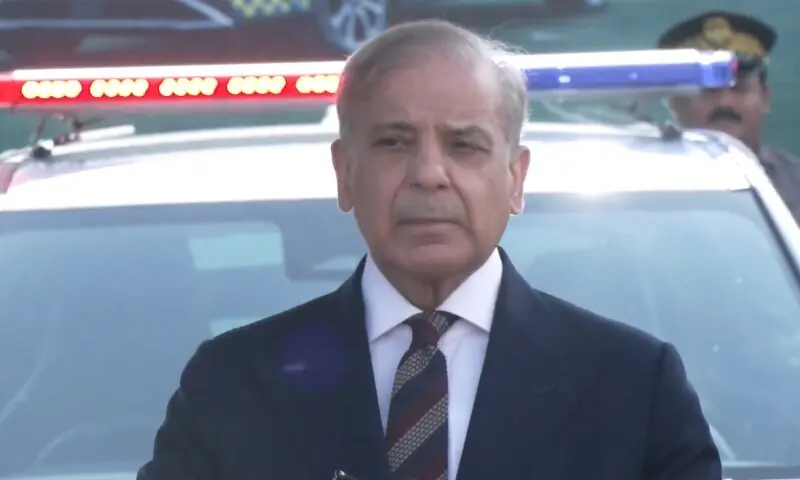
Prime Minister Shehbaz Sharif has called for a nationwide shift to electric vehicles to combat spiraling global petroleum prices and protect the country’s fragile economic stability. Speaking on Monday, the Prime Minister emphasized that transitioning to environment-friendly transport is no longer just an ecological preference but a strategic economic necessity to preserve precious foreign reserves.
The announcement came during a ceremony marking the induction of a latest fleet of eco-smart electric vehicles (EVs) for the Islamabad Traffic Police. The Prime Minister linked the urgency of this transition to the current regional instability and the volatility of international oil markets, which continue to place immense pressure on the national exchequer.
Addressing the gathering, PM Shehbaz Sharif urged all provinces and law enforcement agencies to emulate these energy-saving initiatives. He noted that reducing the reliance on imported fossil fuels is a critical step in safeguarding the economy from external shocks and reducing the monthly outflow of foreign currency used for fuel imports.
Modernizing the Capital’s Traffic Management
As a primary step in this transition, the Interior Ministry has provided an initial batch of 15 electric vehicles to the Islamabad Traffic Police via ProPakistani. These battery-operated vehicles eliminate the need for petrol and oil, significantly reducing the carbon footprint of the capital’s law enforcement operations. The Prime Minister confirmed that What we have is only the beginning, with additional batches of EVs scheduled for induction in the near future.
Islamabad Police Inspector General Syed Ali Nasir Rizvi briefed the Prime Minister on the operational deployment of the fleet. To ensure maximum efficiency and visibility, each vehicle will be manned by a specialized four-person team consisting of a captain, a male responder, an additional responder and a driver. The staff will wear special uniforms to distinguish them while they operate on key avenues of the capital to maintain smooth vehicular flow.
The Economics of Electric Mobility
The shift to EVs is being framed as a high-return investment for the state. According to technical briefings provided during the ceremony, the financial advantages of the new fleet are substantial when compared to traditional internal combustion engine (ICE) vehicles. Each electric vehicle is estimated to save up to Rs 0.55 million per month in fuel costs.
the procurement costs of these vehicles are expected to be recovered rapidly. The Prime Minister was apprised that the expenditure incurred on the purchase of these EVs will be offset by the monthly fuel savings within a window of 13 to 14 months.
Technical Specifications and Performance
The eco-smart vehicles deployed to the Islamabad Traffic Police are designed for urban endurance and rapid turnaround. Key performance metrics include:

- Range: A single full charge allows the vehicle to cover a distance of between 350km, and 400km.
- Fast Charging: The vehicles can be rapidly recharged in 60 to 90 minutes.
- Standard Charging: Regular charging cycles typically take between 6 and 8 hours.
Strategic Impact on Foreign Reserves
The Prime Minister’s insistence on a nationwide shift to electric vehicles is rooted in the broader goal of economic sovereignty. By reducing the national demand for imported petroleum, the government aims to stabilize the balance of payments and protect the country’s foreign exchange reserves via Dawn.
The initiative was lauded as a significant step forward, with the Prime Minister extending congratulations to Interior Minister Mohsin Naqvi and his team for the successful implementation of the project. The event was attended by various federal ministers and high-ranking officials from the Islamabad police and other relevant authorities.
Key Takeaways: The EV Transition Plan
| Metric | Detail |
|---|---|
| Initial Fleet Size | 15 Electric Vehicles |
| Monthly Savings | Up to Rs 0.55 million per vehicle |
| ROI Period | 13 to 14 months |
| Operational Range | 350km – 400km per charge |
| Charging Time | 60-90 mins (Fast) / 6-8 hours (Regular) |
As the government looks to expand this model to other law enforcement agencies and provincial governments, the focus remains on mitigating the impact of spiraling global fuel prices through sustainable, energy-saving technology.
The government is expected to provide further updates on the induction of the next batch of electric vehicles and the expansion of the EV policy to other government departments in the coming months.
World Today Journal encourages readers to share their thoughts on the transition to electric vehicles in the comments section below.