
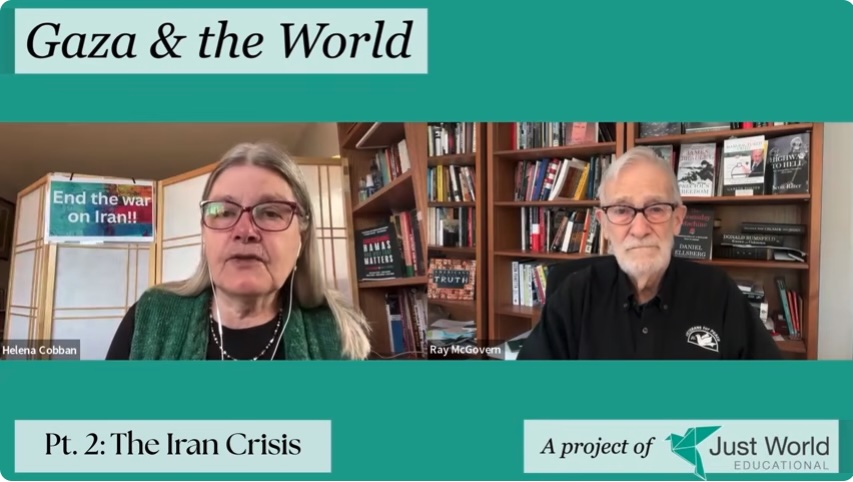
A former senior CIA analyst has warned that the current trajectory of United States and Israeli policy in the Middle East is risking a wider, more volatile conflict, even as Russia and Iran signal a strategic alignment focused on resistance and diplomatic openness.
Ray McGovern, a long-time expert on Soviet and Russian affairs, recently detailed these assessments during a wide-ranging discussion on the evolving Iran crisis. McGovern argued that the current administration in Washington is operating with an unpredictable logic that ignores the resilience of Tehran and the strategic boundaries set by Moscow.
Central to this analysis is a reported high-stakes communication between Russian President Vladimir Putin and U.S. President Donald Trump. According to McGovern, Putin issued a blunt warning against any new military intervention in Iran, specifically targeting the possibility of a ground operation. This warning followed a strategically significant visit to Moscow by Iranian Foreign Minister Abbas Araghchi on April 27.
The conversation, conducted with scholar and activist Helena Cobban, suggests that the geopolitical landscape is shifting toward a more formalized Axis of Resistance, where Iran is increasingly confident in its ability to withstand Western pressure even as maintaining regional solidarity.
The Moscow-Tehran Channel and Putin’s Warning
The diplomatic engagement between Tehran and Moscow has reached a critical juncture. McGovern described Foreign Minister Abbas Araghchi’s April 27 travel to Moscow as strategically notable and productive
, noting that direct access to President Putin provides Iran with a powerful diplomatic channel.
According to McGovern, the Russian readout of a subsequent call between President Putin and President Trump revealed an unusually stern tone. McGovern stated that Putin deemed any U.S. Ground operation in Iran to be particularly unacceptable and dangerous
.
This alignment suggests that Russia may once again position itself as a facilitator for diplomatic contacts regarding Iran’s nuclear program, echoing its role during the era of the Joint Comprehensive Plan of Action (JCPOA). However, McGovern noted that Russian internal attitudes toward Washington remain fractured, citing the public frustrations of former President Dmitry Medvedev as evidence that many in Russia believe the United States cannot be trusted.
Naval Tensions and the Gaza Flotilla
Beyond the diplomatic corridors of Moscow, the tension has manifested in aggressive naval actions in the Mediterranean. McGovern highlighted an incident on April 30, in which the Israeli navy intercepted and disabled numerous compact boats participating in a civilian aid flotilla bound for Gaza.

McGovern, who has a personal history with such missions as a crew member on the 2011 U.S. Boat to Gaza, characterized these actions as piracy
. He argued that the interception of these vessels near Crete indicates a shift toward greater aggression by the Israeli military.
“These civilian aid missions still matter because they draw attention to Israeli actions and provide moral support to people in Gaza.” Ray McGovern, Former CIA Analyst
The analyst linked these current events to historical precedents, recalling how the Obama administration and the Greek government collaborated to block the 2011 aid mission. He suggested that such episodes demonstrate the significant political leverage Israel exerts over Washington and its European allies.
U.S. Political Stability and Democratic Erosion
The analysis extended into the domestic sphere, where McGovern expressed deep concern over the state of American democratic institutions. He pointed to recent congressional hearings involving Defense Secretary Pete Hegseth as evidence of a broader pattern of contempt for legislative oversight.
McGovern argued that the current administration has normalized open disrespect
toward the legislative branch, which he believes contributes to a general erosion of democratic norms. He warned that these authoritarian tendencies are no longer hypothetical
and could potentially interfere with the integrity of future elections, including the midterms.
Despite these concerns, McGovern and Cobban observed a growing trend of resistance within the U.S. Congress regarding U.S.-Israeli policy. However, they cautioned that institutional checks alone are insufficient, as legislative procedures are often overshadowed by political pressure and financial influence.
McGovern emphasized that public skepticism toward Israel is rising in U.S. Polling, suggesting that grassroots pressure to end the war is now a more critical factor than formal legislative procedure.
The Legacy of Military Power
Closing the discussion on a historical note, McGovern referenced the writings of Smedley Butler, a U.S. Marine Corps general who famously characterized war as a racket
. McGovern argued that the current misuse of military power abroad creates a dangerous precedent that can eventually be turned inward.
He warned that the same forces enabling overseas conflicts can be repurposed against domestic targets, including workers, activists and the electoral process. In this view, the Iran crisis is not an isolated diplomatic dispute but a symptom of a larger struggle over imperial power and political accountability.
The broader implication, according to McGovern, is that while Washington and Tel Aviv move toward riskier military options, the combination of Iranian resilience and Russian diplomatic signaling creates a volatile environment where a single miscalculation could lead to a regional conflagration.
Observers are now looking toward the next cycle of diplomatic communications between Moscow and Washington, as well as upcoming congressional oversight hearings, to determine if the U.S. Will pivot toward the diplomatic openness currently signaled by Tehran and Moscow.
World Today Journal encourages readers to share their perspectives on these geopolitical shifts in the comments section below.