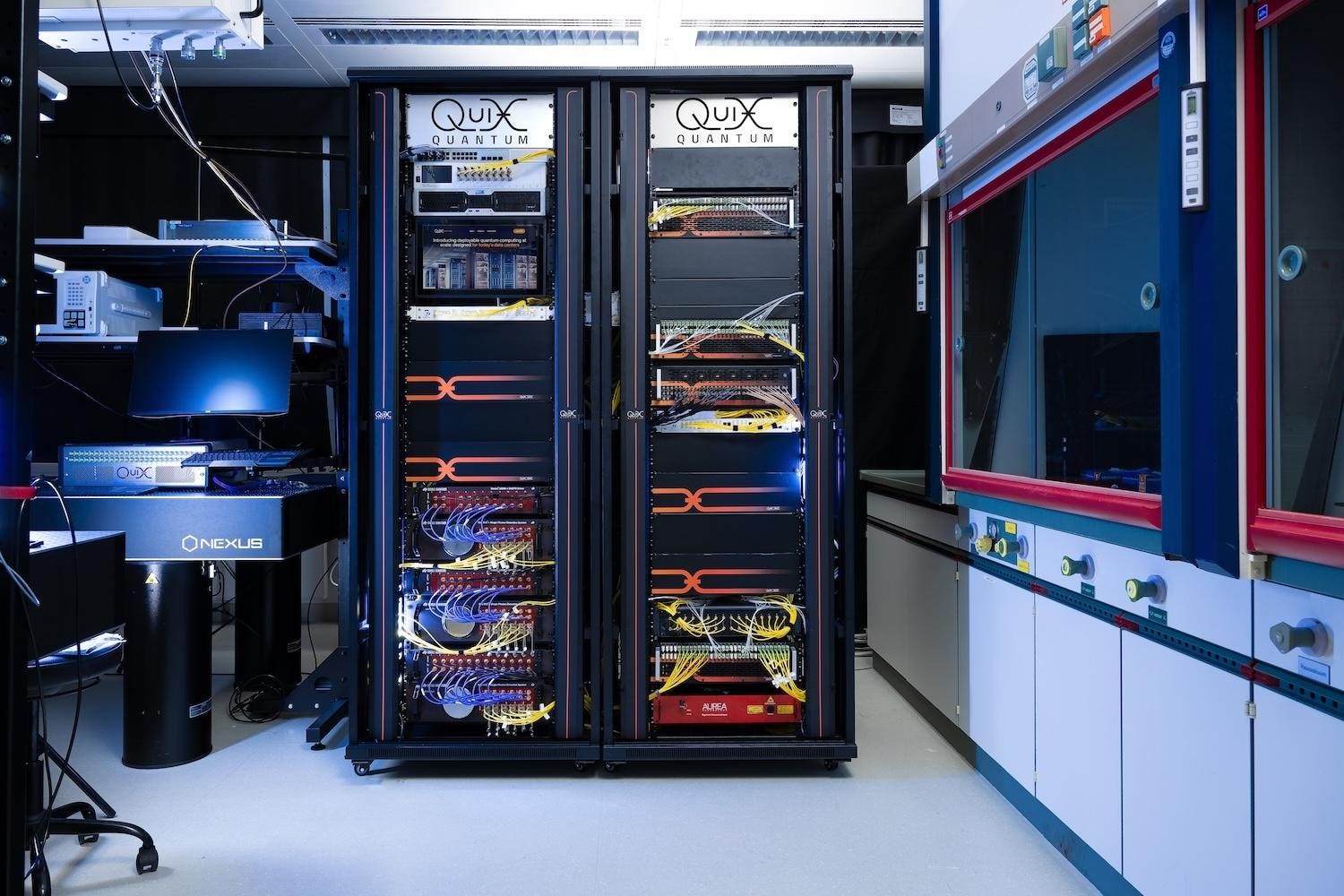
Two separate photonic quantum initiatives have achieved major deployment and strategic backing milestones. A Netherlands-based company delivered the first universal photonic quantum computer to customer environments, while a University of Tokyo spinout secured a strategic alliance with NTT to target a million-qubit optical system by fiscal year 2030.
Carina Arrives in Standard Data Centers at Room Temperature
Most quantum systems require specialized laboratory environments and cryogenic plumbing chilled to near absolute zero. Quantum computing company QuiX Quantum is challenging that infrastructure model by delivering its universal photonic quantum computer, named Carina, directly into standard customer data center environments. The system operates entirely at room temperature.
Carina features eight input photonic qubits and four computational photonic qubits. Rather than building hardware gates directly into optical paths where photons barely interact, the system uses a measurement-based approach. It creates an entangled cluster state and drives computation through adaptive single-qubit measurements handled by fast feed-forward control units.
The system was built as part of the Universal Photonic Quantum Computer project of the German Aerospace Center’s Quantum Computing Initiative (DLR QCI), backed by funding from the German Federal Ministry of Research, Technology and Space. Core hardware has already been delivered to the DLR QCI research hub.
NTT Backs OptQC to Target One Million Qubits by 2030
In a parallel development in Japan, telecom giant NTT has placed a strategic investment in OptQC, a University of Tokyo spinout specializing in room-temperature optical quantum computing. The capital and business alliance aims to scale a fault-tolerant optical quantum computer to one million qubits by fiscal year 2030.
This formal investment escalates a collaboration agreement initially signed in November 2025. The partnership funds an active joint research program running through fiscal year 2027. The program focuses on three primary objectives: scaling qubits via wavelength-division multiplexing (WDM), designing a fault-tolerant architecture, and completing a million-qubit system blueprint.
MoQuren Debuts at the National Institute’s G-QuAT Facility
Unlike theoretical whiteboard architectures, OptQC’s debut system, MoQuren, commenced initial operations on July 21, 2026. The hardware runs at the National Institute of Advanced Industrial Science and Technology’s G-QuAT facility.
The research center represents a major institutional investment. Built at a cost of approximately ¥62 billion (roughly $396 million USD), the G-QuAT hub hosts multiple distinct quantum architectures. Hitachi and Intel’s silicon spin-qubit project is also slated to install hardware at the same campus, making it a rare shared testing ground for competing quantum paradigms.
Time-Domain Multiplexing Versus Superconducting Cryostats
The two photonic architectures highlight a fundamental divergence from superconducting quantum machines built by companies like IBM, Google, and Rigetti. Superconducting processors require a dedicated physical circuit element—such as a Josephson junction and control wiring—for every single qubit. Those systems must be housed inside a dilution refrigerator chilled to roughly 15 millikelvin, drawing considerable cooling power.
By contrast, OptQC relies on time-domain multiplexing (TDM). Quantum information is encoded into sequential pulses of light passing through fixed optical components at different times. The qubit count is determined by time slots rather than physical hardware elements. Furusawa’s laboratory demonstrated this mechanism by generating 10,000-mode entangled cluster states in published research.
With MoQuren operational, NTT’s funding shifts from basic science to commercialization engineering. The roadmap outlines scaling toward a 10,000-qubit machine in fiscal 2027, proof-of-concept deployments in fiscal 2028, and the target million-qubit platform by fiscal 2030.
Keep reading