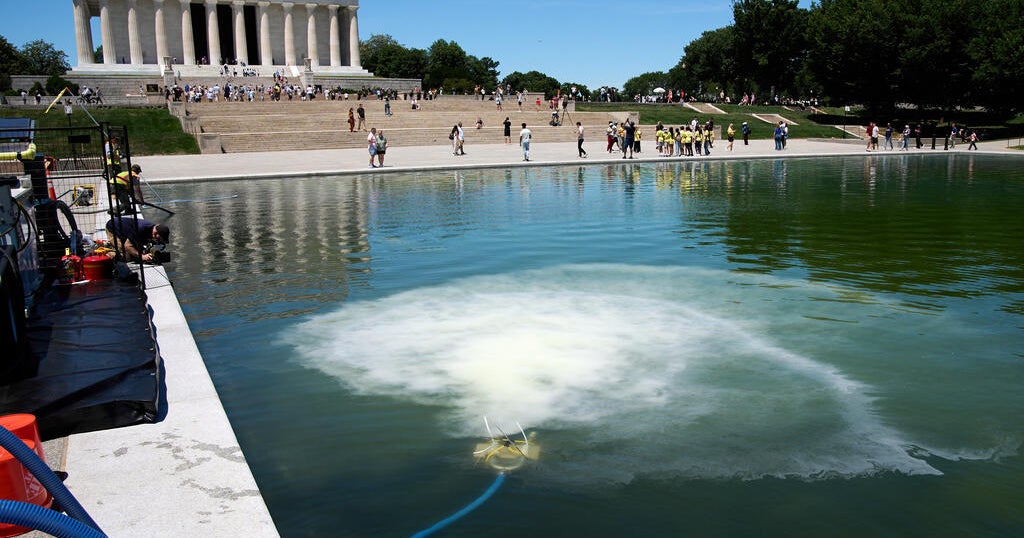
A $1.7 million federal contract awarded to a company owned by a donor to former President Donald Trump for the maintenance of the Lincoln Memorial Reflecting Pool has drawn scrutiny following reports of immediate structural degradation. The National Park Service (NPS) awarded the non-competitive, sole-source contract to a firm for specialized cleaning and coating services, a project that has since faced public criticism as the pool’s surface began to peel and discolor shortly after completion, according to National Park Service official project records.
The contract, finalized to address persistent algae and structural issues at the site, was granted without a traditional bidding process, a practice federal agencies occasionally utilize under specific procurement guidelines for specialized services. The company, which is owned by an individual who has contributed to Donald Trump’s political campaigns, was tasked with removing debris and applying a protective coating to the pool floor. However, within days of the project’s conclusion, visitors and observers reported significant amounts of blue material peeling from the base of the pool, raising questions regarding the quality of materials used and the oversight of the project, as documented by Department of the Interior oversight reports.
Understanding the Procurement Process
Federal agencies are permitted to issue sole-source contracts under the Federal Acquisition Regulation (FAR) when a specific contractor is deemed the only source capable of providing the required services, or in cases of urgent necessity. In this instance, the NPS utilized this authority to expedite the cleaning and restoration of the Reflecting Pool, which serves as a major tourist attraction within the National Mall and Memorial Parks. The $1.7 million figure represents the total commitment of federal funds allocated for these specific maintenance tasks, according to government spending data.
Critics and transparency advocates often monitor non-bid contracts involving political donors to ensure that taxpayer funds are allocated based on merit and capability rather than political influence. While the NPS maintains that the contractor was selected based on technical specifications and the urgency of the maintenance cycle, the subsequent failure of the pool’s coating has prompted calls for a review of the decision-making process. The agency has not publicly released the full internal justification for bypassing the competitive bidding process in this specific instance, though standard protocols require such decisions to be documented in the contract file.
Technical Failures and Maintenance Challenges
The primary issue currently affecting the Reflecting Pool involves the rapid degradation of the newly applied sealant, which has manifested as floating blue paint flakes and uneven discoloration. Environmental experts note that the pool, which is fed by the Tidal Basin, is prone to algae blooms and requires rigorous chemical balancing. The presence of peeling material suggests a failure in the bonding process between the sealant and the concrete floor, potentially exacerbated by the water chemistry or the application method, according to NPS maintenance advisories.
This is not the first time the Reflecting Pool has required extensive rehabilitation. In 2012, a major renovation project was completed to address massive water leaks that had plagued the site for years. The current maintenance issues highlight the ongoing difficulty of managing a structure that is both a historical monument and an active water feature exposed to the elements. The NPS is currently working to assess the extent of the damage to determine if the contractor will be held liable for remediation costs under the terms of the original agreement.
What Happens Next
The National Park Service has indicated that it is evaluating the condition of the pool and reviewing the performance of the contractor. As of the latest update, the agency has not announced a formal investigation into the awarding of the contract, but it remains under pressure to account for the expenditure of the $1.7 million in federal funds. Officials have stated that they are coordinating with environmental experts to manage the immediate impact of the peeling materials on the pool’s water quality and the surrounding ecosystem, according to official agency news releases.

Future updates regarding the status of the Reflecting Pool and any potential legal or administrative actions will be posted through the National Mall and Memorial Parks’ official communications channels. Readers interested in the specifics of federal procurement transparency can monitor the Government Accountability Office for any future audits or reports concerning infrastructure maintenance at national monuments. We encourage our readers to join the conversation in the comments section below regarding the balance between rapid infrastructure repair and the necessity of competitive, transparent government contracting.