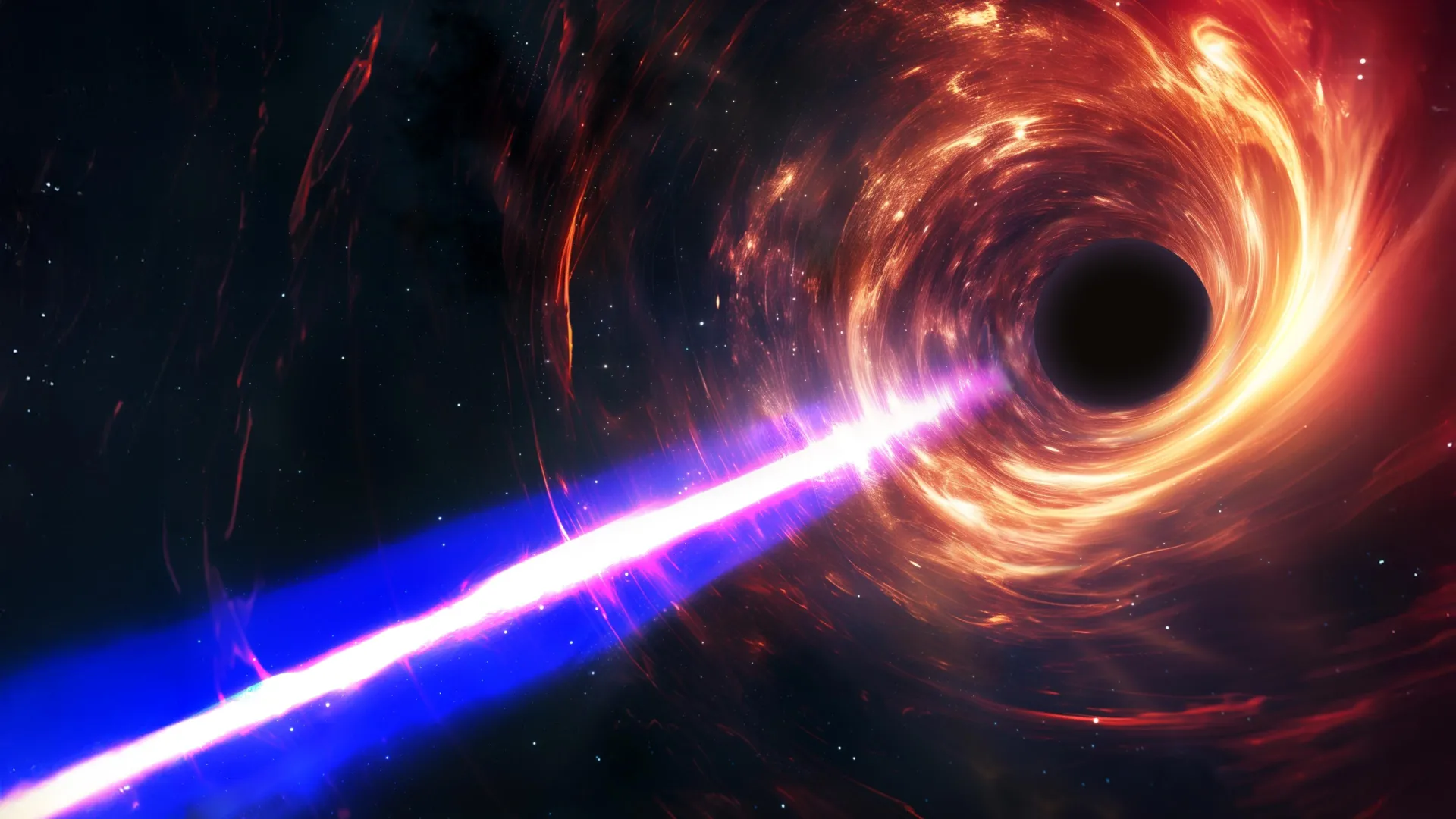
Wandering Black Hole Discovered Near Galactic Center Challenges Black hole Growth Theories
A groundbreaking discovery has confirmed the existence of an actively accreting, intermediate-mass black hole (IMBH) wandering outside the nucleus of a dwarf galaxy, offering unprecedented insights into black hole growth and galactic evolution. This finding, detailed in a recent study, represents the closest and most robustly confirmed case of its kind, perhaps reshaping our understanding of how supermassive black holes form.
For decades,the prevailing model of black hole growth centered on massive black holes residing at the heart of galaxies,rapidly consuming gas and dust from central reservoirs. Though, this new research, led by a team of international astronomers, demonstrates that black holes can also thrive and actively accrete material away from galactic centers, challenging this long-held assumption.
Unveiling a Cosmic Lighthouse
The black hole, located approximately 0.94 kiloparsecs (2.68 arcseconds) from the center of its host galaxy, was initially identified through data from the Mapping Nearby Galaxies at Apache Point Observatory (MaNGA) survey. Follow-up observations using the Very long Baseline Array (VLBA) at 1.6 and 4.9 GHz revealed compelling evidence of active galactic nucleus (AGN) activity. Specifically, the observations showcased a remarkably luminous radio core – exceeding one billion kelvins in temperature – and a jet structure extending 2.2 parsecs (7.2 light-years) southeastward. These are hallmarks of material being ejected at relativistic speeds from the vicinity of a black hole.
Crucially, analysis of archival data spanning 1993 to 2023 revealed irregular, long-term variability in the source’s brightness. This fluctuating behaviour is a strong indicator of sustained accretion onto a black hole, distinctly different from the steady decline characteristic of supernova remnants – a common “impostor” scenario that researchers meticulously ruled out. Based on the host galaxy’s stellar mass, the black hole is estimated to weigh in at approximately 300,000 times the mass of our Sun, firmly placing it within the IMBH category – a notoriously arduous population to identify.
“This is like a cosmic lighthouse lit by a wandering black hole,” explains Dr. LIU Yuanqi, a co-author of the study. ”Although it has strayed from the galactic center, it still shines outward with powerful energy.”
Why This Discovery Matters: A Needle in a haystack
The significance of this discovery extends beyond the identification of a single wandering black hole. The MaNGA survey identified 628 galaxies exhibiting potential AGN activity, with roughly 62% showing offsets from their optical centers.However, only one – MaNGA 12772-12704 – met the stringent “triple solid evidence” criteria: a compact, high-brightness core, parsec-scale jets, and decades-long variability.
“In dwarf galaxies especially, it is extremely difficult to obtain clear observational evidence for wandering AGN,” notes Dr. Mar Mezcua, a co-author from the Institute of Space sciences of Spain. This highlights the challenges in identifying these elusive objects and underscores the robustness of the current findings.
A New Paradigm for Black Hole Growth & Galactic Evolution
This research provides compelling observational support for a new model of black hole growth: distributed feeding and multi-site growth. Instead of solely relying on central gas reservoirs, black holes can accrete material from various locations within a galaxy, potentially accelerating their growth, particularly in the early universe.
“This discovery prompts us to rethink black hole-galaxy co-evolution,” states Dr. AN, a leading researcher on the project. “Black holes are not only central ‘engines’, they may also quietly reshape their host galaxies from the outskirts.”
Even at the periphery of a galaxy, a wandering black hole’s powerful outflows can inject critically important energy into the surrounding environment, influencing galactic dynamics and star formation rates. This suggests a more complex and nuanced relationship between black holes and their host galaxies than previously understood.
The Future of Wandering Black Hole Research
The confirmation of this wandering black hole marks a pivotal moment, transforming it from a theoretical possibility into an observational reality.The advent of next-generation telescopes promises to unlock a wealth of information about this previously “invisible” population.
Future advancements, including:
* Extremely Large Optical Telescopes: Will provide unprecedented precision in mapping galactic centers and structures.
* Deep Radio Surveys (FAST core array & Square Kilometre Array): Will detect fainter radio signals and resolve sub-parsec-scale micro-jets, revealing even more wandering black holes.
These technological leaps will enable astronomers