
Russia’s Happiness Index Hits 15-Year Low: State Poll Shows Sharp Decline in Public Wellbeing
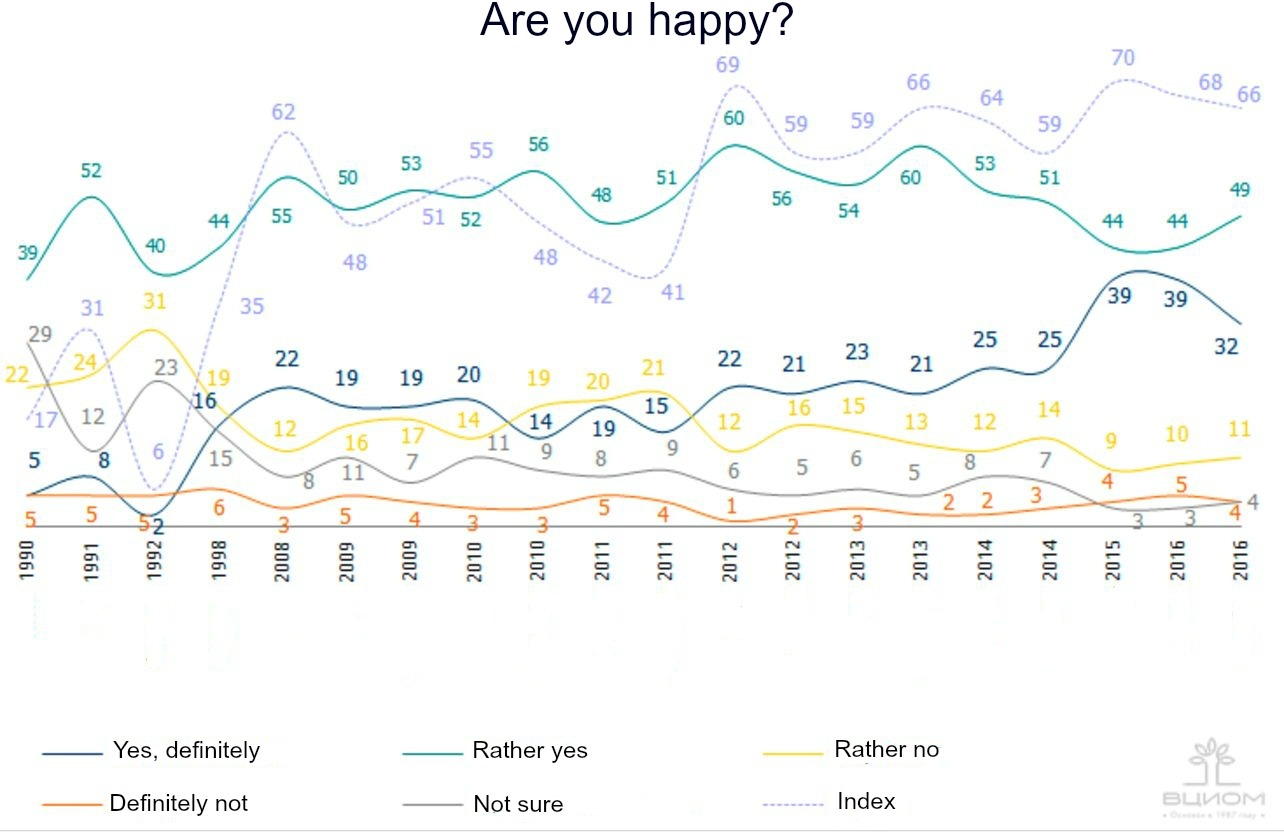
Moscow — Russians’ self-reported happiness has reached its lowest point in 15 years, according to data released by the state-owned Russian Public Opinion Research Centre (VTsIOM). The so-called “happiness index”—a metric tracking responses to the question *”Life has its ups and downs, but would you say you’re happy?”*—fell to 52 points in April 2026, down from 56 in March. The decline marks a significant shift, with only 74% of respondents now describing themselves as happy, compared to 22% who said no. This represents a four-point drop in a single month and the steepest fall since September 2011, when the index hit a historic low of 41 points amid political upheaval.
The latest figures, published by VTsIOM—a research body under the Kremlin’s direct oversight—reflect growing unease among Russians, even as official narratives emphasize stability. The index’s calculation is straightforward: it measures the difference between those who answer “yes” versus “no” to the happiness question. In April, the gap narrowed sharply, with the “yes” share slipping from 76% in March to 74%, while the “no” share rose from 20% to 22%. The trend aligns with broader economic headwinds, including a revised GDP growth forecast of just 0.4% for 2026—down from an earlier projection of 1.3%—suggesting that material security is increasingly tied to public sentiment.
Why It Matters: The happiness index is more than a social indicator. it serves as a real-time barometer of societal resilience. Historically, VTsIOM has linked fluctuations in the index to economic crises, political dissatisfaction, and exposure to opposition media. Sociologist Valery Fyodorov, the center’s director, noted in 2022 that Russians tend to report happiness as long as they maintain stable incomes, family life, and health. The current decline, however, coincides with heightened political engagement among those critical of President Vladimir Putin’s leadership—a group that VTsIOM identifies as the least happy demographic.
Key Findings from the April 2026 Poll
The April 2026 data reveals several critical trends:
- Steepest drop since 2011: The index fell from 56 in March to 52 in April, continuing a downward trajectory that began in February (55 points). A year earlier, in April 2025, the index stood at 63 points.
- Political engagement as a predictor: VTsIOM’s analysis highlights that individuals most engaged with opposition media—and those dissatisfied with Putin’s performance—report the highest levels of unhappiness. This group’s growing influence on the index suggests a widening gap between official narratives and grassroots sentiment.
- Economic anxiety: The decline correlates with Russia’s revised GDP forecast, which the Economic Development Ministry cut to 0.4% growth for 2026—a signal that economic stability, a traditional pillar of reported happiness, is eroding.
- Historical context: The last time the index was this low was September 2011, during the so-called “castling” political maneuver, when Putin and Dmitry Medvedev swapped roles in a move widely seen as a power consolidation strategy.
Methodology and Limitations
The happiness index is derived from VTsIOM’s recurring surveys, which typically sample thousands of Russians nationwide. While the methodology is transparent, critics argue that state-backed polling may underrepresent dissenting voices. Independent outlets like Novaya Gazeta Europe and Meduza have cross-verified the data, noting that the index’s decline aligns with other economic and social indicators, such as rising emigration and reduced consumer confidence.
Expert Perspective: “The happiness index is not just about individual wellbeing—it’s a reflection of systemic pressures,” said Maria Ivanova, a sociologist at the European University at St. Petersburg. “When economic forecasts worsen and political freedoms contract, the index reacts swiftly. The current drop is a warning sign for policymakers.”
What Happens Next?
With the happiness index at a 15-year low, analysts are watching for three key developments:
- Economic policies: The Kremlin may accelerate social spending or subsidies to stabilize public morale, though past measures have shown limited impact on long-term sentiment.
- Media crackdowns: Authorities could tighten controls on independent outlets to limit exposure to critical narratives, potentially insulating the index from further declines.
- Emigration trends: The United Nations High Commissioner for Refugees (UNHCR) has reported a steady rise in Russians leaving the country, particularly skilled workers and young professionals, which could further strain domestic stability.
The next VTsIOM report is expected in June 2026, with May’s data likely to be released alongside it. For real-time updates, readers can monitor:
- VTsIOM’s official releases: vtsiom.ru
- UNHCR’s migration reports: UNHCR
- Russian Economic Development Ministry forecasts: Ministry of Economic Development
Key Takeaways
- The Russian happiness index dropped to 52 points in April 2026—its lowest since September 2011.
- Only 74% of Russians now describe themselves as happy, down from 76% in March, while 22% said they were not happy.
- The decline coincides with economic slowdown (GDP forecast revised to 0.4% growth) and heightened political dissatisfaction.
- VTsIOM identifies opposition media consumers as the least happy demographic, suggesting a link between political engagement and wellbeing.
- Historical lows in the index have preceded major political shifts, including the 2011 “castling” maneuver.
As Russia navigates geopolitical tensions and domestic challenges, the happiness index serves as a critical—if imperfect—measure of societal health. For readers seeking deeper analysis, the World Today Journal’s Geopolitics section offers ongoing coverage of Russia’s social and economic dynamics.
What do you think? Share your insights or questions in the comments below. For breaking updates, follow World Today Journal on social media.
Worth a look