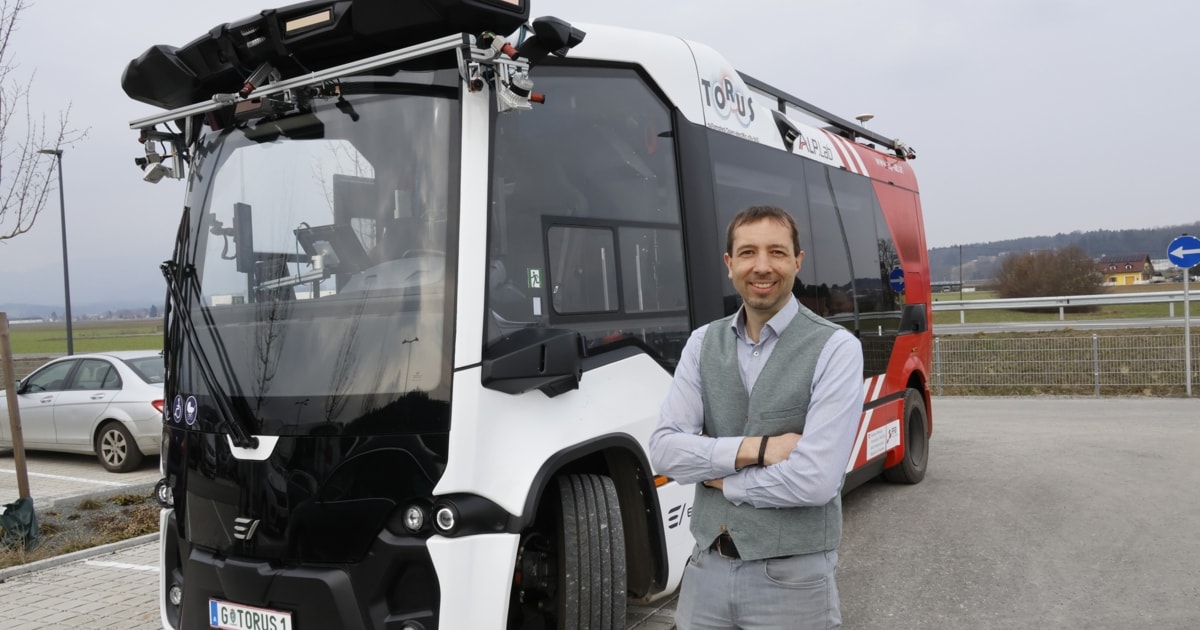
Groß St. Florian, Austria – A latest era of public transportation is dawning in the Austrian region of Styria, as fully automated buses began testing on Monday, March 2, 2026. The initiative, dubbed “Öffi-Revolution,” aims to integrate driverless buses as a feeder service to the Koralm Railway, a major rail link connecting Styria, and Carinthia. The project, involving 19 companies from the transportation, science, and economic sectors, represents a significant step towards the widespread adoption of autonomous vehicles in Europe.
The inaugural run took place on Monday afternoon at the West Styria railway station, with officials, representatives from participating companies, and members of the Styrian Chamber of Commerce observing the demonstration. The bus, developed by AlpLab GmbH, is described as the largest automated vehicle currently produced in Styria. Landesrat Willi Ehrenhöfer and LH-Vize Manuela Khom (ÖVP) expressed their support for the project, drawing parallels to the deployment of self-driving taxis already operating in San Francisco, California.
A Collaborative Effort to Revolutionize Regional Transport
The “Roberta” project, as the initiative is known, is a multi-million euro research undertaking focused on bringing highly automated buses onto public roads. While fully driverless operation is still in the development phase, the current testing phase aims to assess the real-world viability of this technology. Martin Aichholzer was present at the controls during the initial test run, though the intention is for future operation to be entirely autonomous.
Manfred Kainz, Regional Chairman of the Styrian Chamber of Commerce, facilitated the participation of colleagues from Carinthia, utilizing the Koralm Railway to reach Styria before transferring to the autonomous bus. Christoph Knauder, CEO of AlpLab GmbH, highlighted the significance of the demo vehicle, emphasizing its status as the largest automated bus originating from Styrian production. According to a report in Krone.at, the project aims to provide a seamless connection between regional rail networks and local communities.
The Koralm Railway: A Catalyst for Innovation
The Koralm Railway, a crucial infrastructure project for Austria, is designed to improve rail connections between Graz and Klagenfurt, reducing travel times and boosting regional economic development. As reported by Krone.at, the autonomous bus service is envisioned as a key component of the railway’s integrated transport network, offering a convenient “last-mile” solution for passengers traveling to and from smaller towns and villages.
The railway project itself has faced delays and challenges, but its completion is expected to have a transformative impact on the region. The integration of autonomous buses represents a forward-thinking approach to maximizing the benefits of the Koralm Railway, enhancing accessibility and promoting sustainable transportation options.
Implications for the Future of Public Transportation
The “Öffi-Revolution” project in Styria is part of a broader trend towards the adoption of autonomous vehicles in public transportation systems worldwide. While San Francisco has pioneered the use of self-driving taxis, other cities are exploring the potential of autonomous buses and shuttles to improve efficiency, reduce costs, and enhance accessibility.
The successful implementation of this technology will require addressing a number of challenges, including regulatory hurdles, public acceptance, and cybersecurity concerns. However, the potential benefits are significant, offering the prospect of safer, more reliable, and more sustainable public transportation systems.
Regulatory Landscape and Public Perception
The deployment of autonomous vehicles on public roads is subject to stringent regulations, which vary from country to country. Austria, like many European nations, is actively developing a legal framework to govern the operation of autonomous vehicles, balancing innovation with safety and security.
Public perception is similarly a critical factor in the successful adoption of this technology. Addressing concerns about safety, job displacement, and data privacy will be essential to building public trust and fostering widespread acceptance. The “Öffi-Revolution” project in Styria aims to demonstrate the benefits of autonomous buses through real-world testing and public engagement.
Stakeholders and Regional Impact
The “Roberta” project involves a diverse range of stakeholders, including government agencies, research institutions, technology companies, and transportation providers. Landesrat Willi Ehrenhöfer and LH-Vize Manuela Khom represent the Styrian provincial government’s commitment to innovation and sustainable transportation. AlpLab GmbH, as the developer of the autonomous bus, plays a central role in the project’s technical implementation. The Styrian Chamber of Commerce is actively promoting the project to its members and facilitating collaboration between businesses.
The successful implementation of the autonomous bus service is expected to have a positive impact on the regional economy, creating new jobs and attracting investment. It will also enhance the quality of life for residents of West Styria, providing them with improved access to transportation and employment opportunities. The project serves as a model for other regions seeking to leverage the benefits of autonomous vehicle technology.
Manuela Khom also recently hosted Tsengeg Mijiddorj for an exchange, as reported by Cercle Diplomatique Magazin, highlighting the region’s engagement in international collaborations. This demonstrates a broader commitment to fostering relationships and sharing knowledge on innovative technologies.
The project’s progress will be closely monitored by transportation officials and industry experts, as it provides valuable insights into the challenges and opportunities associated with the deployment of autonomous buses in a real-world setting. The next phase of the project will involve expanding the testing area and increasing the frequency of service, paving the way for a potential full-scale rollout in the coming years.
Key Takeaways:
- Fully automated buses are undergoing testing in the West Styria region of Austria.
- The “Öffi-Revolution” project aims to integrate driverless buses with the Koralm Railway.
- The initiative involves 19 companies and represents a significant investment in autonomous vehicle technology.
- Successful implementation could lead to safer, more efficient, and more sustainable public transportation.
The “Öffi-Revolution” represents a bold step towards the future of public transportation in Austria and beyond. As the project progresses, it will be crucial to address the remaining challenges and ensure that the benefits of this technology are shared by all. Stay tuned to World Today Journal for further updates on this developing story.
What are your thoughts on the integration of autonomous buses into public transportation? Share your comments below and join the conversation.
Related reading