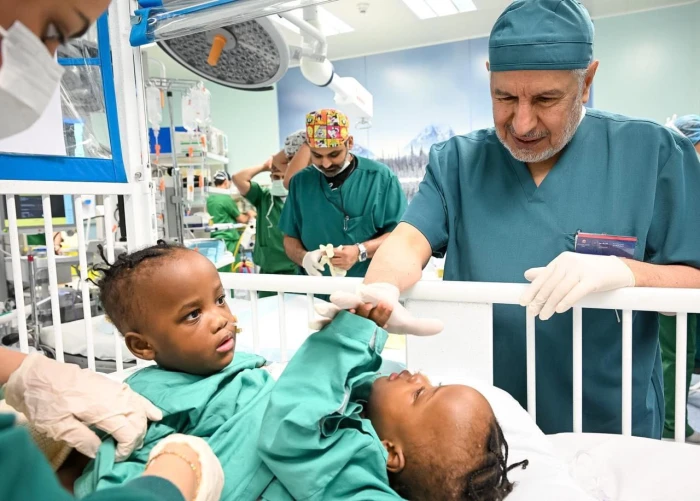
Saudi Medical Team Begins 16-Hour Surgery to Separate Tanzanian Conjoined Twins Nancy and Nice
A 35-member medical team from the Saudi Conjoined Twins Program (SCTP) began a delicate, multi-stage surgical procedure on Thursday to separate 18-month-old Tanzanian conjoined twins Nancy and Nice at King Abdullah Specialized Children’s Hospital in Riyadh. The operation, which is expected to take approximately 16 hours, involves separating the girls at their lower chest, abdominal, and pelvic areas—regions where they share critical anatomical structures.
The surgery, led by Dr. Abdullah Al-Rabeeah, advisor to the royal court, supervisor-general of the aid body KSrelief, and head of the SCTP team, follows months of preparatory examinations conducted after the twins arrived in Saudi Arabia in late January. According to verified reports, Nancy and Nice share one liver, large intestine, anus, urinary and reproductive systems, and a deformed lower limb, while each has one fully formed leg.
The procedure, which will be performed in 10 distinct stages, carries a 60% success rate, according to medical assessments. If successful, it will mark the third instance of Tanzanian conjoined twins being separated by the SCTP since the program’s inception in 1990—and the 71st such operation in its history.
Medical Challenges and Shared Anatomy
The separation of Nancy and Nice presents unique medical complexities due to their shared organs and vascular structures. According to pre-operative evaluations, the twins are conjoined at the thoraco-abdominopelvic region, a classification that accounts for approximately 10% of all conjoined twin cases globally. Their shared liver and large intestine require meticulous surgical planning to ensure post-operative viability for both girls.

Dr. Al-Rabeeah emphasized the interdisciplinary nature of the operation, involving specialists in pediatric surgery, urology, gynecology, and critical care. The team’s approach includes pre-operative imaging, intraoperative monitoring, and post-surgical rehabilitation protocols designed to mitigate risks associated with such high-complexity procedures.
Saudi Conjoined Twins Program: A Legacy of Medical Humanitarianism
The SCTP, established in 1990, has become a global leader in separating conjoined twins, particularly from sub-Saharan Africa, where medical resources for such cases are often limited. Since its founding, the program has successfully separated 71 pairs of conjoined twins, with Tanzanian cases accounting for three of those separations. The initiative operates under the auspices of King Salman Humanitarian Aid and Relief Centre (KSrelief), reflecting Saudi Arabia’s broader commitment to medical diplomacy.
For Nancy and Nice, the surgery represents a rare opportunity for survival and independent life. Conjoined twins with shared abdominal and pelvic structures often face high mortality rates if left untreated, with historical success rates varying between 30% and 60% depending on the complexity of the case. The SCTP’s track record suggests a slightly higher success threshold, though each procedure remains a high-stakes gamble.
What Happens Next: Post-Operative Care and Recovery
Assuming the surgery proceeds without complications, Nancy and Nice will require intensive post-operative care, including monitoring for infections, organ function, and potential complications from shared vascular structures. The medical team has prepared for a minimum 30-day recovery period in Saudi Arabia, during which time the twins will undergo regular evaluations to assess their progress.
If the separation is successful, the girls will likely return to Tanzania with their families, accompanied by Saudi medical advisors to ensure continuity of care. KSrelief has historically facilitated such repatriations, providing follow-up support and medical supplies to local healthcare providers.
Broader Implications: Medical Advancement and Humanitarian Aid
The case of Nancy and Nice underscores the global disparity in medical access, particularly for rare congenital conditions. While advanced surgical techniques exist in wealthier nations, families in resource-limited settings often lack the financial or logistical means to pursue life-saving interventions. Programs like the SCTP bridge this gap, offering pro bono medical care and expertise that would otherwise be unattainable.
Critics, however, have raised questions about the ethical implications of medical tourism for such high-risk procedures, arguing that resources could be better allocated locally. Proponents of the SCTP counter that the program saves lives and contributes to global medical knowledge, with each successful case informing future interventions.
Key Takeaways
- Surgery duration: 16 hours, performed in 10 stages at King Abdullah Specialized Children’s Hospital.
- Shared anatomy: One liver, large intestine, anus, urinary/reproductive systems, and a deformed lower limb.
- Success rate: 60%, per pre-operative assessments by Dr. Abdullah Al-Rabeeah.
- Program history: 71 successful separations since 1990, with three involving Tanzanian twins.
- Post-op care: Minimum 30-day recovery in Saudi Arabia before potential repatriation.
- Humanitarian context: Part of Saudi Arabia’s broader medical aid initiatives through KSrelief.
Next Steps: Monitoring the Outcome
The Saudi Ministry of Health and KSrelief are expected to provide daily updates on the surgery’s progress, though specific timelines for public announcements have not been confirmed. For the latest verified information, readers are encouraged to follow official statements from:

- Saudi Press Agency (SPA)
- King Salman Humanitarian Aid and Relief Centre (KSrelief)
- Saudi Ministry of Health
This story will continue to evolve as medical teams provide further details. We welcome your thoughts on the intersection of medical humanitarianism and global health equity in the comments below.