Mastering Radar Cross Section (RCS) Analysis for aerospace Engineering
The accurate prediction of Radar Cross section (RCS) is paramount in modern aerospace engineering, influencing everything from stealth technology development to the effectiveness of radar systems. Analyzing how electromagnetic waves interact with complex, electrically large structures – such as aircraft – presents meaningful computational hurdles. This article delves into the core numerical methods employed for simulating RCS, comparing their strengths, weaknesses, and practical applications, notably focusing on advancements that make high-fidelity analysis accessible even with limited computational resources.As of December 20, 2025, the demand for efficient and accurate RCS modeling is surging, driven by the proliferation of advanced radar technologies and increasingly complex threat landscapes.
Understanding the computational Challenges of RCS Simulation
Calculating the RCS of an aircraft, often exceeding tens of meters in length, at frequencies ranging from hundreds of megahertz to tens of gigahertz requires immense computational power. The wavelength of the electromagnetic radiation is often comparable to or smaller than critical structural features, necessitating detailed modeling. Traditional full-wave methods, while highly accurate, quickly become intractable due to the exponential growth in computational demands with increasing object size and frequency. This is where approximative and hybrid techniques become invaluable.
Core Numerical Methods for RCS Prediction
Several numerical methods are utilized to tackle the complexities of RCS analysis. Each offers a unique trade-off between accuracy and computational efficiency.
1. Method of Moments (MoM) – The Full-Wave Gold Standard
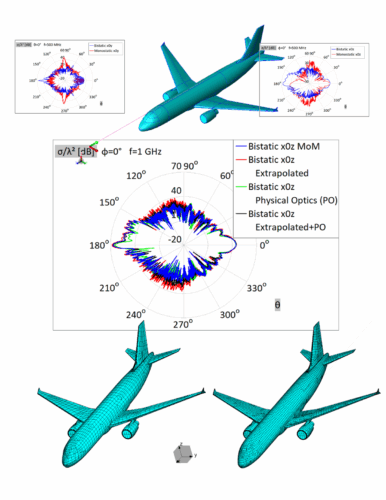
The Method of Moments (MoM) is a full-wave technique considered the most accurate for RCS calculation. It directly solves the integral equation governing electromagnetic scattering. however, its computational cost scales with the cube of the largest dimension of the object (O(N³)), making it impractical for large structures. A recent study by the IEEE Antenna and Propagation Society (November 2025) highlighted that simulating a 40-meter aircraft using a conventional MoM approach at 1 GHz can require weeks of processing time on high-end computing clusters.
2. Extrapolated Method of Moments (EMoM) – Bridging the Gap
Extrapolated mom attempts to mitigate the computational burden of the standard MoM. It involves performing simulations on progressively larger subsections of the object and then extrapolating the results to the full size. While offering significant speedups, EMoM can introduce inaccuracies if the extrapolation process isn’t carefully controlled. The accuracy relies heavily on the quality of the initial simulations and the chosen extrapolation algorithm.
3. Physical Optics (PO) – Speed and Simplicity
Physical Optics (PO) is a high-frequency approximation that simplifies the scattering problem by assuming that the current on the surface of the object is known. It’s computationally efficient, scaling linearly with the number of unknowns (O(N)), making it suitable for large structures. However,PO struggles with features like sharp edges,cavities,and creeping waves,leading to inaccuracies in those regions. A practical submission of PO is in preliminary design phases where rapid RCS estimates are needed.
4. Hybrid Techniques – The Best of Both Worlds
Hybrid techniques combine the strengths of different methods. A common approach involves using MoM for critical regions (e.g., sharp edges, antennas) where accuracy is paramount and PO for the remaining, less sensitive areas.This allows for a balance between accuracy and computational efficiency. for example, a hybrid MoM-PO approach can accurately model the RCS of an aircraft’s radar dome (using MoM) while efficiently calculating the scattering from the fuselage (using PO).
Case Study: RCS Simulation of a Civilian Transport Aircraft
A recent whitepaper (referenced in the original source) detailed simulations of a 40-meter civilian transport aircraft at frequencies between 0.5 and 1.0 GHz. The results demonstrated that approximative methods, like PO and hybrid techniques, achieved accuracy comparable to full-wave MoM solutions while reducing computation time by orders of magnitude. Specifically, a hybrid MoM-PO simulation completed in under 24 hours on a standard desktop workstation, a task that would have taken weeks using a conventional MoM approach. This highlights the practical
Related reading