
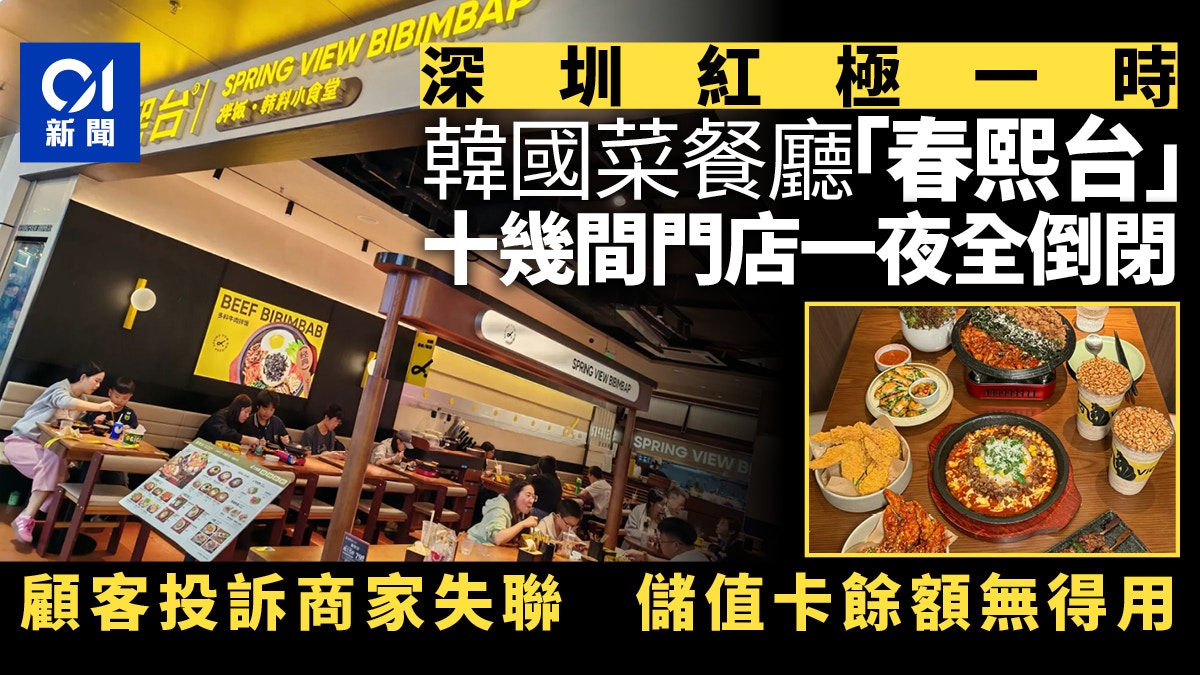
Sudden Collapse of Popular Shenzhen Restaurant Chain Leaves Customers and Staff in Limbo
Shenzhen, China — In a dramatic turn of events that has sent shockwaves through the city’s dining scene, the once-thriving Korean restaurant chain Chunxitai (春熙台) has abruptly shuttered all 12 of its locations, leaving hundreds of customers with frozen prepaid cards and employees unpaid. The sudden closure, which appears to have occurred without warning, has sparked outrage among patrons and raised concerns about the financial health of popular dining chains in China’s tech hub.
According to reports from local media and social media users, the chain’s doors were locked as early as April 26, with no official announcement or explanation from management. Customers who had prepaid for meals using the chain’s stored-value cards now find themselves unable to access their funds, with some reporting losses ranging from 200 to 1,000 yuan (approximately $28 to $140 USD). Meanwhile, employees claim they have not received their wages, fueling speculation that the company’s leadership may have absconded with remaining funds.
The collapse of Chunxitai highlights the risks consumers face when using prepaid cards in China’s booming but volatile service sector. While such cards are popular for their convenience and discounts, they often lack regulatory protections, leaving customers vulnerable when businesses fail. The incident has reignited debates about the need for stronger consumer safeguards in the country’s rapidly evolving retail landscape.
All Locations Closed, No Contact with Management
On April 26, local journalists from am730, a Hong Kong-based news outlet, visited several Chunxitai locations across Shenzhen, including branches in high-traffic areas like Futian’s COCO Park and Luohu’s MixC mall. All stores were found to be closed, with some even barricaded by temporary fencing. A search on Dianping, China’s equivalent of Yelp, confirmed that all 12 Shenzhen locations were listed as “temporarily closed,” with one branch marked as “permanently closed.”
Attempts to contact the company’s management have been futile. Multiple customers and journalists reported that phone lines for the chain’s branches were either disconnected or went unanswered. A search on Qichacha, a Chinese corporate database, revealed that Shenzhen Chunxitai Catering Chain Co., Ltd. (深圳市春熙台饮食连锁有限公司) was officially deregistered on February 28, 2025, raising further questions about the company’s financial troubles and the timing of its collapse.
“They didn’t even bother to put up a notice,” one customer, identified only as Ms. Li, told am730. She and her husband had prepaid 800 yuan (about $112 USD) in December 2025, leaving a remaining balance of approximately 570 yuan (about $80 USD) on their card. “It’s not just about the money—it’s the principle. They treated their customers like this, with no respect.”
Prepaid Cards: A Convenient but Risky Practice
The Chunxitai incident underscores the widespread employ—and inherent risks—of prepaid stored-value cards in China. These cards, which allow customers to load funds in advance for future purchases, are a common feature in restaurants, cafes and retail stores across the country. Businesses often incentivize their use by offering discounts or freebies, making them an attractive option for frequent customers.
However, unlike bank-issued debit or credit cards, stored-value cards are not protected by China’s financial regulations. If a business closes or declares bankruptcy, customers typically have no legal recourse to recover their funds. The lack of transparency around these cards’ terms and conditions further exacerbates the problem, leaving consumers in the dark about what happens to their money if a company fails.

In recent years, there have been growing calls for stricter oversight of prepaid cards. In 2023, China’s Ministry of Commerce issued guidelines encouraging businesses to use third-party escrow accounts to hold prepaid funds, but compliance remains voluntary. Consumer advocates argue that mandatory protections, such as requiring businesses to insure prepaid balances or hold them in segregated accounts, are necessary to prevent future incidents like the Chunxitai collapse.
“This is a systemic issue,” said Wang Hai, a well-known consumer rights lawyer in China, in an interview with The Paper. “Prepaid cards are a double-edged sword. They benefit businesses by providing upfront cash flow, but they likewise create significant risks for consumers. The government needs to step in and establish clear rules to protect people’s money.”
Employees Left in the Lurch
While customers grapple with lost funds, former Chunxitai employees are facing their own set of challenges. Multiple staff members took to social media to voice their frustrations, claiming they were owed back wages and had received no communication from management about the closures. Some alleged that the company’s leadership had effectively disappeared, leaving them with no way to seek compensation.
“We were told everything was normal, and then one day, the stores just didn’t open,” said a former employee who requested anonymity. “No one answered our calls, and we don’t know if we’ll ever get paid. It’s like we’ve been abandoned.”
Under Chinese labor laws, employees are entitled to unpaid wages and severance pay if a company closes or declares bankruptcy. However, the process of recovering these funds can be lengthy and complex, particularly if the company’s assets have been liquidated or hidden. In cases where management has fled, employees often have little recourse beyond filing complaints with local labor bureaus or pursuing legal action, which can be costly and time-consuming.
The Chunxitai case is not an isolated incident. In recent years, several high-profile restaurant chains in China have collapsed under financial strain, leaving employees and customers in similar predicaments. The COVID-19 pandemic exacerbated these challenges, as lockdowns and reduced foot traffic strained businesses’ cash flows. While the industry has since rebounded, rising costs, fierce competition, and shifting consumer preferences continue to put pressure on dining establishments.
What Happens Next for Affected Customers and Staff?
For Chunxitai’s customers, the outlook for recovering their prepaid funds appears bleak. Legal experts say that without a formal bankruptcy proceeding or a clear paper trail of the company’s assets, it will be difficult to track down any remaining funds. Some customers have organized online groups to share information and explore potential legal action, but the prospects for success are uncertain.
“In cases like this, the first step is to file a complaint with the local market supervision bureau,” advised Liu Junhai, a professor of consumer law at Renmin University of China, in an interview with Yicai Global. “However, if the company has already been deregistered and its assets have been dissipated, the chances of recovery are slim. Consumers should be cautious about using prepaid cards, especially for large sums of money.”
Employees, meanwhile, are being urged to report their unpaid wages to local labor authorities. In Shenzhen, the municipal human resources and social security bureau has set up a hotline for workers to file complaints and seek assistance. However, the process of recovering wages can take months, and there is no guarantee that employees will receive full compensation.
As of April 28, 2026, there has been no official statement from Chunxitai’s management or any government agency regarding the closures. The Shenzhen Market Supervision Administration has not responded to inquiries about whether an investigation into the company’s practices is underway.
Broader Implications for China’s Dining Industry
The sudden collapse of Chunxitai has reignited discussions about the financial health of China’s restaurant industry, particularly among mid-sized chains. While the sector has seen robust growth in recent years, driven by rising disposable incomes and a thriving food delivery market, many businesses struggle with thin profit margins, high rental costs, and intense competition.
According to data from the China Cuisine Association, the restaurant industry’s average profit margin hovers around 5-8%, with many establishments operating on razor-thin margins. The pandemic further strained businesses, with many forced to close temporarily or pivot to delivery-only models. While the industry has since recovered, the scars of that period remain, and many chains continue to face financial pressures.
“The Chunxitai case is a wake-up call for both consumers and businesses,” said Zhang Lei, a senior analyst at iResearch Consulting Group. “For consumers, it’s a reminder to be cautious about prepaid cards and to demand greater transparency from businesses. For restaurant operators, it highlights the need for better financial management and contingency planning. The industry is evolving rapidly, and only those who adapt will survive.”
Key Takeaways
- All 12 Chunxitai locations in Shenzhen have abruptly closed, leaving customers with frozen prepaid card balances and employees unpaid.
- The company was officially deregistered on February 28, 2025, raising questions about its financial health prior to the closures.
- Prepaid stored-value cards are popular in China but lack regulatory protections, leaving consumers vulnerable when businesses fail.
- Employees are owed back wages, but recovering these funds may be difficult without a formal bankruptcy proceeding.
- Experts urge caution with prepaid cards and call for stronger consumer protections in China’s retail sector.
- No official statement has been issued by Chunxitai’s management or local authorities as of April 28, 2026.
What You Can Do If You’re Affected
If you are a Chunxitai customer or employee affected by the closures, here are some steps you can take:
- File a complaint with the Shenzhen Market Supervision Administration: Report the issue to local authorities to assist track the case and potentially recover funds. The administration’s hotline is 12315.
- Join online consumer groups: Many affected customers are organizing on social media platforms like WeChat and Weibo to share information and explore legal options.
- Consult a lawyer: If you are owed a significant amount of money, consider seeking legal advice. Some law firms specialize in consumer rights cases and may offer free consultations.
- Employees: Report unpaid wages: Contact the Shenzhen Human Resources and Social Security Bureau at 12333 to file a complaint and seek assistance.
- Monitor official updates: Follow local news outlets and government announcements for any developments in the case.
The next official update on the Chunxitai closures is expected to come from the Shenzhen Market Supervision Administration or the local labor bureau. Until then, affected customers and employees are left waiting for answers—and for their money.
Have you been affected by the Chunxitai closures? Share your story in the comments below, and help spread the word to others who may be impacted.