
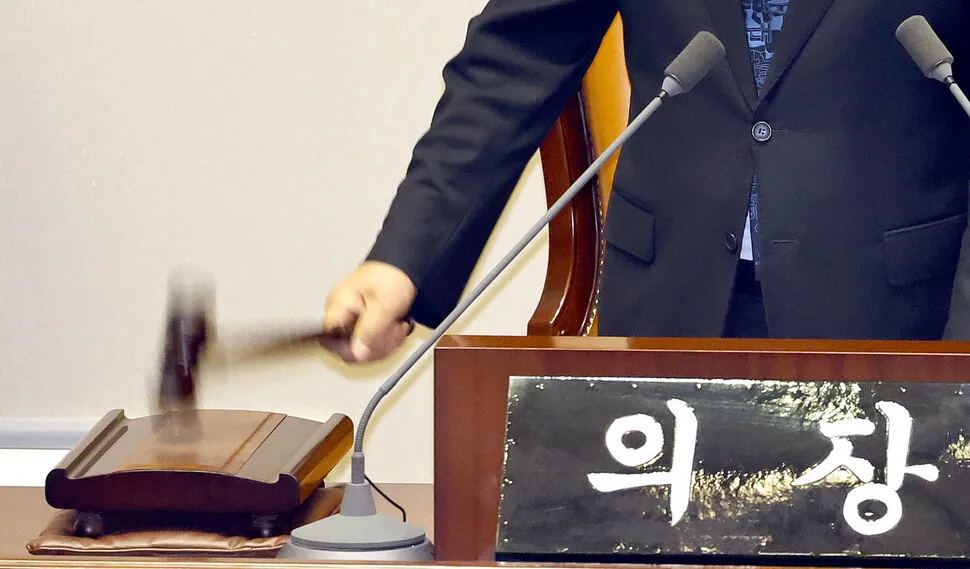
South Korea is currently embroiled in a high-stakes political stalemate as the National Assembly struggles to find common ground on constitutional reform. What began as a bipartisan discussion to modernize the nation’s foundational law has devolved into a symbolic war over the country’s historical identity and the scope of executive authority. The deadlock reflects a deeply polarized political landscape where the ruling People Power Party (PPP) and the opposition Democratic Party (DP) are fundamentally at odds over how the state should be defined in the 21st century.
At the heart of the South Korea constitutional reform deadlock is a clash between two competing visions of the republic. On one side, the opposition seeks to enshrine the legacy of pro-democracy movements—specifically the May 18 Democratic Uprising—into the constitutional preamble. On the other, members of the ruling party are pushing for language that aligns more closely with the current administration’s philosophy of governance and national security. This tension has effectively frozen progress on structural changes that many legal experts argue are long overdue.
The current legal framework, established by the 1987 Constitution, was a landmark achievement that ended decades of military dictatorship and ushered in a direct presidential election system. However, nearly four decades later, the “1987 system” is increasingly viewed as a relic of a different era. Critics argue it created an “imperial presidency,” concentrating excessive power in a single individual for a single five-year term, which often leads to extreme political volatility and a “winner-take-all” mentality in the Blue House—now the Presidential Office in Yongsan.
As the National Assembly attempts to navigate these waters, the debate has shifted from practical governance to ideological warfare. The failure to reach a consensus not only delays the redistribution of power between the executive and legislative branches but also risks further alienating a public weary of perpetual partisan conflict. With the constitutional amendment process requiring a rigorous two-thirds majority in the National Assembly followed by a national referendum, the current level of animosity makes a successful overhaul seem increasingly remote.
The Preamble War: Historical Memory vs. Administrative Ideology
The most visceral point of contention in the current reform effort is the preamble of the Constitution. While the preamble does not typically carry the same legal weight as specific articles, it serves as the moral and philosophical compass of the state. For the Democratic Party, the preamble is the rightful place to recognize the May 18 Democratic Uprising in Gwangju. This 1980 event, where citizens rose up against military repression, is seen by the opposition as the cornerstone of modern Korean democracy and a necessary acknowledgment for national healing.
However, the People Power Party has resisted the explicit inclusion of May 18, arguing that the preamble should remain a broad, unifying statement rather than a record of specific political conflicts. More controversially, reports indicate a push within the ruling party to incorporate language that reflects the current administration’s worldview—often described as a desire to cement the “Yoon Suk Yeol era” philosophy of strong leadership and a firm stance on North Korean relations into the permanent fabric of the state. This move is viewed by critics as an attempt to “ideologize” the constitution, shifting it from a neutral legal document to a political manifesto.
This ideological divide has created a paradoxical situation where both sides claim to be protecting the “spirit” of the constitution while simultaneously attempting to rewrite its essence. The opposition argues that neglecting the democratic struggles of the past is a betrayal of the people, while the ruling party claims that the opposition’s proposals are an attempt to maintain a specific political narrative under the guise of legal reform.
The ‘Imperial Presidency’ and the Struggle for Structural Change
Beyond the symbolic battles of the preamble, the structural debate centers on the nature of the presidency. The 1987 Constitution mandates a single five-year term. While this was designed to prevent the return of a lifelong dictator, it has created a phenomenon known as the “lame duck” effect, where a president’s influence wanes precipitously in their final years, often leading to governance paralysis.
Proposed alternatives include moving to a four-year term with the possibility of a single reelection. Proponents argue this would make the president more accountable to the public, as they would have to face the voters halfway through their tenure to justify their performance. Conversely, others suggest a shift toward a parliamentary system or a semi-presidential model to distribute power more equitably between the president and the Prime Minister, thereby reducing the concentration of authority that characterizes the current “imperial” model.
The deadlock persists because any change to the presidential term or power structure is seen through the lens of immediate political advantage. The ruling party is hesitant to support changes that might weaken the executive branch during their tenure, while the opposition is wary of any reform that could potentially allow a sitting president to extend their hold on power. The conversation has stalled, leaving the 1987 structure intact despite widespread agreement that it is ill-suited for the complexities of modern governance.
The Legal Hurdle: Why Reform is So Difficult
To understand why the South Korea constitutional reform deadlock is so persistent, one must look at the stringent requirements for amendment under the current law. According to the Constitution of the Republic of Korea, the process for amendment is intentionally arduous to prevent frequent or frivolous changes to the state’s foundation.
The process typically follows these stages:
- Proposal: An amendment must be proposed either by the President or by a majority of the members of the National Assembly.
- Public Notice: The proposal must be publicly announced by the President for at least 20 days.
- Legislative Vote: The amendment must be passed by a two-thirds majority of the National Assembly within 60 days of the public notice.
- National Referendum: If passed by the legislature, the amendment must then be approved by a majority of voters in a national referendum, provided that a majority of eligible voters participate.
The requirement for a two-thirds majority in the National Assembly is the primary bottleneck. In a political environment characterized by extreme polarization, achieving such a supermajority is nearly impossible without a grand bargain between the two major parties. When the debate shifts from structural efficiency (like term limits) to identity politics (like the preamble), the likelihood of such a bargain vanishes. The current stalemate is not merely a failure of diplomacy but a reflection of a legislative body that is structurally incapable of consensus on foundational issues.
Stakeholders and the Impact of Continued Paralysis
The consequences of this deadlock extend far beyond the halls of the National Assembly. Several key stakeholders are directly affected by the inability to modernize the constitution:
The Judiciary and Legal Community: Judges are often forced to interpret outdated 1987-era language to resolve modern disputes regarding digital privacy, environmental rights and gender equality. A modernized constitution would provide clearer mandates for the courts to protect contemporary civil liberties.
The Electorate: For the general public, the constant bickering over the preamble and presidential power reinforces a perception of political cynicism. Many voters feel that constitutional reform is being used as a tool for partisan maneuvering rather than a means to improve the quality of democracy.
International Observers: As a leading global democracy and economic power, South Korea’s internal political stability is closely watched. A prolonged inability to reform its basic law may be seen as a sign of democratic fragility, potentially affecting investor confidence and diplomatic standing.
the failure to address the “imperial presidency” continues to fuel a cycle of political retribution. In South Korea, it has become common for former presidents to face investigation or imprisonment after leaving office, as the immense power they wielded during their term often leads to accusations of abuse of power. Reformers argue that by decentralizing executive authority, the state could break this destructive cycle of “presidential revenge.”
What Happens Next?
With no immediate consensus in sight, the path forward remains murky. The current administration continues to emphasize a strong executive to manage national security challenges, while the opposition remains steadfast in its demand for the recognition of the May 18 movement. The most likely short-term outcome is a continuation of the status quo, where the 1987 Constitution remains the law of the land by default rather than by design.
However, the pressure for change is mounting from civil society and legal scholars. There are growing calls for a “Citizen’s Constitutional Convention”—a body independent of party politics—to draft a proposal that could then be presented to the National Assembly. While such a move would be unprecedented in South Korean history, it may be the only way to bypass the partisan gridlock currently paralyzing the legislature.
The next critical checkpoint will be the upcoming legislative session, where the National Assembly is expected to review several proposed bills related to governance reform. While these may not be full constitutional amendments, they will serve as a litmus test for whether the two parties are capable of any meaningful cooperation on the structure of the state.
Do you believe South Korea should move toward a parliamentary system to end the ‘imperial presidency,’ or is the current system necessary for stability? Share your thoughts in the comments below and subscribe to World Today Journal for further analysis on East Asian political developments.