The political landscape in South Korea has entered a period of intense volatility as the nation prepares for a decisive election that promises to further define the trajectory of its young democracy. As voters approach the polls, the rhetoric from both the ruling and opposition parties has escalated into a high-stakes battle over the country’s recent history and the legitimacy of its current governance.
At the heart of the confrontation is a fundamental disagreement over the meaning of political accountability. The ruling Democratic Party is framing the upcoming vote as a final “judgment” on those perceived to have supported the previous administration’s controversial and failed martial law attempt. Meanwhile, the opposition People Power Party is mounting a fierce counter-offensive, characterizing the current Lee Jae-myung administration as an “arrogant” government that has overstepped its bounds.
This deepening divide comes at a critical juncture for Seoul, as the country continues to navigate the democratic tremors left by the impeachment and removal of former President Yoon Suk Yeol. The tension currently saturating the streets of Seoul and beyond reflects a nation still grappling with the fallout of political instability and the rapid transition of power that followed the martial law crisis.
A Mandate for Accountability: The Ruling Party’s Stance
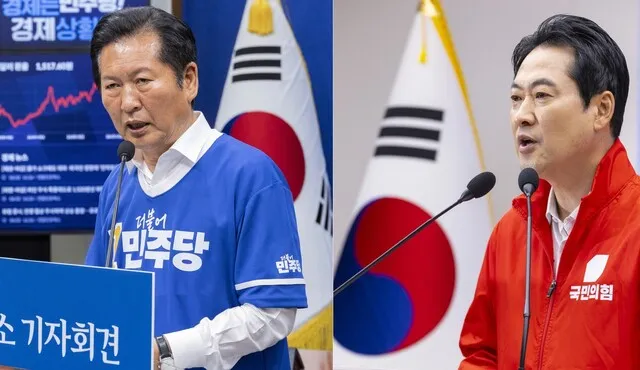
For members of the Democratic Party, the current political moment is less about policy and more about a moral reckoning. Jung Chung-rae, a prominent figure within the party, has been vocal in characterizing the election as a “cool-headed judgment” against those who allegedly defended the “insurrection” attempted by the previous administration.
The term “insurrection” in this context refers to the brief yet disastrous martial law bid by former President Yoon Suk Yeol, an event that triggered massive public protests and ultimately ended his political career. The Democratic Party’s strategy appears to be centered on consolidating support by positioning themselves as the defenders of democratic norms, demanding that voters punish those who stood by during the constitutional crisis.
As the election nears, party leaders have been engaged in a final, frantic push for voter turnout. Jung has emphasized the importance of every single vote, urging supporters to remain engaged until the very last second of the polling period. This “last mile” approach highlights the party’s belief that the election’s outcome hinges on mobilizing a base that is deeply motivated by the desire to protect South Korea’s democratic institutions.
Challenging the Incumbent: The Opposition’s Counter-Attack
The People Power Party, serving as the primary opposition, has rejected the narrative of democratic defense, instead focusing its criticism on the perceived overreach of the current administration. Jang Dong-hyuk, representing the opposition’s front line, has framed the election as a necessary check on what he describes as the “arrogance” of the Lee Jae-myung government.
The opposition’s platform seeks to tap into growing concerns regarding the ruling party’s dominance and its approach to governance. By labeling the administration as “arrogant,” the People Power Party is attempting to appeal to moderate voters who may feel that the rapid shift in political power has led to a lack of bipartisan cooperation and a disregard for traditional checks and balances.
This strategy aims to pivot the national conversation away from the martial law aftermath and toward the day-to-day realities of the Lee Jae-myung presidency. For the opposition, the election is not a referendum on the past, but a critical opportunity to prevent what they describe as a “runaway” government from exerting unchecked control over the legislative and executive branches.
The Shadow of Martial Law: A Nation Reeling
To understand the ferocity of the current political battle, the profound impact of the events that led to the current administration. The transition from the Yoon Suk Yeol era to the presidency of Lee Jae-myung was marked by unprecedented political chaos. The failed martial law bid by the former president served as a catalyst for a massive movement for democratic accountability, eventually leading to his impeachment and removal from office.

Lee Jae-myung, who secured a decisive victory in the snap presidential election held in June 2025, inherited a country that was both relieved and deeply scarred by the instability. While his victory was seen by many as a rejection of the previous administration’s tactics, it also left him with the monumental task of uniting a highly polarized electorate. The current political climate suggests that the wounds from that period have not yet healed, but have instead been repurposed as potent political weapons by both sides.
The polarization currently seen in the South Korean political landscape is a direct reflection of this history. The struggle is no longer just about administrative policy; We see a fundamental clash over the interpretation of the recent constitutional crisis and the appropriate role of the state in a post-martial law society.
Navigating a Polarized Future
As the election approaches, the stakes for South Korean democracy could not be higher. The outcome will likely determine whether the nation moves toward a period of consolidated democratic stability or descends further into partisan gridlock.
If the ruling Democratic Party secures a significant victory, it may feel emboldened to pursue a more aggressive agenda of political accountability, potentially leading to further investigations and legal proceedings regarding the previous administration’s actions. Conversely, a strong showing for the People Power Party could serve as a significant check on the Lee Jae-myung administration, forcing a more consultative approach to governance but also potentially deepening the legislative stalemate.
For the global community, the stability of South Korea remains a key interest, particularly given its role in regional security and its complex economic relationships with major powers like the United States. The ability of the South Korean political system to resolve these deep-seated tensions through the ballot box will be a critical test of its democratic resilience.
Key Takeaways
- Rhetorical Warfare: The Democratic Party is framing the election as a “judgment” on supporters of the previous administration’s martial law attempt, while the People Power Party is attacking the “arrogance” of the current Lee Jae-myung government.
- Historical Context: The current tension is deeply rooted in the impeachment of former President Yoon Suk Yeol following his failed martial law bid.
- Polarization: The political divide in South Korea remains extreme, with both major parties utilizing the recent constitutional crisis to mobilize their respective bases.
- Democratic Stakes: The election results will significantly influence the balance of power between the executive and legislative branches and the overall stability of the nation.
The next major development will be the official announcement of preliminary vote tallies following the close of polling. We will continue to monitor the situation as more data becomes available.
What do you think about the current political direction in South Korea? Share your thoughts in the comments below and share this article to join the conversation.
Worth a look