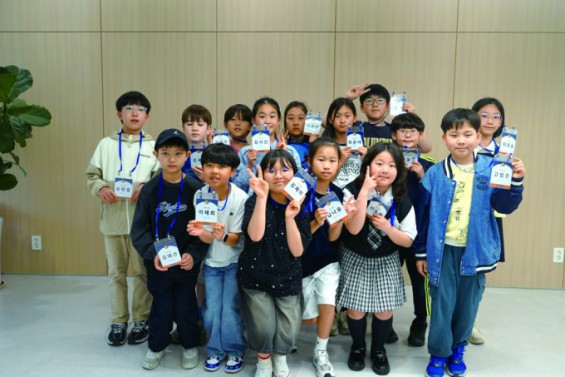
Space traffic management has become a critical concern as Earth’s orbit grows increasingly crowded with active satellites and debris. On April 15, 2025, a group of young science reporters visited the headquarters of Dongascience in Seoul to learn how South Korean company Spacemap is addressing this challenge through real-time satellite tracking and collision prediction technology. The visit was part of the first field mission for the third generation of the Children’s Space Reporter program, an initiative by the science magazine Children’s Science DongA designed to inspire elementary students toward careers in space science and technology.
During the session, Spacemap researcher Hyun-oh Heo presented a visualization of Earth’s surrounding orbit filled with satellites and space debris, prompting the young reporters to consider what happens when spacecraft collide in orbit. The demonstration highlighted the growing risk of orbital collisions as the number of objects in space continues to rise, a concern underscored by recent military exercises involving satellite maneuvering observed by international defense agencies.
Spacemap, founded in September 2021 by Professor Deok-soo Kim of Hanyang University’s Department of Mechanical Engineering, specializes in space situational awareness and space traffic management. The company develops systems that monitor the position and movement of artificial satellites and debris to predict potential collisions and support safe satellite operations. Its technology enables operators to assess collision risks and make informed decisions about satellite maneuvers to avoid impacts in orbit.
The Children’s Space Reporter program has engaged over 1,800 elementary students since its launch in 2024, with participants completing dozens of space-themed missions. Two students selected from the 2025 cohort were awarded a visit to the National Aeronautics and Space Administration (NASA) in the United States as recognition of their outstanding participation. The program collaborates with major South Korean space institutions and enterprises to provide hands-on learning experiences that foster future talent in the aerospace sector.
As part of their visit to Dongascience, the young reporters tested Spacemap’s educational platform called ’42SAGA,’ which simulates space environments to teach users about satellite operations and orbital mechanics. Through this interactive tool, they practiced maneuvering virtual satellites while learning how real-time data supports decision-making in space traffic control. The platform aims to make complex concepts in astrodynamics accessible to younger audiences through experiential learning.
Spacemap’s work reflects broader international efforts to ensure the long-term sustainability of activities in Earth’s orbit. With thousands of satellites currently operational and many more planned for deployment in large constellations, accurate tracking and predictive analytics are essential to prevent cascading collisions that could render certain orbital paths unusable—a scenario known as the Kessler Syndrome. The company’s contributions to space domain awareness support global initiatives to develop norms and technical standards for responsible space operations.
Later in 2025, Spacemap introduced a public-facing service named ‘SpaceTube,’ described as a hybrid of ‘space’ and ‘YouTube’ that allows users to observe real-time movements of satellites, including notable activities such as Chinese satellite maneuvers referenced in international defense reports. The platform enables users to click on individual space objects to view their trajectories and assess collision risks using integrated analytics. According to company representatives, SpaceTube leverages real-time satellite data to provide transparency into orbital activities while supporting educational and professional use cases.
The development of SpaceTube builds upon Spacemap’s core expertise in space object recognition and tracking, which has drawn attention from international partners including entities within the United States space sector. By making orbital data more accessible, the company aims to promote awareness of space traffic dynamics among policymakers, educators, and the general public. Such tools are increasingly valued as nations work to establish cooperative frameworks for monitoring and managing activities in shared orbital environments.
Educational outreach remains a central component of Spacemap’s mission, with programs like the Children’s Space Reporter initiative serving to connect young learners with real-world applications of space technology. By engaging students in hands-on simulations and expert interactions, the company helps cultivate interest in science, technology, engineering, and mathematics (STEM) fields related to aerospace. These efforts align with national strategies to strengthen South Korea’s position in the global space industry through workforce development and public engagement.
As orbital congestion continues to present operational challenges, the role of companies like Spacemap in providing accurate, timely information about satellite positions and movement patterns becomes increasingly vital. Their systems support not only collision avoidance for individual satellite operators but likewise contribute to the collective understanding of space traffic patterns necessary for sustainable use of near-Earth space. Ongoing advancements in sensing, data processing, and predictive modeling will be key to enhancing the reliability of space traffic management systems in the years ahead.
To stay informed about developments in space traffic management and satellite safety, readers can follow updates from international organizations such as the Inter-Agency Space Debris Coordination Committee (IADC) and the United Nations Committee on the Peaceful Uses of Outer Space (COPUOS). These forums regularly publish guidelines and technical recommendations aimed at reducing orbital debris and improving operational safety.
What are your thoughts on how emerging technologies can help ensure the safety and sustainability of activities in Earth’s orbit? Share your perspective in the comments below and help spread awareness by sharing this article with others interested in the future of space exploration.
Keep reading