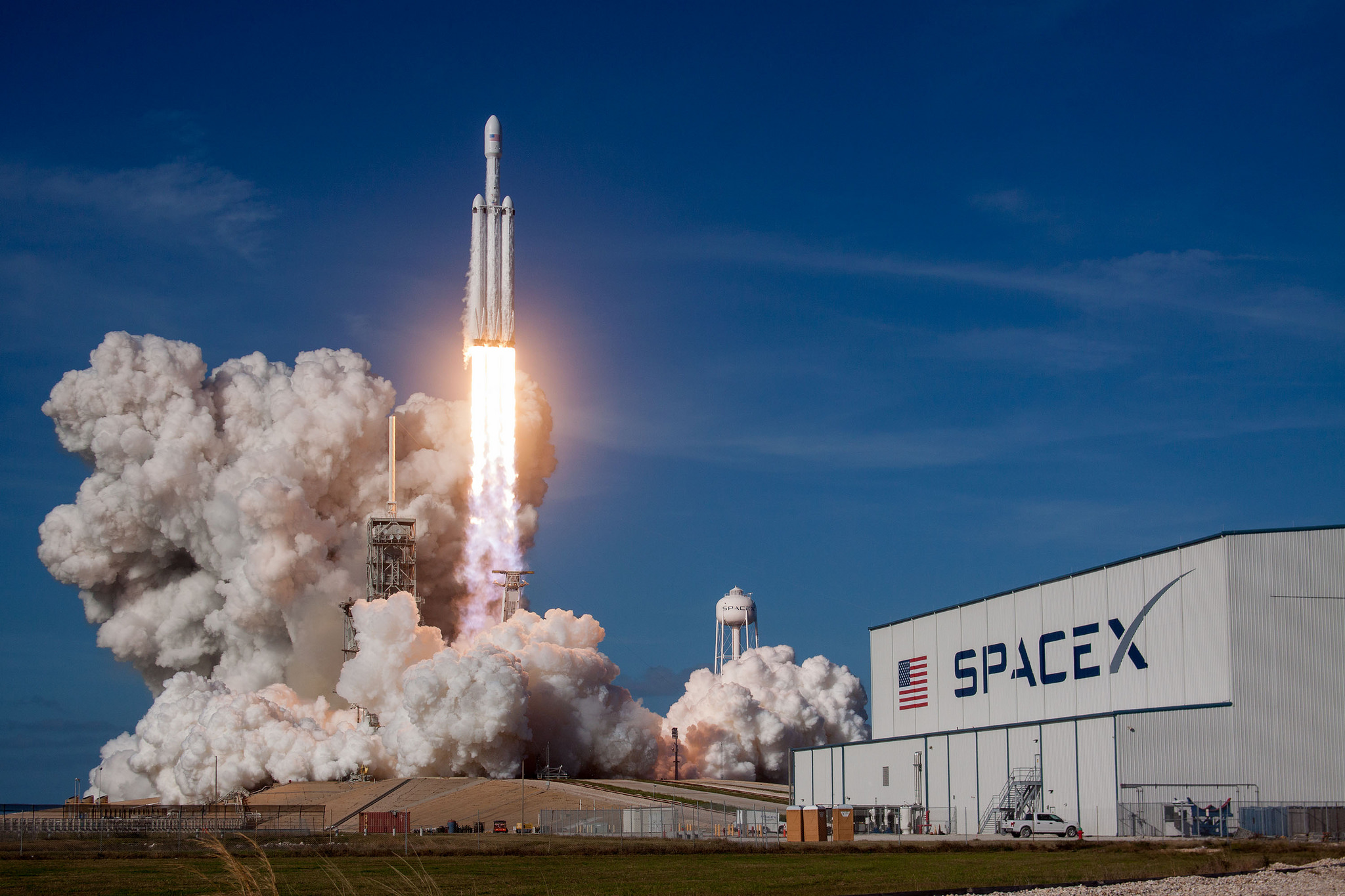
An uncontrolled Falcon 9 rocket stage launched in January 2025 is on a collision course to strike the Moon at 8,700 kilometers per hour.
A spent rocket stage that has drifted through deep space for a year and a half is hours away from colliding with the Moon. The impact, scheduled for the early hours of Wednesday, August 5, 2026, involves the upper stage of a SpaceX Falcon 9 rocket that launched on January 15, 2025, from Cape Canaveral, Florida.
That initial mission carried a pair of lunar payloads, including the Blue Ghost 1 lander built by Firefly Aerospace under NASA’s Commercial Lunar Payload Services program. While the lander successfully reached the lunar surface, the rocket’s upper stage lacked sufficient fuel to return to Earth or enter a stable parking orbit, leaving it vulnerable to gravitational perturbations that ultimately steered it toward the lunar surface.
Impact Trajectory, Energy, and the Cratering Experiment Near Crater Einstein
The four-metric-ton vehicle measures more than 12 meters in length and will strike the Moon at approximately 8,700 kilometers per hour, roughly seven times the speed of sound. Because the Moon lacks an atmosphere to slow down incoming projectiles, the collision will release energy equivalent to roughly three tons of TNT, according to analyses from orbital tracking researchers. Alternate calculations published by European outlets estimate the energy yield slightly higher, at roughly 118 gigajulios, or the equivalent of about 28 tons of TNT.
The collision is expected to occur near the Einstein crater on the western edge of the Moon’s visible face.
Scientists view the impending crash as a rare scientific opportunity. Because researchers know the exact mass, velocity, angle, and trajectory of the projectile, the event serves as a controlled laboratory test for lunar crater formation models.
Tracking the Drift and the Precedent Set by Previous Lunar Impacts
The collision path was not calculated by SpaceX, which has not issued public statements regarding the impending impact. Instead, the trajectory was mapped by Bill Gray, creator of Project Pluto software used to track near-Earth objects, alongside a team of independent researchers.
This marks the second recorded instance of an uncontrolled human-made rocket stage striking the Moon. In March 2022, remnants from a Chinese Long March 3C mission launched originally in 2014 collided unexpectedly with the lunar surface.
Cislunar Debris Hazards for NASA Artemis and Future Lunar Bases
While the upcoming impact poses no danger to the Moon’s uninhabited environment or to recent landing sites, astrofisicists and legal scholars warn that it highlights a rapidly growing blind spot in space traffic management.
As space agencies and private commercial operators ramp up missions toward the lunar south pole under initiatives like NASA’s Artemis program, the volume of traffic traveling between Earth and the Moon is expected to increase dramatically. Experts emphasize that leaving spent upper stages in chaotic cislunar orbits will transform accidental collisions from rare anomalies into routine hazards for future permanent human settlements.
With international commercial lunar exploration accelerating, the August 2026 impact serves as both an unprecedented geological experiment and a stark reminder of the need for binding orbital cleanup frameworks beyond low-Earth orbit.
Keep reading