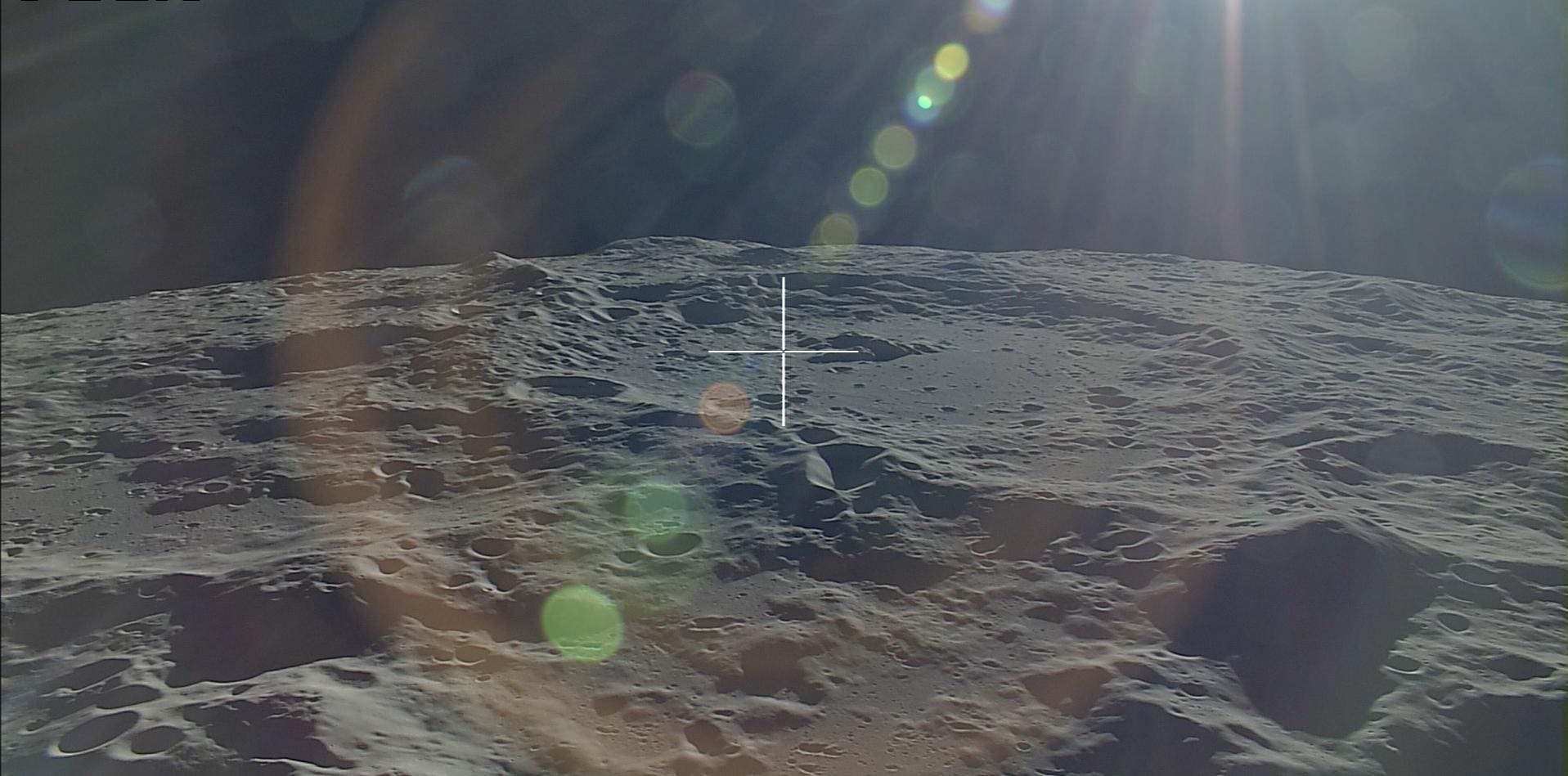
A discarded SpaceX Falcon 9 rocket stage struck the moon on Wednesday, August 5, 2026, creating a fresh impact crater near Einstein Crater. Space tracking experts confirmed the collision after the 4-ton upper stage spent nearly seven months drifting off course, posing no danger to Earth.
The 45-foot upper stage crashed into the lunar surface at approximately 2:35 a.m. EDT, traveling at roughly 5,400 mph (according to Forbes reporting). The collision occurred on the moon’s far side near Einstein Crater during daylight hours, making the impact flash invisible from Earth-based telescopes.
SpaceX launched the Falcon 9 rocket on Jan. 15, 2025, from Cape Canaveral, carrying Firefly Aerospace’s Blue Ghost Mission 1 and ispace’s Resilience lunar lander. While Blue Ghost successfully touched down on March 2, 2025, and Resilience wrecked on June 4, 2025, the rocket’s upper stage remained adrift in space rather than executing a destructive atmospheric re-entry over Earth.
Tracking the Unplanned Collision Course
Astronomers tracked the erratic trajectory of the abandoned hardware for months. A combination of solar activity and gravitational forces gradually altered the path of the 4-ton cylinder, setting it on a definitive collision course with the lunar surface (noted in regional coverage). By May, researchers confirmed the object—cataloged as 2025-010D—would hit the moon.
Jonathan McDowell, retired astrophysicist via Associated Press, stated that there is no doubt in his mind that the rocket is now in tiny little pieces scattered over the moon near Einstein Crater.
Independent observers attempted to capture the event in real time. Dutch scientist Marco Langbroek aimed his telescope at the target zone during the predicted impact window but recorded no visible plume or flash. Langbroek acknowledged that they knew this would be a long shot. Visual confirmation of the resulting crater, estimated by researchers to span about 89 feet wide, must wait for NASA’s Lunar Reconnaissance Orbiter to pass over the site.
Growing Concerns Over Lunar Debris and Traffic
NASA officials emphasized that the impact carried zero risk for Earth according to statements from agency spokesperson Jimi Russell, who confirmed no dangerous debris would project toward our planet. However, the incident renews safety debates as commercial and government agencies ramp up lunar exploration.
The European Space Agency tracks roughly 35,000 total objects in space based on surveillance network data, while media reports indicate about 3,000 human-made items now rest on the moon. That inventory totals roughly 209 tons of discarded hardware, stretching back to the Soviet Union’s Luna 2 mission in 1959 and encompassing equipment left behind during NASA’s historic Apollo missions.
Future Exploration Plans and Disposal Rules
With more than 100 lunar missions planned over the coming decade by international space agencies and private firms, scientists warn that uncontrolled debris could threaten robotic craft, future lunar bases, and sensitive geological sites. SpaceX’s Julianna Scheiman stated that her company actively collaborates with NASA to mitigate future disposal risks, clarifying that the recent trajectory was entirely accidental rather than deliberate.
The stakes will rise significantly as agencies prepare for human landings. NASA intends to build a permanent base near the lunar south pole through upcoming Artemis missions, creating an enduring presence
on the surface as outlined in agency plans. Private providers including SpaceX and Blue Origin are developing landers for these programs, targeting an astronaut touchdown as early as 2028.
Jonathan McDowell, astrophysicist via Associated Press, noted that things are going to get a lot busier near the moon and added that at that point an impact like this on the lunar surface plowing up huge amounts of dust going for hundreds of miles around is not going to be acceptable.
Keep reading
- Mars 5 Review: The Best Budget 3D Printer of 2026 (Deal Included)
- OPPO Find X9 Ultra Camera Review: London Photo Samples & Xiaomi 17 Ultra Comparison
- Russian Missile and Drone Strikes Kill at Least 14 in Kyiv Region (archyworldys.com)
- SpaceX Rocket Stage to Hit Moon at 5,400 MPH in Unplanned Collision (time.news)