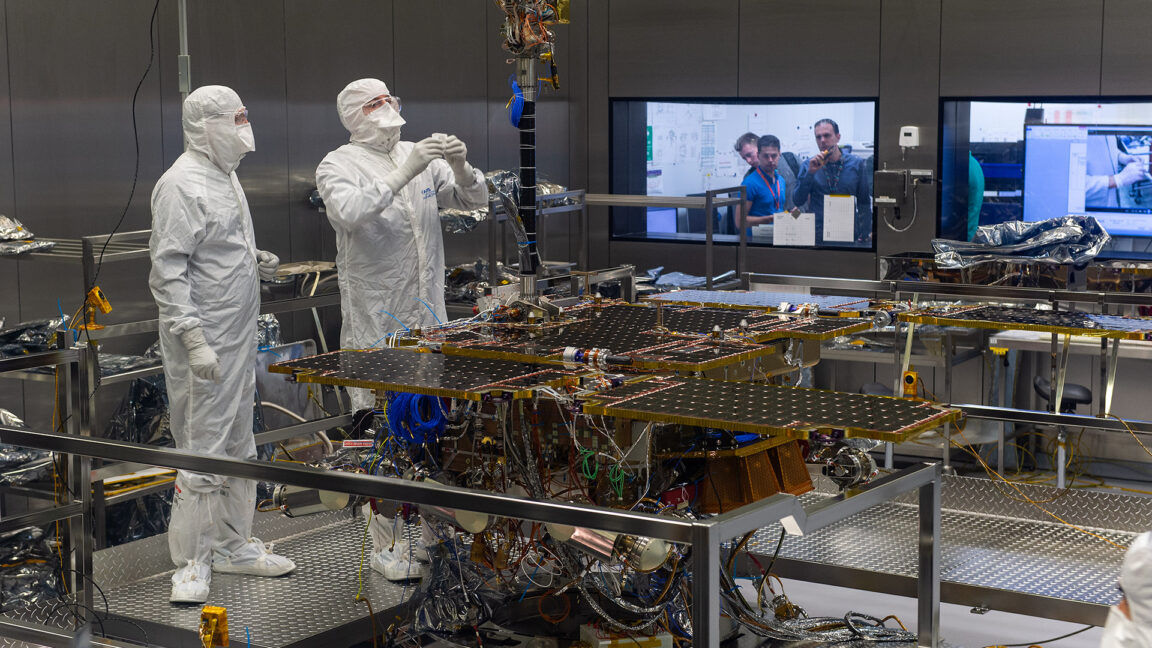
NASA confirmed on Thursday that SpaceX will launch the European Space Agency’s Rosalind Franklin Mars rover on a Falcon Heavy rocket from Kennedy Space Center in Florida, with a potential launch window as early as late 2028. This announcement marks a pivotal moment for the long-delayed ExoMars mission, which has faced years of setbacks due to shifting partnerships, geopolitical tensions, and technical challenges.
The Rosalind Franklin rover, named after the British chemist whose perform was critical to understanding the structure of DNA, is designed to search for signs of ancient life on Mars by drilling up to two meters below the surface to collect samples shielded from surface radiation and extreme temperatures. NASA’s involvement includes providing heater units, elements of the propulsion system, and contributing to the Mars Organic Molecule Analyzer (MOMA) instrument through existing partnerships with the German Aerospace Center (DLR) and the French space agency CNES.
The agreement between NASA and ESA, formalized in May 2024, expands NASA’s role in the mission by having the NASA Launch Services Program procure a U.S. Commercial launch provider—now confirmed as SpaceX—for the rover’s journey to Mars. This collaboration builds on a history of transatlantic cooperation in space exploration that dates back decades, though the path to this point has been far from straightforward.
The origins of the Rosalind Franklin mission trace back nearly 25 years to the Aurora program, conceived by ESA in the early 2000s following NASA’s Mars Pathfinder landing in 1997. Initial plans envisioned a 2009 launch using a Russian Soyuz rocket, but delays and evolving international dynamics led to a restructured effort. In 2009, NASA and ESA signed an agreement to jointly pursue Mars exploration, with the European rover slated to launch alongside a NASA counterpart in 2018 using United Launch Alliance Atlas V rockets. That partnership dissolved less than three years later when NASA withdrew from the agreement.
Subsequent attempts to proceed with a Russian-led launch via Roscosmos were halted in 2022 following Russia’s invasion of Ukraine, which prompted ESA to suspend cooperation with Roscosmos on the ExoMars program. This left the rover without a launch vehicle and thrust the mission into uncertainty until NASA stepped in to secure a U.S.-based solution.
The decision to use SpaceX’s Falcon Heavy reflects both the rocket’s proven capability for deep-space missions and the strategic importance of maintaining access to reliable U.S. Launch services for international partners. Falcon Heavy has demonstrated its ability to deliver heavy payloads to Mars, most notably during the 2018 test flight that carried Elon Musk’s Tesla Roadster into heliocentric orbit.
Scientists emphasize that the Rosalind Franklin rover’s subsurface drilling capability is unique among current and planned Mars missions. By accessing layers of soil untouched by surface oxidation and cosmic radiation, the rover increases the likelihood of detecting preserved organic molecules—potential biosignatures that could indicate past microbial life. The MOMA instrument, a key contribution from European and U.S. Partners, will analyze these samples for a wide range of organic compounds using laser desorption and mass spectrometry.
As of early 2026, the rover has completed critical environmental testing and is undergoing final preparations at Airbus Defence and Space’s facility in Stevenage, United Kingdom. Once launched, it will join a growing fleet of robotic explorers on Mars, including NASA’s Perseverance and Curiosity rovers, which have already transformed our understanding of the planet’s geology and climate history.
The mission underscores the enduring value of international collaboration in space science, even amid terrestrial challenges. With the launch now targeted for no earlier than late 2028, the Rosalind Franklin rover stands poised to contribute one of the most sophisticated searches for life’s building blocks ever attempted on another world.
For updates on mission milestones, testing phases, and launch preparations, readers can follow official announcements from the European Space Agency’s ExoMars portal and NASA’s Mars Exploration Program website.
What are your thoughts on the renewed push to find signs of ancient life on Mars? Share your perspective in the comments below and help keep the conversation going.
Related reading
- Long March 8A Rocket Launches New Internet Constellation Satellites
- Total Solar Eclipse and Perseid Meteor Shower to Occur on August 12, 2026
- Dengue Fever Alert: Miami-Dade Confirms Case and Warns of Symptoms (time.news)
- Guoan Club Confirms Major Exit List as Transfer Rumors Spark Fan Outrage (archyde.com)