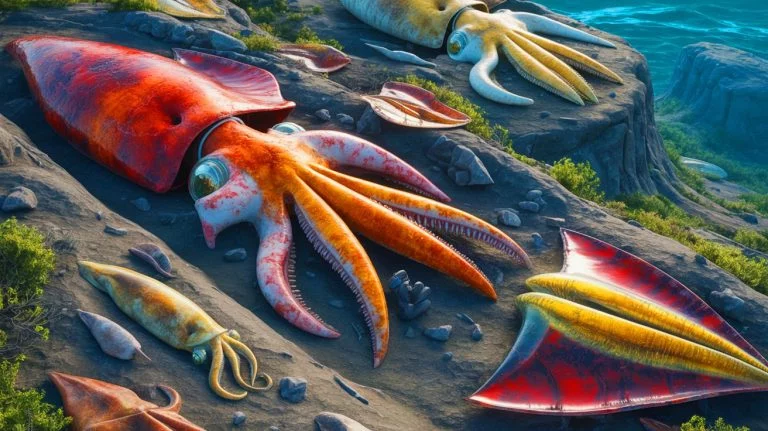
Scientists have made significant progress in understanding how squid and cuttlefish survived major extinction events and came to dominate marine ecosystems. Research published in recent studies indicates that these cephalopods originated in deep ocean environments over 100 million years ago, using oxygen-rich deep-sea refuges to endure periods of widespread environmental upheaval. Their evolutionary journey remained relatively stable for millions of years before a period of rapid diversification allowed them to expand into novel habitats.
This evolutionary resilience has positioned squid and cuttlefish as key players in modern ocean food webs, with their intelligence and adaptability continuing to intrigue researchers. The findings build on genomic analyses that trace the lineage of these creatures back to the Cretaceous period, shedding light on how certain species endure planetary-scale disruptions while others vanish.
One study, highlighted in science news outlets, explains that by sequencing the genomes of multiple squid and cuttlefish species and comparing them with global ecological data, researchers identified a pattern of survival tied to deep-sea refuge utilization during mass extinctions. After these events, as conditions stabilized in shallower waters, the creatures underwent a burst of evolutionary innovation, developing diverse forms suited to varying depths, temperatures and predatory pressures.
The research does not attribute this adaptation to any single genetic mutation but rather to a combination of regulatory changes and environmental opportunity. Scientists emphasize that the ability to shift habitats in response to changing ocean chemistry and temperature played a crucial role in their long-term success.
These insights contribute to broader discussions about marine biodiversity and ecosystem resilience, particularly as modern oceans face challenges from climate change, acidification, and deoxygenation. Understanding how cephalopods navigated past crises may offer valuable context for predicting how marine life could respond to current and future stressors.
In related developments, scientists continue to explore the neurological complexity of cephalopods, noting their advanced problem-solving abilities, camouflage techniques, and decentralized nervous systems. Studies have shown that cuttlefish, in particular, exhibit signs of self-control and learning capabilities comparable to some vertebrates, further underscoring their evolutionary significance.
While the core findings about deep-sea refuges and post-extinction diversification are supported by multiple peer-reviewed analyses, researchers caution that the fossil record for soft-bodied organisms like squid remains incomplete. Ongoing efforts to improve deep-sea sampling and genomic databases aim to refine timelines and clarify evolutionary branching points.
As part of ongoing science communication, this topic invites reflection on the interconnectedness of life and the importance of preserving ocean health. The story of squid and cuttlefish survival serves as a reminder of life’s capacity to adapt—even in the face of profound disruption—when suitable refuges exist.
For readers interested in staying informed about similar scientific breakthroughs, following updates from reputable science journals and marine research institutions provides access to the latest verified findings. World Today Journal remains committed to delivering accurate, well-sourced coverage of developments in natural science and technology.
To join the conversation, share your thoughts in the comments below or pass this article along to others curious about the mysteries of evolution and ocean life. Engaged readership helps support quality journalism that brings complex topics to light with clarity and care.