Two women and a nine-year-old boy were rescued in west Michigan after spending three grueling days stranded in dense wilderness following a failed river tubing trip, according to body camera footage and official reports released by the Michigan Department of Natural Resources.
Search teams located Sarah Vida, 28, her son Kayden Kovalcik, 9, and Jazmin Hock, 28, on Friday in a heavily wooded area roughly seven miles from where they originally entered the Muskegon River. The group had been reported missing earlier in the week after one of the women failed to show up for a scheduled dentist appointment, prompting an extensive search across rugged terrain and high riverbanks.
The ordeal began on Tuesday in the small community of Twin Lake when the trio’s inner tubes repeatedly struck logs and eventually popped, according to state officials. Stranded in their swimwear without a working phone and with only a single water bottle containing a few sips of liquid, the group attempted to walk out of the area on foot but quickly became disoriented in the dense brush.
The Muskegon River Wilderness Search and Rescue
For 72 hours, local conservation officers and state police scoured remote timberland and river corridors. According to Cameron Wright, a conservation officer from Newaygo County who participated in the search, rescue crews were running low on viable search locations when they picked up physical traces of the missing group.
Rescuers tracked footprints, broken twigs, and flattened switchgrass along the riverbank before hearing a faint noise in the distance. Body camera footage shows officers pushing through sharp vegetation and shoulder-high brush before spotting the trio in a remote thicket.
“You’re talking about vegetation that’s higher than your eyes and switchgrass that cuts you when you touch it and stinging nettles that makes your skin set on fire,” Anna Cullen, a conservation officer from Muskegon County who assisted in the operation, told reporters on Tuesday, as detailed by U.S. News & World Report.
Survival Tactics in the Michigan Brush
During their three days in the wilderness, the stranded tubers relied on what the environment provided. In the rescue video, young Kayden explained to officers that they survived by eating bark and flowers, while Hock noted that they drank river water when dehydration set in.
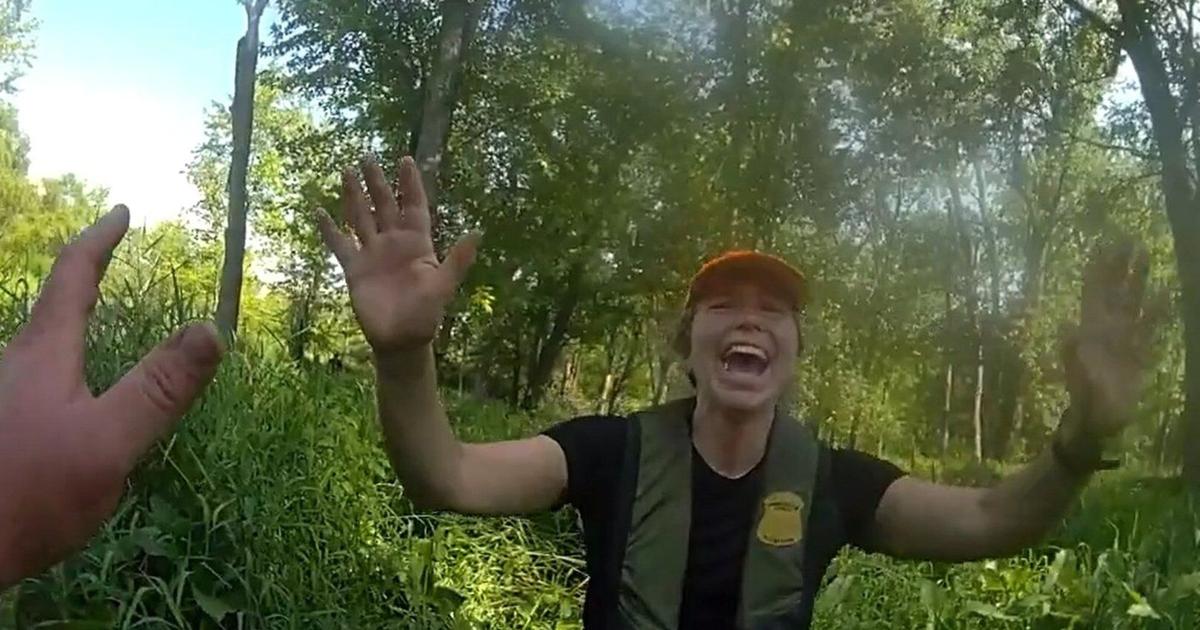
Officials reported that the group was plagued by swarms of bugs and covered in deep, red cuts, mud, and scrapes. When rescuers finally reached them, the conditions were severe enough that the two women were unable to walk. Rescue personnel placed them into Stokes baskets for extraction, while Wright carried the nine-year-old boy out on his back.
“There was not even an inch of their exposed skin that was not just covered in cuts and bug bites and mud and scrapes where they were just physically not able to go any further,” Wright said, according to Associated Press reporting.
Medical Evaluation and Recovery
Following their extraction from the dense brush, Vida, Kovalcik, and Hock were evaluated by emergency medical personnel and transported to a local hospital to be treated for exhaustion, severe dehydration, and numerous insect bites, according to Lt. Pat Agema, a spokesperson for the Michigan State Police.

Despite the physical toll of the three-day ordeal, responders noted the resilience of the young boy. Wright recalled that during the long hike out of the woods, Kayden talked excitedly about the food he planned to eat, including root beer, slushies, pizza, and doughnuts.
“You would have no idea that he had just spent 72 hours in the woods from how happy he was,” Wright added.