
For decades, one of the most enduring mysteries in paleontology has been the anatomical paradox of Tyrannosaurus rex: how could a creature of such immense power, a predator that sat at the absolute pinnacle of the Cretaceous food web, possess forelimbs so small they seemed almost vestigial?
While popular culture often depicts the T-Rex as a clumsy giant hindered by its diminutive reach, recent paleontological research is reshaping our understanding. The answer, it appears, lies not in a loss of function, but in a profound evolutionary trade-off. New biomechanical insights suggest that the evolution of the T-Rex’s legendary skull strength and massive bite force directly contributed to the reduction of its arms.
This shift in perspective moves the conversation away from “useless limbs” and toward a sophisticated model of evolutionary specialization. As the Tyrannosaurid lineage moved toward extreme cranial specialization, the biological and mechanical costs of maintaining large, muscular forelimbs became an evolutionary disadvantage.
The Biomechanics of a Bone-Crushing Predator
To understand why the arms shrank, one must first understand the sheer scale of the head. The Tyrannosaurus rex was not merely a flesh-eater; it was a specialized “puncture-pull” predator. Unlike many other large theropods that relied on slicing meat, the T-Rex possessed a skull designed to withstand—and deliver—extraordinary crushing forces.
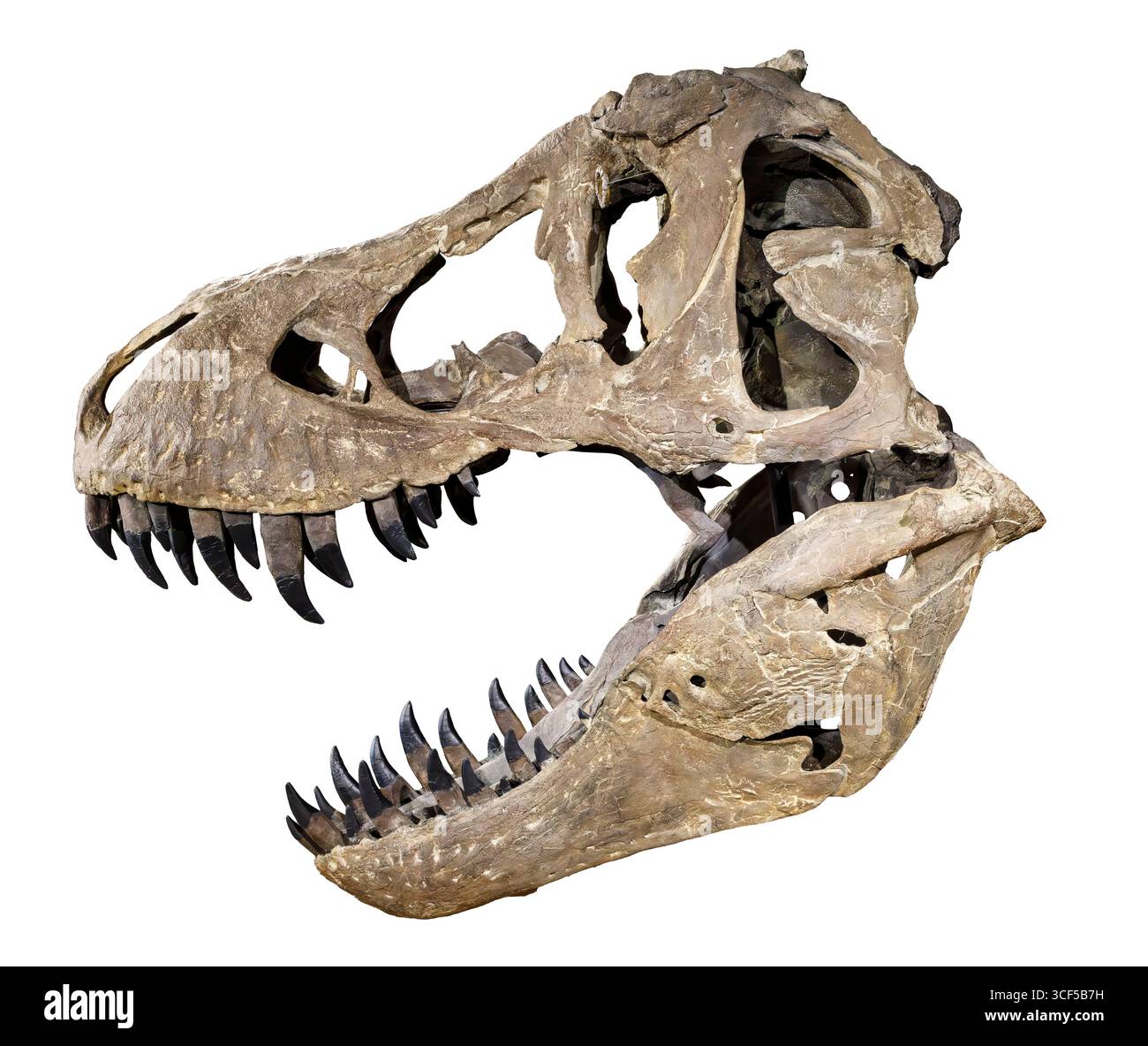
Recent biomechanical modeling has highlighted the incredible structural integrity of the Tyrannosaurid skull. The skull was not a solid block of bone but a complex, lightweight architecture of fused bones and air-filled cavities (sinuses) that allowed it to absorb the massive stresses generated during a bite. This evolutionary masterpiece allowed the T-Rex to exert a bite force estimated to be in the range of 35,000 to 57,000 Newtons, capable of shattering the bones of its prey.
This specialization required a massive investment in cranial musculature. The attachment points for the jaw muscles—the temporal fenestrae—were enormous, necessitating a wider, more robust skull. This increased mass at the front of the animal fundamentally altered its center of gravity and its overall metabolic requirements.
The Evolutionary Trade-Off: Energy and Equilibrium
In evolutionary biology, no trait is “free.” Every specialized adaptation carries a cost in terms of metabolic energy and structural stability. The “Evolutionary Trade-Off” hypothesis posits that as the T-Rex’s head and neck musculature became increasingly massive to support its crushing bite, the animal had to optimize its body plan elsewhere to maintain balance and efficiency.
The reduction of the forelimbs can be viewed through two primary lenses: metabolic economy and biomechanical equilibrium.
1. Metabolic Economy: Maintaining large, muscular limbs requires a significant amount of caloric intake. For a multi-ton predator, every pound of muscle must be fueled. As the evolutionary pressure intensified to favor a more powerful, specialized head and neck, the biological “budget” was redirected. The energy previously used to grow and maintain large arms was more effectively spent on the massive muscles required for the jaw and the heavy-duty skeletal structure of the skull.
2. Biomechanical Equilibrium: A massive head creates a significant lever arm that pulls the animal’s center of mass forward. To remain a stable, efficient bipedal walker, the T-Rex had to balance this weight. While the heavy, muscular tail acted as the primary counterbalance, the reduction of the forelimbs further optimized the animal’s center of gravity, allowing for more efficient movement during pursuit and combat.
Essentially, the T-Rex became a highly specialized “head-first” predator. The arms, which might have been used for grasping or manipulation in more primitive theropod ancestors, became redundant once the skull evolved into a tool capable of both capturing and processing prey with overwhelming force.
From Grasping to Crushing: A Functional Shift
The transition from the relatively large arms seen in earlier theropods to the miniature limbs of the T-Rex marks a fundamental shift in predatory strategy. In many earlier dinosaur species, the forelimbs played a critical role in prey restraint. However, the T-Rex’s specialized dentition—thick, serrated, “lethal bananas” rather than thin blades—meant that the animal did not need to hold its prey in place for long. The sheer force of the initial strike and the subsequent crushing bite were sufficient.
This functional shift meant that the selective pressure to maintain large, functional arms was relaxed. In evolutionary terms, once a trait is no longer essential for survival or reproduction, it often undergoes reduction through a process known as vestigialization, or it is actively selected against to save energy.
It is also worth noting that “small” does not mean “weak.” While tiny compared to the rest of the body, the T-Rex’s arms were still remarkably robust for their size, possessing strong muscle attachments that suggest they may have still played a minor role in stabilizing prey or assisting in certain movements during close-quarters combat.
Key Takeaways: The Science of T-Rex Evolution
- Cranial Specialization: The T-Rex evolved an incredibly strong skull to facilitate a “puncture-pull” feeding style, requiring massive jaw muscles.
- Energy Redirection: Metabolic energy was shifted away from limb development and toward the high-cost requirements of skull and neck musculature.
- Center of Gravity: The reduction of forelimb mass helped balance the increased weight of the massive head and neck, optimizing bipedal movement.
- Functional Redundancy: As the skull became the primary tool for both prey capture and processing, the evolutionary necessity for large, grasping arms diminished.
- Evolutionary Trade-off: The T-Rex represents a peak of predatory specialization where certain anatomical features were sacrificed to maximize the efficiency of others.
The Future of Paleontological Research
While the link between skull strength and limb reduction provides a compelling explanation, the study of theropod biomechanics is far from complete. Researchers are currently utilizing advanced 3D computational modeling and finite element analysis (FEA) to simulate the stresses on dinosaur skeletons with unprecedented precision. These digital simulations allow scientists to test how different body configurations would have handled the rigors of hunting and feeding.

Next steps in this research field involve more detailed studies of the soft tissue—the muscles and ligaments—that once surrounded these bones. Understanding the exact distribution of mass in the neck and jaw will provide even more clarity on how the T-Rex maintained its balance and how its entire body plan was a finely tuned machine of evolution.
As more fossilized remains are discovered and analyzed with new technology, our picture of the Tyrannosaurus rex continues to evolve from a simple monster into one of the most complex and specialized biological entities to ever walk the Earth.
What do you think about this evolutionary trade-off? Does it change how you view the T-Rex? Share your thoughts in the comments below and share this article with your fellow science enthusiasts!
Related reading