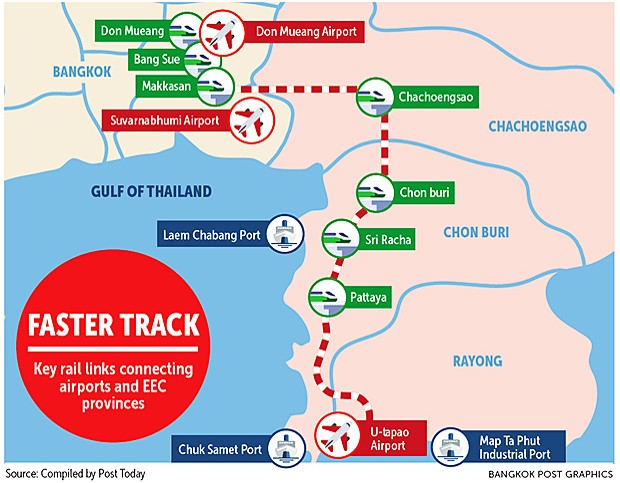
Thailand’s ambitious infrastructure goal to connect three major aviation hubs via a high-speed rail network faces continued uncertainty, as long-standing disputes over risk-sharing and financing show few signs of resolution. The 224.5-billion-baht project, designed to link Don Mueang, Suvarnabhumi, and U-Tapao airports, remains a central pillar of the Eastern Economic Corridor (EEC) strategy, yet it continues to navigate a complex landscape of contractual and logistical challenges more than eight years after its initial approval in March 2018 under the administration of then-Prime Minister Gen Prayut Chan-o-cha, according to official reports from the Bangkok Post.
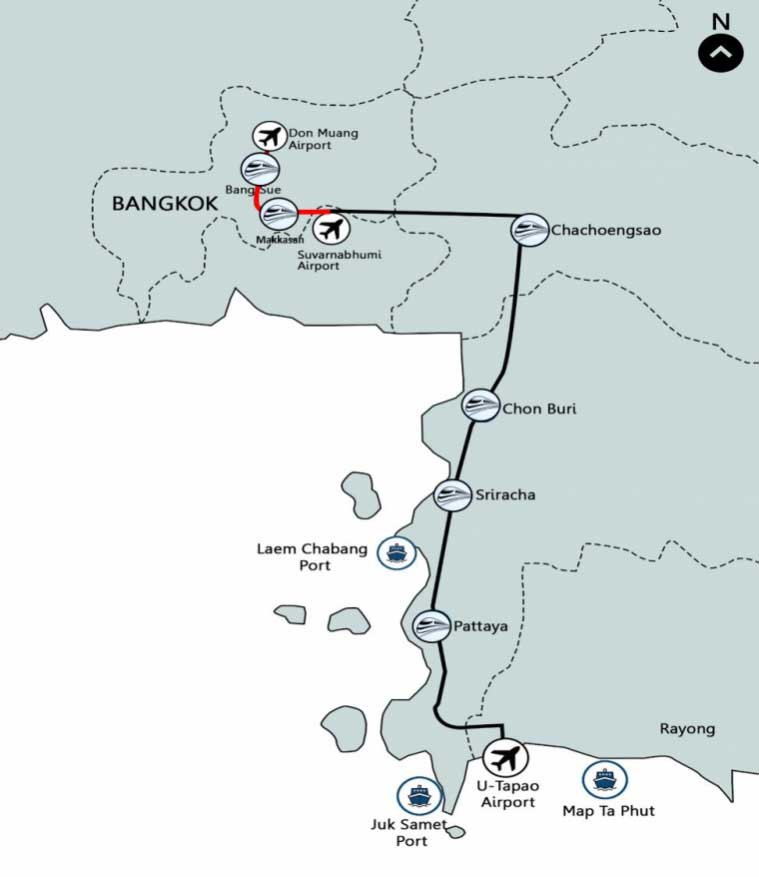
The project, which spans 220 kilometres across five provinces—Bangkok, Samut Prakan, Chachoengsao, Chon Buri, and Rayong—is intended to serve as the transport backbone for the industrial and tourism-heavy eastern region. Despite its strategic importance, the venture has been marked by years of delays involving multiple government administrations. The primary friction point currently involves the private concessionaire, Asia Era One, and the state, represented by the State Railway of Thailand (SRT), as they struggle to reconcile differing perspectives on financial risk and contract terms.
A Complex Public-Private Partnership
The railway is structured as a public-private partnership (PPP) and is intended to integrate the existing Airport Rail Link with newly constructed high-speed infrastructure. Asia Era One, a consortium led by the CP Group, secured the concession in 2019. The consortium’s ownership structure reflects a significant international and domestic investment mix, including Charoen Pokphand Holding (87.15%), Bangkok Expressway and Metro Plc (5.14%), China Railway Construction Corporation (5.14%), and Italian-Thai Development (2.57%), as detailed in current project summaries.
While the Office of the Attorney General (OAG) has provided clearance for a draft contract amendment, the path forward remains obstructed. Disagreements persist regarding the allocation of financial exposure and the viability of the project under current economic conditions. Financing has emerged as a particularly difficult hurdle, with the concessionaire reportedly facing challenges in securing necessary loans as project costs have fluctuated over the years.
Strategic Importance to the Eastern Economic Corridor
The project’s scope extends beyond simple passenger rail transport; it is envisioned as a critical support system for the expansion of U-Tapao Airport and the development of the Eastern Aviation City. By improving connectivity between industrial estates and major international gateways, the government aims to bolster Thailand’s competitive position in regional logistics and tourism.
However, the transition from planning to execution has been hampered by a combination of land acquisition issues, financing disputes, and the evolving requirements of the contractual framework. Observers note that the project has transitioned through seven different governments since its inception, each bringing shifting priorities and administrative hurdles that have contributed to the current impasse.
Looking Ahead: The Path to Resolution
As of June 2026, the project remains at a decisive, yet stalled, stage. The core challenge for stakeholders is to finalize a risk-sharing agreement that satisfies the state’s need to protect public financial exposure while providing the private consortium with the stability required to secure the necessary capital for construction and long-term operation.
There is no public timeline for the resolution of these ongoing contractual disputes. Stakeholders are expected to continue negotiations to bridge the gap between the state’s requirements and the commercial realities faced by the private concessionaire. Interested parties and investors are advised to monitor official updates from the State Railway of Thailand and the Eastern Economic Corridor Office for information regarding future contract revisions or ministerial decisions.
As this story develops, further details regarding the status of the concessions and potential legislative adjustments will be crucial for understanding the feasibility of this massive transport undertaking. We invite our readers to share their perspectives on the role of public-private partnerships in national infrastructure development in the comments section below.
Keep reading