
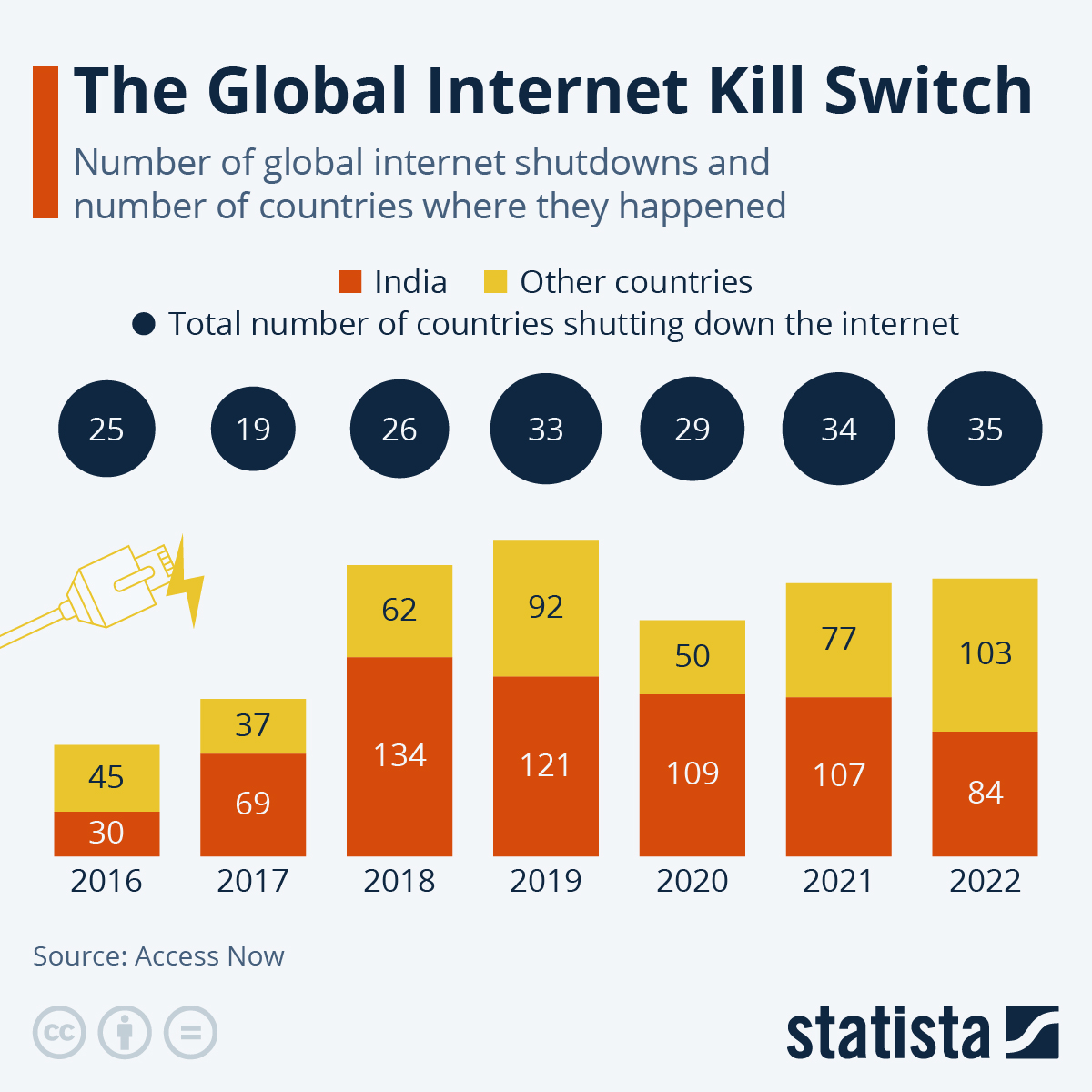
In recent years, governments around the world have increasingly turned to internet shutdowns as a tool to manage political unrest, control information flow, and suppress dissent. Once considered an extreme measure reserved for emergencies, network disruptions have become a routine tactic in dozens of countries, affecting millions of people’s access to news, function, education, and essential services. This shift reflects a broader trend where digital connectivity is treated not as a right, but as a privilege that can be granted or withdrawn at the discretion of state authorities.
The normalization of shutdowns marks a significant departure from the early optimism surrounding the internet’s potential to empower citizens and foster democratic participation. During the 2011 Arab uprisings, social media platforms enabled protesters in Tunisia, Egypt, and beyond to organize and share their stories globally. In response, governments began developing more sophisticated systems of control, moving from ad-hoc blackouts to legally sanctioned powers to suspend telecommunications services. Today, what began as an improvised tactic has evolved into a durable infrastructure of control, embedded in national laws and executed with growing precision.
Verified data from Access Now’s #KeepItOn campaign shows that in 2024 alone, authorities imposed 304 internet shutdowns across 54 countries—the highest number ever recorded in a single year. This surpassed the previous high set in 2023 and continued a troubling upward trend into 2025, when shutdowns broke the annual record once again. These disruptions are not evenly distributed; certain regions and contexts see disproportionate impact, particularly during periods of heightened political sensitivity such as elections, protests, or armed conflict.
The Legal Framework Behind Shutdowns
What was once an exceptional measure has, in many countries, been formalized through legislation. In India, the 2017 Temporary Suspension of Telecom Services Rules—issued under the Telegraph Act—provided the first clear legal pathway for cutting connectivity at the request of authorized officers. This framework was later strengthened by the Telecommunications Act of 2023, which expanded the government’s authority to suspend services in the interest of public safety, sovereignty, or during emergencies. According to the Software Freedom Law Centre’s Shutdown Tracker, India has instigated more than 900 shutdowns since tracking began, with 447 occurring in Jammu and Kashmir alone.
Similarly, in Kazakhstan, a series of laws and decrees have expanded the state’s power to disrupt communications. The 2012 law on national security allowed shutdowns during anti-terrorist operations and to contain riots. Subsequent amendments in 2014 and 2016 broadened the range of officials who could order disruptions without judicial oversight, and a 2018 government decree authorized shutdowns during declared “social emergencies.” These legal changes reflect a pattern seen elsewhere: where explicit authorization is absent, broadly worded provisions on national security or public order are routinely invoked to justify network cuts.
In Ethiopia, the state-dominated telecommunications sector enabled a near-total internet blackout in the Tigray region that lasted more than two years during the conflict from 2020 to 2022. Access Now and human rights groups documented how this prolonged disruption hampered humanitarian efforts, obscured reports of atrocities, and severed civilians from family and information. The shutdown was not merely a side effect of war but a deliberate component of information control, demonstrating how infrastructure ownership can be leveraged to enforce isolation.
Elections as a Trigger for Disruption
Elections have emerged as one of the most common catalysts for internet shutdowns. In 2024, as more than half the world’s population prepared to vote, authorities in at least 24 countries with prior histories of shutdowns implemented disruptions during voting periods. These actions raised serious concerns about the integrity of democratic processes, as citizens were cut off from news, fact-checking, voter education materials, and the ability to report irregularities or violence in real time.
Some countries went beyond full blackouts to target specific platforms. In Mauritius, the government ordered a temporary suspension of social media services ahead of elections, a move later reversed after public backlash and legal challenge. The Comoros imposed its first-ever nationwide internet shutdown during its 2024 electoral period, marking a significant escalation in the country’s approach to managing political dissent. These cases illustrate how shutdowns are increasingly used not just to react to unrest, but to preempt it—cutting off communication channels before protests or criticism can gain traction.
Human Impact and Civil Society Resistance
The consequences of shutdowns extend far beyond inconvenience. When networks go down, people lose access to online banking, telemedicine, remote work, and educational resources. Tiny businesses unable to process digital payments suffer immediate revenue losses. Journalists and human rights defenders are hindered in their ability to document abuses or share evidence with international bodies. In Gaza, where repeated bombardments have damaged an estimated 75% of telecommunications infrastructure, residents have relied on grassroots efforts to distribute eSIMs and maintain limited connectivity amid near-constant blackouts.
Civil society organizations have responded with innovation and advocacy. Access Now’s #KeepItOn campaign, launched in 2016, now unites over 345 groups worldwide, including the Electronic Frontier Foundation (EFF), in monitoring shutdowns, documenting their impact, and pushing for accountability. The campaign provides practical guidance on circumvention tools, supports local responders, and engages with international institutions such as the United Nations, which passed a landmark resolution in 2016 condemning internet shutdowns as a violation of human rights.
Technological workarounds have emerged, though they reach with limitations. Satellite internet services like Starlink have been deployed in Ukraine and Iran to bypass ground-based restrictions, but experts warn these systems are not immune to state interference, including signal jamming or licensing pressures. In Gaza, where traditional infrastructure is severely degraded, eSIM distribution campaigns have helped some residents access international networks through Egyptian or Israeli providers, though access remains uneven and precarious.
Why This Matters Now
The rise of network shutdowns reflects a deeper struggle over who controls the digital public square. As more aspects of life—commerce, governance, social interaction—move online, the ability to cut connectivity becomes a powerful lever of authority. Yet this power is often exercised without transparency, oversight, or recourse for those affected. The lack of consistent international standards means that similar actions may be condemned in one context and ignored in another, depending on geopolitical alliances.
Understanding this trend is essential not only for technologists and policymakers but for anyone concerned about the future of free expression, democratic participation, and economic opportunity in a connected world. As shutdowns grow more frequent and legally entrenched, the demand for verifiable data, cross-border advocacy, and technical resilience becomes increasingly urgent.
The next major opportunity for review comes at the United Nations Human Rights Council’s upcoming session in June 2025, where member states are expected to discuss updates on digital rights and the implementation of past resolutions on internet freedom. Advocacy groups plan to submit updated shutdown data and case studies from 2024–2025 to inform ongoing debates.
For readers seeking to stay informed or take action, Access Now’s Shutdown Tracker offers real-time updates and downloadable reports, while the #KeepItOn coalition provides toolkits for journalists, activists, and technologists working to document and resist network disruptions. Staying informed, sharing verified information, and supporting groups on the front lines remain some of the most effective ways to push back against the normalization of digital blackouts.